
How does the installation process of a straight stairlift differ from that of a curved stairlift, and what considerations should be made for a smooth installation?
A straight stairlift usually fits to a standard, linear rail and can be installed quickly once the staircase and access points have been checked, while a curved stairlift requires a bespoke rail measured and manufactured to follow each bend, landing or intermediate floor. For a smooth installation, ensure the survey covers staircase dimensions, power supply, access and parking, and discuss seating, controls, obstruction clearance and any household safety requirements in advance.
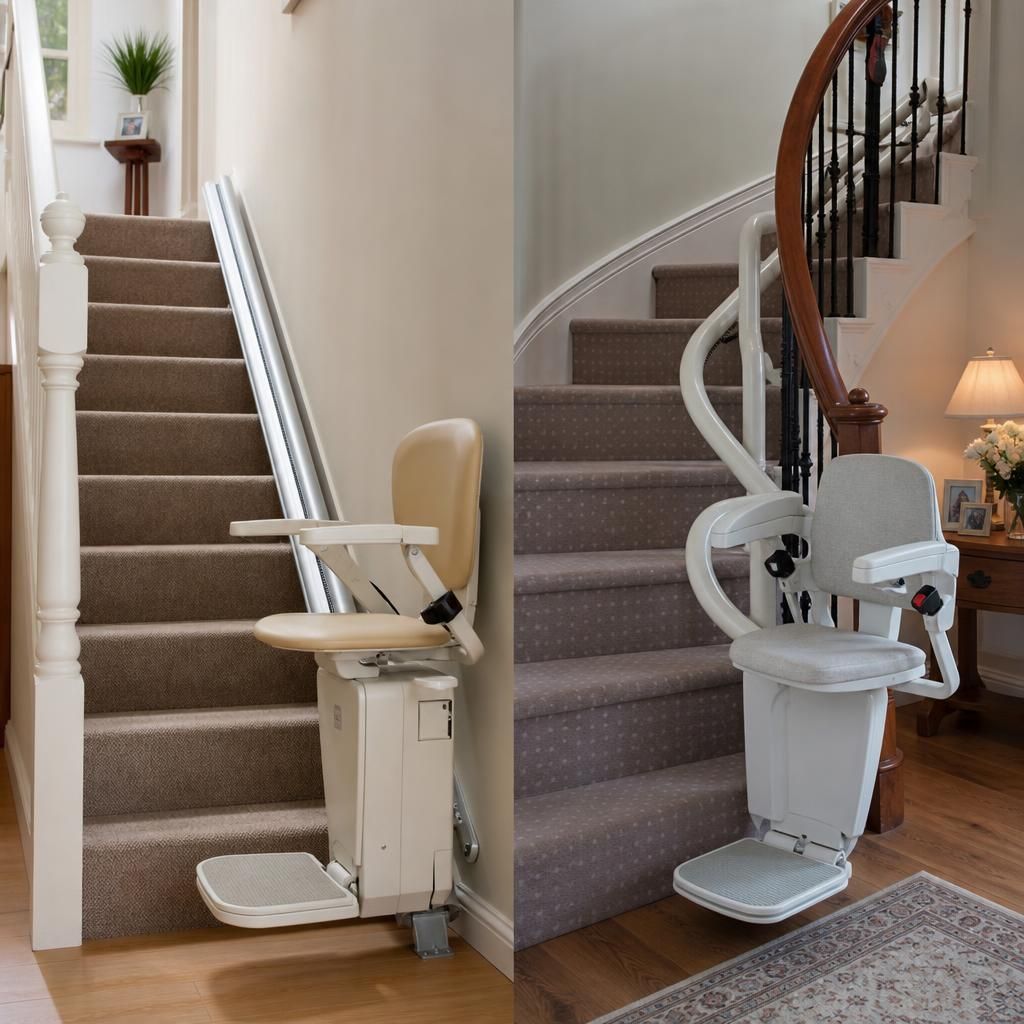
A straight stairlift is normally installed onto a standard rail that follows one uninterrupted flight, whereas a curved stairlift needs a bespoke rail designed to follow bends, landings, changes in direction or intermediate floors. This means a straight installation is usually simpler and quicker once the staircase has been surveyed, while a curved installation involves more detailed measuring, rail manufacture and planning before fitting.
How a straight stairlift is installed
During the initial assessment, the installer checks that the staircase is sufficiently wide, that the steps and fixing points are suitable, and that the proposed seat position will leave safe clearance for other users. The survey also identifies where the stairlift can be parked at the top or bottom and confirms the most practical position for charging.
A straight stairlift is fitted to the stairs rather than fixed directly to the wall in most installations. The rail is secured to the treads or suitable structural points, and the stairlift carriage and seat are then mounted onto it. The installer connects the charging equipment, sets the controls and checks the operation of the safety features. If the staircase matches a standard straight configuration, much of the equipment can be prepared in advance, reducing the work required in the home.
Installation generally causes limited disruption, but the staircase must remain clear while the rail is positioned and secured. The installer should also check access to the property, the location of electrical sockets and whether doors, radiators, handrails or furniture could obstruct the stairlift or its user.
How a curved stairlift is installed
A curved stairlift requires a more detailed survey because the rail must be shaped specifically for the staircase. The installer records the dimensions and angles of each section, the position of landings and any changes in floor level, and the available clearance around corners. The design may also need to account for narrow landings, doorways, architraves, radiators and areas where other people need to pass.
The measurements are used to produce a bespoke rail. Unlike a standard straight rail, this normally means that the curved equipment must be manufactured before the installation can take place. The final design should show where the stairlift will start and finish, how it will negotiate each bend and where it will park safely when not in use. Depending on the staircase, the rail may extend across a landing or serve more than one flight.
On installation day, the rail sections are assembled and fixed in their planned positions before the stairlift carriage and seat are fitted. The installer tests the movement through every curve, checks that the seat rotates or swivels correctly where applicable, and confirms that the stairlift stops safely at the intended points. A curved installation may require more on-site adjustment than a straight one because the rail must align accurately with the staircase and surrounding features.
Key considerations for either type of installation
- Arrange a thorough home survey. Do not rely only on photographs or general staircase measurements. The survey should consider the full route, the user’s mobility, transfer position, preferred controls, parking locations and the needs of other people using the stairs.
- Check the staircase and fixing points. The installer must identify suitable structural positions for securing the rail and note any unusual construction, loose treads, changes in floor level or obstructions. These details can affect the rail design and the installation method.
- Plan the power supply. The stairlift needs a suitable charging point, usually at one of its parking positions. The installer should confirm whether an existing socket is appropriate or whether electrical work is needed. Never use an unsuitable extension arrangement without professional advice.
- Consider clearance. Check the space available for the rider’s knees, feet, arms and clothing, as well as clearance for people walking past. The folded seat, footrest and armrests should not create an avoidable obstruction at doorways or landings.
- Choose the right seat and controls. Seat height, swivel action, armrest position, footrest design and control placement can affect safe transfers and comfort. If more than one person may use the stairlift, discuss whether remote controls or other adjustments are appropriate.
- Allow for access and parking. The stairlift should park where it does not block a doorway, corridor or landing. On a curved staircase, the most suitable parking position may require the rail to extend beyond the main flight.
- Prepare the property. Remove ornaments, furniture and loose items near the staircase before the installer arrives. Ensure there is clear access from the entrance to the stairs and advise the installation team about pets, alarm systems or other practical issues.
- Discuss building or electrical requirements. Most domestic installations are straightforward, but unusual structures, shared areas or required alterations should be identified during the survey. Any work outside the stairlift installation should be agreed in advance.
Checks carried out after fitting
After the stairlift has been installed, it should be run repeatedly along its complete route. The installer should check the start and stop positions, charging, obstruction sensors, seat belt, swivel or folding mechanisms, controls and emergency functions. The rail, seat and footrest should be secure, and the stairlift should travel smoothly without contacting walls, doors, furniture or the staircase.
You should receive an explanation of how to use the stairlift, including how to fasten the seat belt, operate the controls, use the swivel seat if fitted, call the stairlift with a remote control and respond if it stops. Make sure you know where the charger and isolation controls are located and what to do if the stairlift displays a fault. Keep the operating instructions available and ask questions before the installer leaves.
Making the process as smooth as possible
For a straight stairlift, the main priorities are confirming that the standard rail suits the staircase, arranging a clear installation route and resolving power or clearance issues early. For a curved stairlift, accurate surveying and agreeing the rail design are particularly important because changes identified after manufacture may affect the fitting programme.
Tell the surveyor about any planned changes to the home, such as replacing flooring, moving a radiator or altering a doorway. Also explain any difficulty the user has with standing, turning, bending or transferring, as these factors can influence the seat, controls and parking arrangement. With the staircase, access and user requirements assessed in advance, both types of installation can be completed safely and the finished stairlift can be set up for reliable everyday use.
The main difference between straight and curved stairlift installation is the rail: a straight stairlift uses a standard rail for one uninterrupted flight, while a curved stairlift needs a bespoke rail measured and manufactured to follow bends, landings and changes in direction.
This makes the home survey especially important. The installer should assess staircase width, fixing points, doorways, handrails, radiators, parking positions and the space needed for safe transfers. For a curved model, they will also check clearance around each corner and confirm where the rail will start, finish and park. Removing nearby furniture and ornaments, keeping the access route clear and discussing electrical requirements before installation can help prevent avoidable delays.
Arrange Your Stairlift Installation Survey
Arrange your stairlift installation survey with Independent Stairlifts to confirm the right rail, parking position, access and power requirements for your staircase. Our assessment helps identify any practical considerations before fitting begins.