
How do straight stairlifts address safety concerns?
Straight stairlifts improve safety by providing a stable, powered seat that carries the user between floors, reducing the need to climb stairs and helping prevent slips, trips and falls. Safety features such as a seat belt, swivel seat, obstruction sensors, controlled speed and automatic braking support secure use when the stairlift is correctly assessed, installed and operated.
Straight stairlifts address safety concerns by carrying the user between floors in a controlled, seated position, reducing the need to climb the stairs and helping lower the risk of slips, trips and falls. A correctly assessed and installed stairlift combines a stable seat and rail with safety controls such as a seat belt, swivel seat, obstruction sensors, controlled movement and automatic braking.
They reduce exposure to the main risks of using stairs. Climbing can become hazardous when balance, strength, vision or confidence is affected. A stairlift provides a consistent route between floors without requiring the user to place weight on every step or manage the stairs while carrying items. It can be particularly useful where fatigue, joint pain or a medical condition makes stair use less predictable.
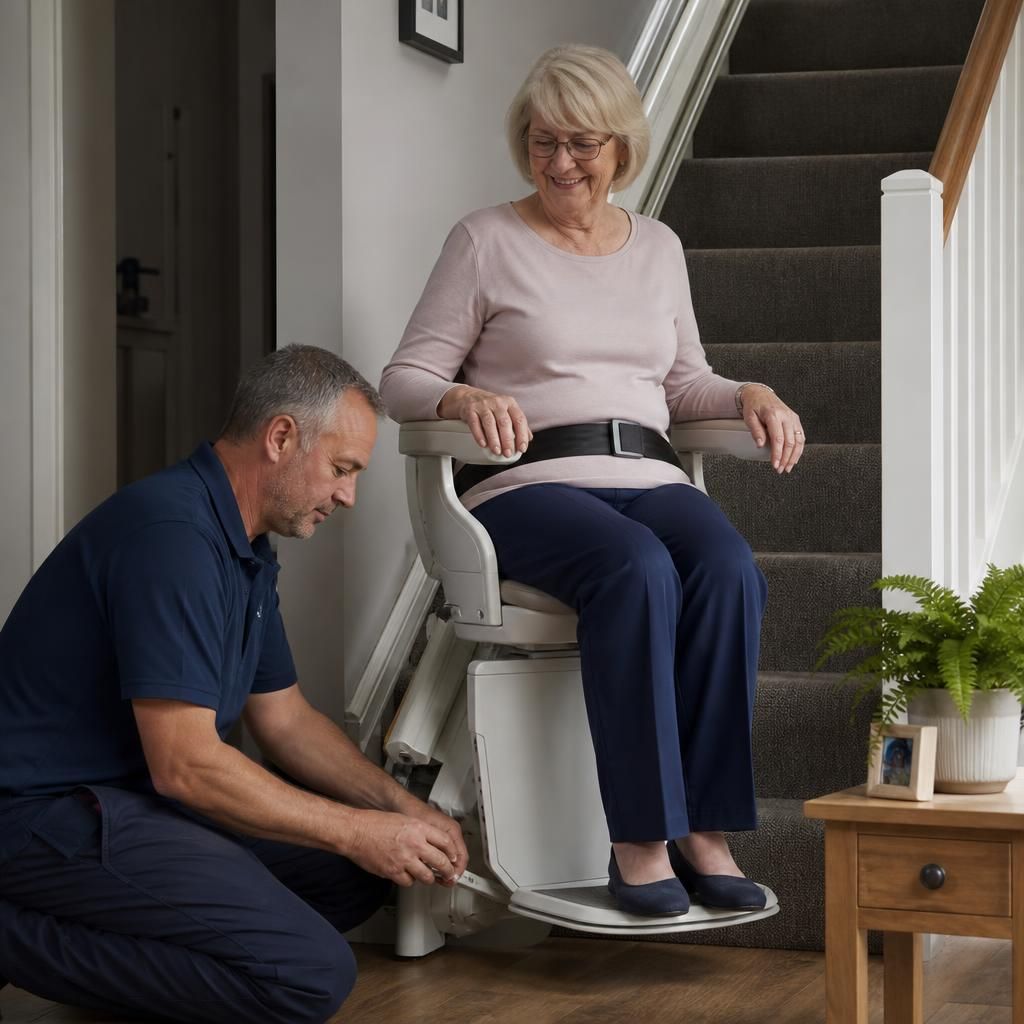
The seat and restraint help maintain a secure position. A properly adjusted seat supports the user while travelling, while the armrests provide additional stability when sitting down and standing up. The seat belt should be fastened before every journey and kept correctly adjusted. A swivel seat can turn towards the landing when the lift reaches the top, allowing the user to get off facing away from the stairs rather than twisting on the steps. The swivel should be operated only when the stairlift has stopped at the landing.
Obstruction sensors help prevent contact with objects. Sensors are commonly fitted around the footrest and other vulnerable areas. If the stairlift detects an object on the rail or stairs, it should stop or prevent movement, depending on the design. These sensors are an additional safeguard, not a replacement for keeping the staircase clear. Toys, footwear, pet items, loose mats and other objects should be removed before use.
Controlled speed and braking support predictable travel. The stairlift is designed to move at a steady speed rather than requiring the user to manage their own pace. Its braking system should bring the lift to a controlled stop when the control is released or a safety system is activated. Users should keep their hands, feet and clothing within the seat area while travelling and should not attempt to lean out or reach for objects on the stairs.
Controls are intended to be simple and accessible. A directional control on the armrest allows the user to start, stop and guide the journey. Many models also have remote controls, allowing the stairlift to be called to the required floor. A key switch or similar control can prevent unauthorised use. Controls should be positioned and set up so that the user can operate them without stretching or losing balance.
Safety begins with the assessment and installation. Before installation, the staircase, landings, access points and surrounding space should be checked. The installer needs to consider the user’s height, weight, posture, leg movement, transfer ability and likely future needs, as well as the position of doors, radiators and other fixtures. The rail must be securely fixed to the stairs or suitable supporting structure, and the lift must leave enough room for safe boarding and exit. A straight staircase does not automatically mean that every model or layout will be suitable.
An assessment should also consider people who share the staircase. The rail and parked stairlift should leave a practical walking route where possible, although the remaining space depends on the staircase width and design. Other household members should be shown how to pass safely and how to avoid using the stairlift as a handrail. If the staircase is narrow or has unusual landings, a different seat, folding component or parking position may be appropriate.
Battery operation helps maintain controlled use during a power cut. Most modern stairlifts charge while parked at designated charging points and use batteries to complete journeys when the mains supply is interrupted. The exact reserve and charging behaviour depend on the model and condition of the batteries. The stairlift should normally be left at its charging point when not in use, rather than routinely parked elsewhere.
Good housekeeping is an important part of safe operation. Keep the rail, steps and landings free from obstructions; do not place liquids or cleaning products on the lift; and avoid loose clothing or bags that could catch on the armrests, footrest or rail. The user should sit fully back in the seat, place their feet securely on the footrest, fasten the belt and keep the control pressed only as instructed. Children and pets should be kept clear while the stairlift is moving.
Regular servicing helps preserve the safety systems. Checks should include the seat belt, swivel mechanism, armrests, footrest, sensors, controls, batteries, charging points, rail fixings and braking performance. A change in noise, movement, stopping behaviour, battery performance or sensor response should be treated as a reason to stop using the lift and arrange professional advice. Do not bypass a sensor, continue using a lift that stops unexpectedly or attempt electrical or mechanical repairs yourself.
Users should be shown how to respond if the stairlift stops. The usual approach is to remain seated, keep the belt fastened, use the controls as instructed and contact the designated support service. Do not try to climb off between floors or move the stairlift manually unless specifically instructed by a qualified professional. The installation and user instructions should be kept accessible, and household members or carers should know how to provide assistance.
A stairlift is a mobility aid, not a complete emergency-evacuation solution. In a fire or another emergency, follow the household’s emergency arrangements and any advice from the relevant professionals. Never block the staircase with the lift, furniture or stored items, and ensure that any alternative exit remains usable.
For the safest result, the stairlift should be matched to the user and the staircase rather than selected on appearance or price alone. An in-person assessment can identify transfer risks, landing clearance, charging requirements and features that may become important if mobility changes. When correctly specified, installed, maintained and used, a straight stairlift can provide a safer and more consistent way to move around a multi-level home.
Professional assessment and correct installation are central to stairlift safety. The lift must suit the user’s posture, weight, transfer ability and movement, as well as the staircase, landings and surrounding fixtures. The installer should check that the rail is securely fixed, the seat is positioned correctly and there is enough space to board and leave the lift safely at both ends.
Safe use also depends on keeping the stairs and rail clear. Remove footwear, mats, toys, pet items and other obstructions before travelling, and keep hands, feet and loose clothing within the seat area. Obstruction sensors provide an additional safeguard, but they do not replace good housekeeping. If the stairlift stops unexpectedly, makes an unusual noise or shows a change in movement, remain seated with the belt fastened and contact the designated support service rather than attempting a repair or getting off between floors.
Arrange a Professional Stairlift Safety Assessment
Arrange a professional stairlift safety assessment with Independent Stairlifts to check that the lift, staircase and surrounding space are suitable for safe use. Contact our team for tailored advice on the right solution for your home and mobility needs.