
What specific features should I look for in a stairlift designed for a split-level home?
For a split-level home, look for a stairlift with a bespoke rail that follows turns, landings and changes in stair direction smoothly, while keeping the staircase clear. Useful features include a compact or hinged rail, powered swivel seat, adjustable seat and footrest, obstruction sensors, secure seatbelt, simple controls and reliable charging points positioned for the full route.
The most important feature in a stairlift for a split-level home is a rail designed specifically for the complete staircase layout. It should follow changes in direction, gradients and intermediate landings accurately, while leaving enough usable space for other people to pass where possible. The lift should also include safety and comfort features suited to the user, the available landing space and the way the stairs are used every day.
Look for the following features when discussing your options:
- A bespoke rail system: Split-level staircases can include turns, half-landings, narrow sections and changes in direction. A made-to-measure rail is generally more suitable than a standard straight rail because it can follow the staircase closely and provide a continuous journey where the layout allows. The assessment should establish whether one continuous stairlift is practical or whether separate lifts, a transfer point or another arrangement would be safer.
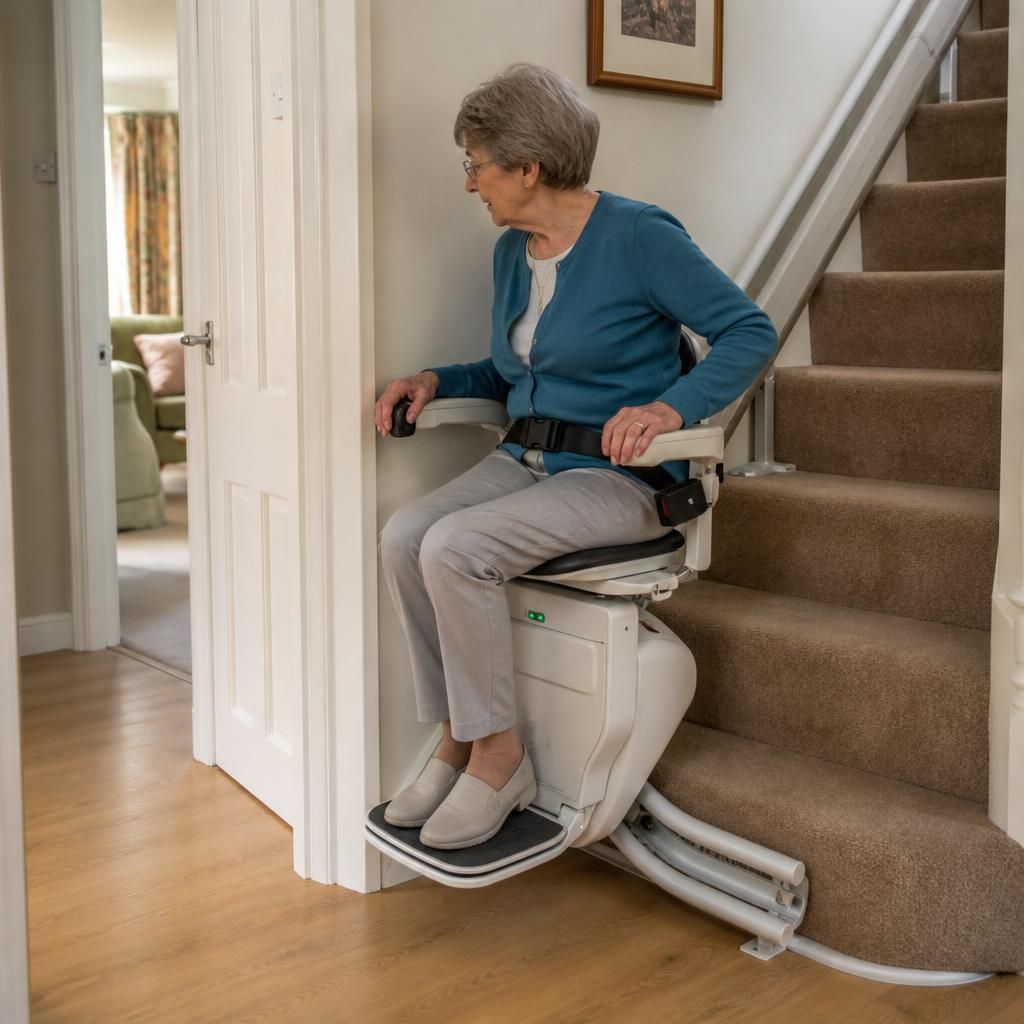
- Compact parking positions: The stairlift should park without unnecessarily blocking a doorway, landing or route through the home. A parking position may be at the top, bottom or another suitable point, depending on how the stairs are arranged. On a tight landing, the folded seat, arms and footrest should be checked carefully to make sure they do not create an obstruction.
- A hinged or retractable rail where appropriate: If the bottom of the rail would interfere with a doorway, hallway or frequently used area, a manual or powered hinge can move the rail out of the way when the lift is parked. This is particularly useful in split-level homes where a staircase may open directly into a busy circulation area. The hinge must be positioned and operated safely, and it is not suitable for every staircase.
- Reliable turning and landing performance: The carriage should travel smoothly around bends and through changes in direction without sudden movement. A proper survey will consider the angle of each turn, the width of the staircase, headroom and the position of the user’s knees and feet. These details are especially important on compact landings or staircases with unusual geometry.
- A powered swivel seat: A seat that turns at the top, and sometimes at the bottom, can help the user get on and off facing the landing rather than the stairs. Powered swivelling is useful where the user has limited balance, strength or movement. The seat should lock securely in the travel position and rotate only when it is safe to do so.
- Adjustable seating and foot support: Seat height, armrest position and footrest design should suit the user’s posture and the staircase. A powered or manually adjustable footrest can make transfers more comfortable, while a folding seat and arms can help keep the stairs clear when the lift is not being used. The footrest should provide stable support throughout the route, including on turns.
- Secure restraint and stable controls: A properly fitted seatbelt or harness, supportive armrests and controls that are easy to operate help the user remain secure. Controls may be placed on an armrest, supplied as a remote control or provided in both forms. The user should be able to start, stop and summon the stairlift without needing to stretch or twist.
- Obstruction detection: Sensors should stop the stairlift if an object, pet or person is detected in its path. This is important on a split-level route because different sections may have different visibility and may be used by several household members. Sensors reduce risk but do not replace clear stairs and safe supervision where needed.
- Safety at changes in direction: The lift should maintain a stable seating position and controlled speed through bends and around landings. Smooth starting and stopping are valuable for users who are unsteady or sensitive to sudden movement. The installer should also explain where the user should keep their hands, feet and any walking aid during travel.
- Accessible charging points: A stairlift normally charges through points along its rail or at designated parking positions. On a long or multi-section route, confirm that the lift can charge reliably wherever it is expected to park. The charging arrangement should not require the user to reach an awkward position, and the installer should explain what happens if the lift is left away from a charging point.
- Battery operation and emergency reliability: Battery-powered operation allows the lift to complete a journey during a temporary mains power failure, subject to the battery’s condition and charge. Ask how the system indicates a low battery, how it can be moved safely if power is unavailable and what support is provided if a fault occurs.
- Suitable weight capacity and dimensions: The chosen model must be appropriate for the user’s weight, body shape and mobility needs, not simply for the staircase. Seat width, armrest spacing, footrest size and the space required to turn onto the landing all need checking. If the user is likely to need assistance, this should be discussed before the rail and seat are specified.
- Controls suited to the user: Controls should be clearly marked, responsive and usable with the user’s available grip and movement. A simple joystick, push-button control or remote may be preferable depending on dexterity and vision. Controls should not be so sensitive that an accidental touch starts the lift, but they must not require excessive force.
- Manual lowering or emergency features: Depending on the model, there may be an emergency stop, manual swivel release, diagnostic display or a way for an authorised person to move the lift in an unusual situation. Ask the installer to demonstrate these features and provide clear instructions rather than relying on the user to work them out later.
- Appropriate seat and rail finishes: Materials should be practical for the home and easy to clean. The rail finish, upholstery and folded components should be considered alongside décor, but appearance should not take priority over safe dimensions, visibility of the controls or ease of use.
The installation itself is part of the feature specification. The survey should assess every flight and landing, door swing, headroom, radiator or furniture position, lighting and the route used by other people in the household. It should also check whether a continuous rail would leave sufficient clearance at each landing and whether the user can transfer safely if the design requires more than one lift.
Ask for the proposed parking locations and turning positions to be shown before installation. It is useful to confirm where the lift will charge, how much stair width remains when it is folded, whether a hinged rail is needed and how the user will enter and leave the seat at each end. These practical checks often matter more than choosing the model with the longest list of optional features.
Finally, make sure the quotation and handover cover servicing, battery replacement, fault reporting and user instruction. A stairlift in a split-level home has more complex travel geometry than a simple straight installation, so regular checks of the rail, carriage, safety sensors, seat mechanism and charging points are important. The best specification is one that combines a precisely fitted rail with controls and safety features the user can operate confidently every day.
A compact parking position is an important feature in a split-level stairlift because the lift may finish beside a doorway, hallway or narrow landing. When folded, the seat, arms and footrest should leave a practical route for other people to use the stairs and surrounding area.
During the survey, check the proposed parking point rather than relying on measurements alone. If the lower rail would obstruct a doorway or busy passage, a hinged rail may allow it to fold away when the stairlift is parked. The installer should also confirm that the user can reach the seat safely, that the lift can charge in its parking position and that the folded components do not create a trip or collision risk.
Arrange Your Bespoke Split-Level Stairlift Assessment
Arrange a bespoke split-level stairlift assessment with Independent Stairlifts to review your staircase, landings, parking positions and the features that will best suit your needs. We can explain the available options and confirm the safest practical installation for your home.