
What maintenance is required for a stair lift with a landing in split-level homes to ensure optimal performance?
A stair lift with a landing in a split-level home needs regular servicing to check its separate rail sections, landing or transfer points, drive system, batteries and safety sensors. Keep the rails and carriage clear and clean, follow the manufacturer’s charging guidance, and arrange professional maintenance if you notice unusual noise, jerky movement, reduced battery life or a fault warning.
A stair lift with a landing in a split-level home requires regular professional servicing of its connected rail sections, landing or transfer points, drive components, batteries and safety systems. The rails and carriage should also be kept clean and free from obstructions, while the lift should be used and charged in accordance with the manufacturer’s instructions. This combination of routine checks and prompt attention to faults helps maintain safe, smooth and reliable operation.
Professional servicing
Arrange servicing at the interval recommended for your particular model and usage. A qualified stairlift engineer will normally inspect the complete route rather than treating each staircase as a separate installation. This is especially important in a split-level home, where the lift may travel through a change of direction, stop at a landing, or use more than one rail section.
- Inspecting rail fixings, joints, bends and end stops for movement, wear or damage.
- Checking the carriage, motor, drive mechanism and any rack or gearing for wear and correct adjustment.
- Testing the lift’s movement between sections and its stopping position at the landing.
- Checking swivel seats, powered hinges, folding rails, transfer points or other features fitted to suit the staircase.
- Testing safety sensors, control switches, armrests, seat belts, brakes and obstruction detection.
- Inspecting charging contacts, batteries, wiring and visible electrical connections.
- Checking that the lift parks and charges correctly at its designated position.
A split-level stair lift can have more points where alignment and positioning matter than a straightforward single-flight model. A service therefore needs to confirm that the carriage moves smoothly across the entire route and that the lift stops in the intended position without leaving an unsafe gap or obstructing a landing.
Checks you can make between services
Before using the lift, keep the rail, steps and landing clear of clothing, toys, bags, furniture and other items. Pay particular attention to areas where the rail changes direction or ends at a landing. Do not place objects beneath a folding rail or close to a powered hinge, as an obstruction can prevent the lift from operating or cause damage.
- Wipe accessible rail and seat surfaces with a soft, dry or slightly damp cloth, following the care instructions supplied with the lift.
- Keep the carriage and charging contacts free from dust and debris.
- Check that the seat locks in its travelling position and that the armrests, footrest and seat belt are secure.
- Make sure the lift is left at its correct charging point when not in use, if required by the model.
- Keep remote controls dry and replace their batteries when they no longer operate reliably.
- Observe whether the lift starts, stops and travels in the usual manner.
Do not apply oil, grease or household cleaning products to the rail, motor or electrical parts unless the manufacturer specifically allows it. Some stair lifts use components that require specialist lubrication or no user-applied lubricant at all. Incorrect products can attract dirt, affect sensors or interfere with the drive system.
Battery care and charging
Rechargeable batteries are essential because they allow the lift to operate during a temporary power interruption. Leaving the lift at its charging point as instructed helps maintain battery condition. Avoid repeatedly switching off the lift’s power supply unless advised to do so, as this can prevent the batteries from charging.
Reduced travel distance, slower operation, repeated low-battery warnings or the lift stopping away from its normal charging position can indicate battery or charging problems. Batteries are consumable components and may eventually need replacement, but an engineer should confirm the cause because a faulty charger, contact or power supply can produce similar symptoms.
Signs that require prompt attention
Stop using the stair lift and contact the servicing team if it makes an unusual grinding, clicking or squealing sound, moves jerkily, fails to stop accurately, loses power, displays a fault warning or repeatedly stops on the landing. Do not attempt to bypass a safety sensor, force the carriage past an obstruction or continue using the lift if the seat, belt, armrest or footrest is loose.
If the lift stops between levels, follow the model’s user instructions and use the emergency procedure provided at installation. Do not try to climb out onto the stairs unless emergency services or a qualified professional directs you to do so. Keep the service contact details and the lift’s model information accessible for anyone who may need to assist.
Maintenance after changes to the home
Tell the stairlift provider before altering flooring, skirting boards, doors, lighting or furniture near the route. Work around a landing can affect clearances, charging positions or the operation of a folding rail. After building work, have the lift checked if its route, fixing points or surrounding access has been disturbed. Never move rail fixings or alter electrical connections yourself.
The exact maintenance requirements depend on the stair lift’s make, age, configuration and level of use. Keep the service record, report small changes rather than waiting for a complete failure, and follow the manufacturer’s instructions alongside any advice given by the installation engineer. Regular servicing cannot prevent every fault, but it is the most reliable way to identify wear early and keep a stair lift with a landing operating safely throughout a split-level home.
Professional servicing should cover the complete stairlift route, including every rail section, bend, joint and landing or transfer point. In a split-level home, an engineer must confirm that the carriage travels smoothly between levels, stops accurately and parks safely without creating an unsafe gap or obstructing the landing.
During a service, the engineer can also inspect the drive system, rail fixings, charging contacts, batteries, seat, belt, footrest and safety sensors. Report unusual noise, jerky movement, inaccurate stopping or repeated faults promptly, rather than waiting for the stairlift to stop working.
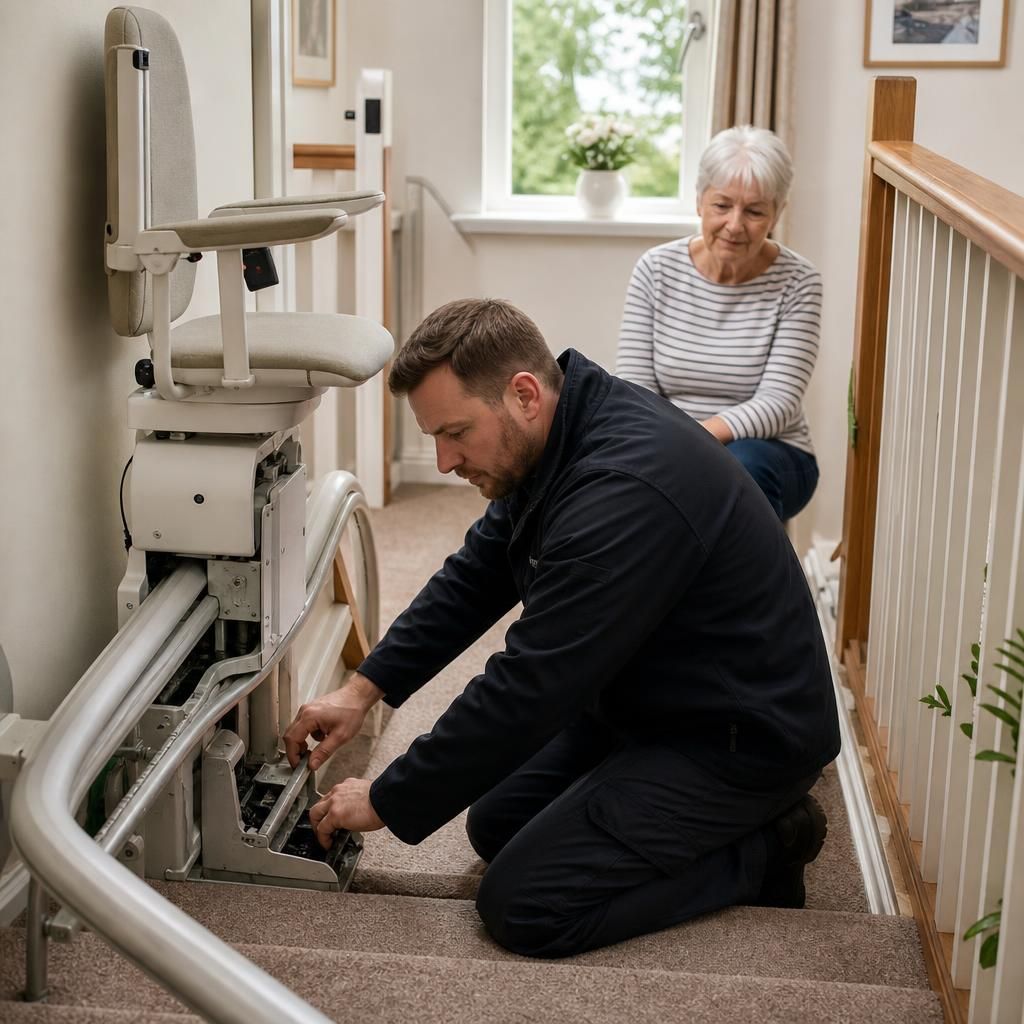
Arrange a stairlift maintenance check
Arrange a professional maintenance check for your stairlift with landing to confirm that the rail sections, landing points, batteries and safety systems are operating correctly.
Contact Independent Stairlifts to book a service or discuss any changes in performance.