
How do stair lifts with landings ensure safety and stability in split-level homes?
Stair lifts with landings provide safe, stable access in split-level homes by guiding the user smoothly between stair sections and landings with a properly fitted track, secure seat, armrests, footrest and safety belt. A professional assessment ensures the lift follows the staircase accurately, stops securely at each landing and includes suitable safety features such as sensors and emergency controls.
Stair lifts with landings ensure safety and stability in split-level homes by providing a controlled route between separate stair sections, with the track designed to follow each flight and transition securely at the landing. A professional assessment determines whether a continuous curved stair lift, a lift with a suitable landing arrangement, or separate lifts is most appropriate. The finished installation should allow the user to travel smoothly, stop safely at the required level and transfer on and off the seat with as little risk as possible.
Split-level staircases can include changes of direction, intermediate landings, short flights and limited standing space. These features make a standard straight stair lift unsuitable in many homes. A bespoke system is measured and manufactured to suit the actual staircase rather than relying on a standard track. This helps the lift maintain a consistent relationship with the steps, walls, handrails and landing areas throughout its journey.
- Accurate track positioning: The rail is fixed securely to the stairs or another suitable structural surface, following the staircase profile and any bends around the landing. Correct positioning helps prevent unwanted movement and leaves appropriate clearance for the user and other people using the stairs.
- Controlled movement around landings: Where the track changes direction or gradient, the lift is programmed to move at a controlled speed. A correctly designed transition avoids an abrupt change in movement and helps keep the chair stable as it approaches, crosses or leaves the landing.
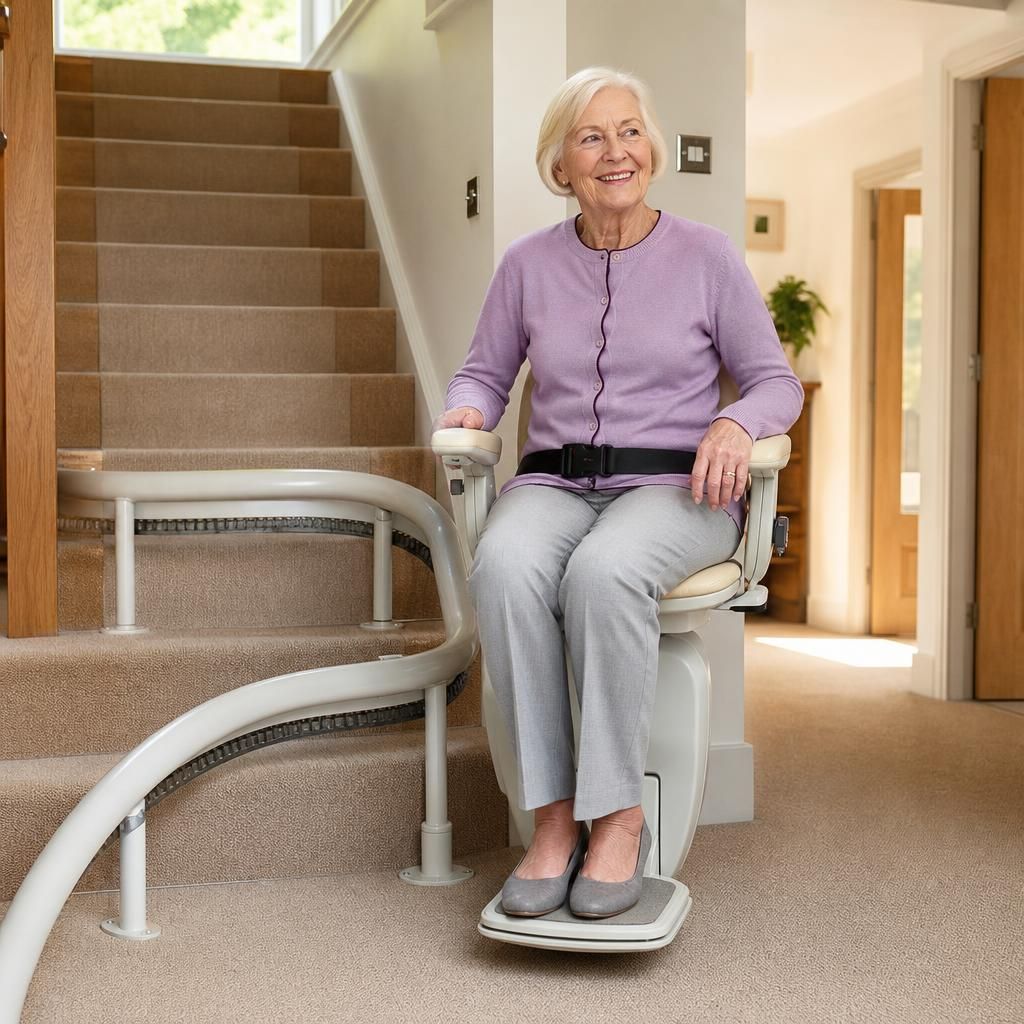
- Secure stopping points: The chair should stop at an appropriate position at the top, bottom and any required landing. This gives the user a stable place to mount or dismount. In some layouts, the seat can swivel towards the landing so that the user does not have to twist towards the stairs while standing up.
- Stable seating: The seat, backrest and armrests support the user during travel. A fitted seat belt or safety restraint helps keep the user correctly positioned, particularly where balance is reduced or the journey includes a change of direction. The restraint should be used as instructed and should not be treated as a substitute for correct seating posture.
- Protected foot and leg position: A footrest supports the feet and helps keep them away from the steps, wall and moving parts. Safety edges or sensors may detect an obstruction around the footrest or other areas of the lift and stop its movement when necessary.
Safety sensors are especially important in a split-level layout because the lift may pass close to walls, skirting boards, doorways or the edge of a landing. If the system detects an obstruction, it should stop or prevent movement until the obstruction has been removed. The exact sensor arrangement varies by model and installation, so the user should be shown what each control and safety feature does during handover.
Controls are normally provided on the armrest and may also be available through remote controls at the relevant floors. These allow the lift to be called to a landing when required, while the controls are designed to require deliberate operation rather than accidental activation. A key switch or similar user control may help prevent unauthorised use. Emergency stop controls and battery backup are also commonly included, allowing the lift to be stopped safely and helping it complete a journey if there is a temporary power failure, subject to the model’s specification.
The landing itself must be assessed as part of the safety design. There needs to be enough room for the user to approach the seat, turn or transfer safely and keep clear of doors and other hazards. A landing may need a different seat option, a powered swivel, a folding rail or another adaptation if space is restricted. The lift should not obstruct an essential doorway, narrow escape route or other access point. Where the available space is limited, the installer can explain the practical compromises and whether an alternative arrangement would provide a safer transfer.
Safety and stability also depend on the condition of the staircase and the quality of the installation. Before fitting, the installer should check the structure, step dimensions, wall positions, electrical supply and any features that could affect the track. The rail must be fixed in accordance with the manufacturer’s requirements, and the completed lift should be tested through its full route, including every landing and stopping position. A demonstration should cover the seat belt, swivel mechanism, controls, obstruction sensors, charging points and what to do if the lift stops unexpectedly.
Users can reduce risk by sitting fully back in the seat, fastening the restraint, keeping hands inside the armrests and keeping feet on the footrest. The lift should be operated only while seated and should not be overloaded with shopping, luggage or other items. The staircase and landing should be kept clear, particularly near the track and the areas used to get on and off. If the chair begins to move unevenly, makes an unusual noise, stops repeatedly or shows a warning, it should be taken out of use and checked rather than repeatedly restarted.
Regular servicing helps preserve reliable operation. Checks may include the track, drive system, batteries, charging points, seat belt, swivel mechanism, safety sensors, fastenings and braking or stopping functions. The recommended service interval depends on the equipment and how it is used. Cleaning the track and keeping the mechanism free from objects is sensible, but repairs, adjustments and replacement of safety components should be carried out by a suitably qualified technician.
No stair lift can remove every risk associated with transferring on a staircase, and the safest arrangement depends on the person’s mobility, the staircase design and the space available at each landing. During an assessment, explain how the user approaches the stairs, where they need to stop and any difficulties with balance, strength, vision or memory. This information helps determine the most suitable seating, controls and landing arrangement, so the completed system provides stable access without creating a new obstruction elsewhere in the home.
Stair lifts with landings ensure safety and stability by using a bespoke track that follows each section of the staircase and provides controlled stopping points at the required levels. This allows the user to travel securely between flights without having to negotiate the stairs on foot.
At the landing, the chair should stop in a position that gives enough room to approach, sit down and stand up safely. A swivel seat may turn the user towards the landing, reducing the need to twist towards the stairs. The installer will also check clearance around doors, walls, handrails and other access routes so the lift does not create a new obstruction.
Safety features such as a fitted restraint, armrests, a supportive footrest, obstruction sensors and emergency controls help maintain stability throughout the journey. The track and stopping points must be measured and installed accurately for the specific staircase, which is why a professional assessment is important in split-level homes.
Arrange a stairlift assessment for your split-level home
Arrange a stairlift assessment for your split-level home so we can review the staircase, landings and transfer areas and identify the safest suitable arrangement.