
Are stair lifts with landing capabilities more expensive to maintain than standard models?
Stair lifts with landing capabilities can cost slightly more to maintain than standard straight models because they may have additional track sections, controls and moving parts. However, routine servicing is generally similar, and the total cost depends more on the lift’s design, age, usage and condition than on the landing feature alone.
Stair lifts with landing capabilities can be slightly more expensive to maintain than a standard straight stairlift, but the difference is not automatic or necessarily substantial. Ongoing costs are influenced more by the lift’s age, design, usage, track layout and condition than by the landing feature alone. A well-installed, regularly serviced lift should remain dependable whether it serves one straight flight or includes additional movement around a landing.
Why maintenance can be more involved
A standard straight stairlift normally has a comparatively simple rail and drive system. A lift designed to reach, stop at or travel around a landing may include additional track sections, bends, charging points, sensors, controls or powered track components. Each extra component provides another part that may need inspection, adjustment or eventual replacement.
This does not mean that every landing-capable model will have higher maintenance costs. Some systems use a continuous bespoke rail with few additional moving parts, while others use powered sections or more complex controls. The specification chosen for the staircase is therefore important when considering long-term upkeep.
What routine servicing involves
A service typically includes checking the rail, carriage, drive mechanism, seat, armrests, footrest, safety sensors, batteries, charging points and controls. On a lift with landing capabilities, the engineer may also check:
- Track joints, bends and any powered or hinged rail sections
- Landing stops, sensors and positioning accuracy
- Additional remote controls or call-and-send controls
- Charging contacts at each designated parking position
- Clearance from doors, walls, furniture and other parts of the landing
These checks help identify wear before it affects operation. Keeping the rail and surrounding area clear is also important, particularly where the lift parks or changes direction near a landing.
Parts most likely to affect future costs
Batteries are normal replacement items on both standard and landing-capable stairlifts. Their service life depends on use, charging conditions and the age of the lift. Warning beeps, reduced travel performance or the lift failing to operate away from its charging point can indicate that the batteries need attention.
Other commonly inspected items include the drive rollers, switches, sensors, remote controls and charging contacts. A landing-capable system may have more of these components, so a repair can occasionally involve more diagnostic work or a greater number of parts. However, this should be assessed on the individual lift rather than assumed from its layout.
How maintenance compares with a standard model
For a straightforward, single-flight stairlift, servicing is usually simpler because there is one main rail and one travel path. A lift serving a split-level layout may require additional checks around the landing and may take longer to diagnose if movement between sections is controlled by powered or interconnected parts.
The difference is generally less significant when the system has been correctly designed for the staircase and installed by an experienced engineer. Poor alignment, unsuitable parking positions, restricted charging access or frequent obstruction can create avoidable wear on any stairlift, regardless of whether it has landing capabilities.
How to keep maintenance costs under control
- Arrange servicing at the interval recommended for the specific model and usage pattern.
- Keep the rail, charging points and landing areas free from dust, objects and obstructions.
- Use the controls as instructed and avoid forcing the seat, footrest or track sections.
- Report unusual noises, hesitation, uneven movement or repeated warning signals promptly.
- Do not attempt to lubricate, adjust or repair the lift yourself unless the manufacturer specifically allows it.
- Keep a note of the model, installation details and previous service work for future engineers.
Prompt attention can prevent a minor adjustment from becoming a larger repair. It also helps maintain safe operation, particularly where the lift must stop accurately at a landing or connect with more than one charging position.
Warranty and servicing arrangements
Before installation, check what is included with the warranty or service agreement. Coverage can differ between the lift, batteries, labour and accidental damage, and some agreements may specify servicing requirements. A warranty does not necessarily cover consumable items or damage caused by misuse, so the terms should be explained clearly.
If a lift is reconditioned, ask about the condition and age of the batteries, carriage, track components and controls, as well as the servicing history. A reconditioned lift can be suitable for some homes, but its likely future maintenance needs depend on the actual equipment and its remaining component life.
What to consider before choosing a landing-capable lift
Request a full assessment of the staircase and a clear explanation of the proposed track design. Ask which parts are additional to a standard installation, which items are expected to require routine replacement and how servicing access will be managed at the landing. It is also sensible to confirm the expected response process if the lift develops a fault.
In summary, a stair lift with landing capabilities may have more components to inspect and can therefore involve higher maintenance costs in some installations. The landing arrangement itself is not a reliable indicator of expense. Correct design, quality installation, appropriate use and planned servicing have a greater effect on reliability and the total cost of ownership.
Stair lifts with landing capabilities are not automatically more expensive to maintain than standard models. Costs depend mainly on the track design and components fitted. A system with powered track sections, extra charging points or additional sensors may require more checks, while a bespoke continuous rail may have fewer moving parts. Regular servicing should cover the rail, drive mechanism, batteries, controls, safety sensors and landing positions so minor wear can be identified before it becomes a larger repair.
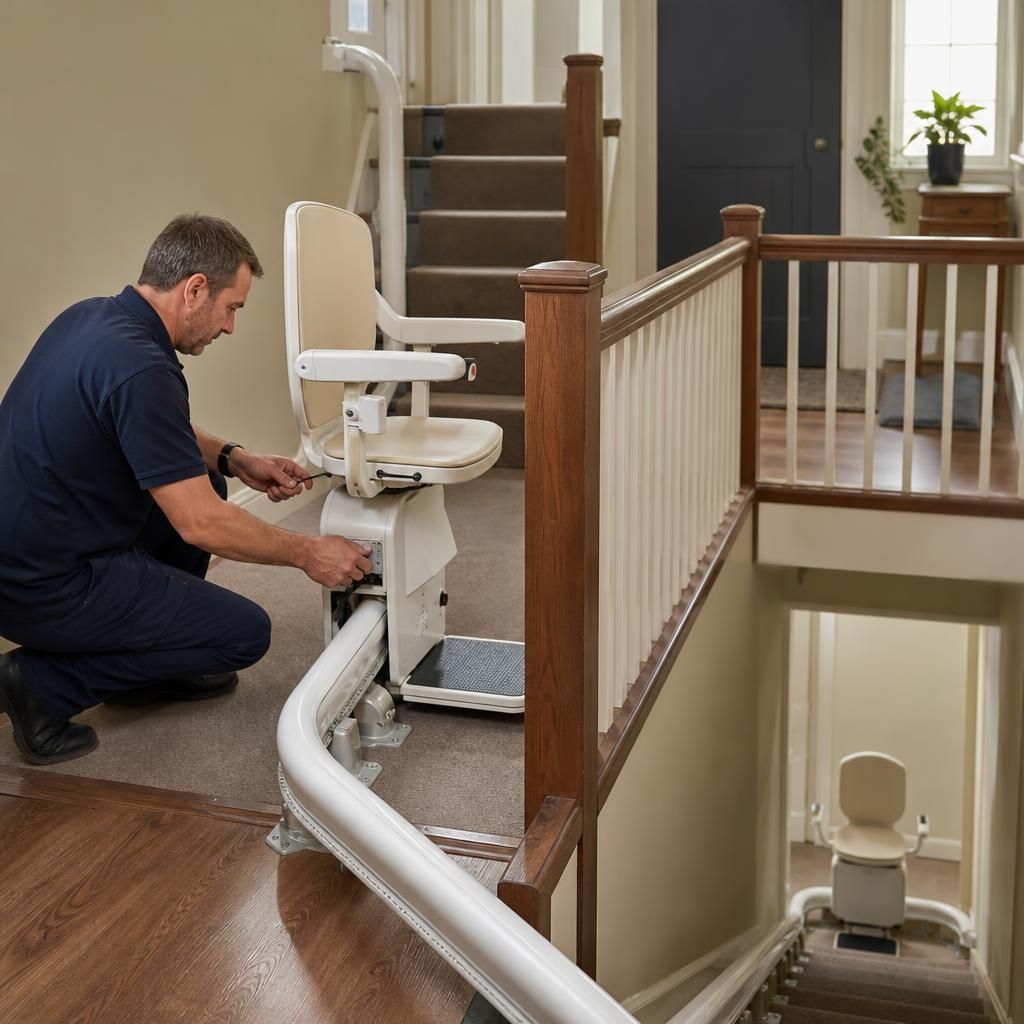
Ask About Your Stair Lift’s Ongoing Maintenance Costs
Contact Independent Stairlifts to discuss your stair lift’s track design, servicing requirements and likely ongoing maintenance costs. We can assess your split-level staircase and explain the most suitable options for reliable, manageable upkeep.