
What options are available if the stair lift breaks down or needs repair?
If your stairlift breaks down, stop using it, check that it is switched on and correctly positioned on the charging points, then contact Independent Stairlifts for advice or a repair visit. Depending on the fault and any cover in place, an engineer can diagnose the problem, carry out the repair and advise whether replacement parts or further servicing are required.
If your split-level stairlift breaks down, stop using it and contact Independent Stairlifts for advice or an engineer’s assessment. The available options normally include safe basic checks, telephone guidance, an on-site repair, replacement of worn or failed components, or—if the lift is beyond economical repair—a suitable replacement.
Make the lift safe first. Do not attempt to force the carriage, bypass a safety switch, remove covers or carry out electrical repairs yourself. If the stairlift has stopped on the stairs, remain seated with the seat belt fastened if it is safe to do so, and use the handset or controls only as advised. Keep other people away from the staircase until the fault has been assessed. If there is an immediate medical or safety emergency, contact the appropriate emergency service.
Before requesting a repair, you can carry out a few simple checks without dismantling the lift:
- Check that the mains power switch is on and that the charger is plugged in.
- Make sure the stairlift is parked correctly on a charging point. A lift that has been left away from its charging position may have insufficient battery power.
- Check that the seat, armrests, swivel mechanism and safety belt are in their normal operating positions.
- Confirm that the key switch, if fitted, is turned on and that the handset has working batteries.
- Look for an obstruction on or beside the rail, particularly around landings, bends and intermediate floors.
- Check whether an error light, warning tone or display message is present, and tell the engineer exactly what you observed.
Do not repeatedly operate the controls if the stairlift still will not move. Repeated attempts can drain the batteries further or make it more difficult to identify the original fault. When you contact us, provide the lift model if known, its location, what happened immediately before the breakdown, whether it stops at a particular point, and any warning messages or unusual sounds.
Telephone troubleshooting may resolve straightforward issues such as a switched-off supply, an incorrectly positioned seat, a handset problem or a lift that has not returned fully to its charging point. Guidance will depend on the symptoms and the particular stairlift. Only follow instructions that can be completed safely and without removing parts or opening electrical compartments.
An engineer’s repair visit is appropriate when the basic checks do not restore operation, the lift is making an unusual noise, the batteries are not charging, or a safety feature is preventing movement. The engineer can inspect the rail, drive unit, batteries, controls, charging points, sensors and safety systems, then identify whether the fault is mechanical, electrical or related to the installation. Repairs may involve adjustment, cleaning, resetting a component, replacing batteries or fitting another approved part.
For a split-level stairlift, the assessment may also include the joins, bends, intermediate landing sections and any changeover or transfer arrangement between levels. These areas must be checked carefully because a fault at one point can affect the lift’s movement elsewhere on the staircase. Do not assume that a power cut, battery warning or intermittent stop is harmless; intermittent faults should be reported before the lift is used again.
Warranty, service cover and repair costs depend on the age and condition of the stairlift, the original agreement and the part or labour required. Check any documentation you received and tell us if the lift is covered by a warranty or service plan. An engineer can explain what is included, identify any chargeable work before proceeding where possible, and advise whether parts are available.
If a repair cannot be completed immediately, ask what temporary arrangements are available. Depending on the circumstances, this may include a follow-up visit once a part has been obtained or advice about using another safe route within the home. Do not use a chair lift that has been isolated because of a safety fault, even if it appears to move normally afterwards.
Replacement may be considered where the stairlift has severe damage, obsolete parts, repeated failures or a repair cost that is not proportionate to the lift’s remaining service life. A replacement assessment should take account of the full staircase layout, including every level, landing, curve, parking position, user requirements and any changes to mobility since the original installation. A reconditioned stairlift may also be an option where it is suitable for the staircase and meets the required safety and usability requirements.
After a repair, the engineer should test the stairlift through its operating route and confirm that the charging system and safety features work correctly. Keep the service or repair record with your stairlift documents, follow the recommended maintenance schedule and report recurring symptoms rather than waiting for a complete breakdown. If you are unsure whether the lift is safe to operate, leave it switched off and contact Independent Stairlifts for further advice.
If your split-level stairlift stops working, the safest option is to stop using it and arrange professional advice or a repair assessment. You can check that the power is switched on, the lift is parked on a charging point, the seat and safety belt are correctly positioned, and the handset has working batteries. Do not remove covers, bypass safety switches or attempt electrical repairs.
If these checks do not restore operation, or the lift is making unusual noises, stopping intermittently or failing to charge, contact Independent Stairlifts. An engineer can assess the rail, drive unit, batteries, charging points and safety systems, including bends, joins and intermediate landing sections specific to a split-level installation.
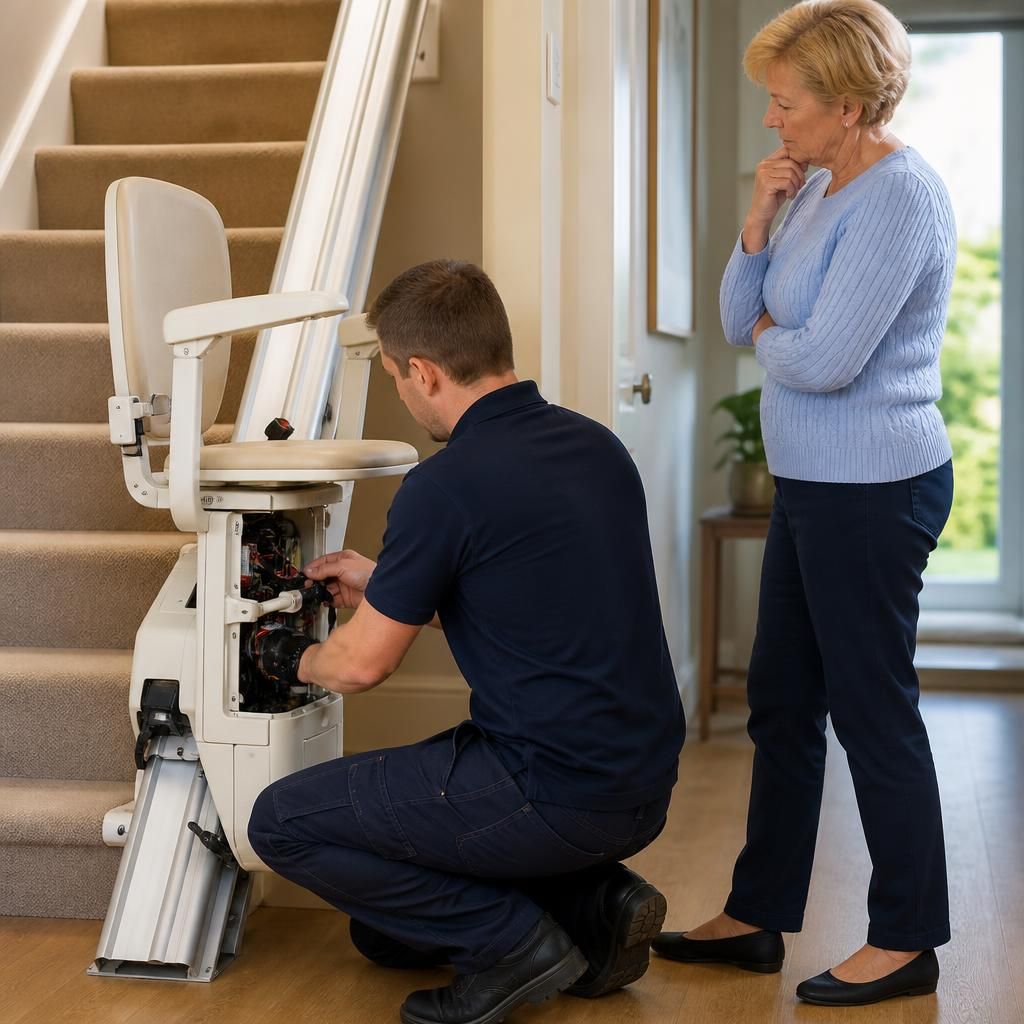
Arrange Expert Stairlift Repair Advice
If your split-level stairlift has stopped working, is making unusual noises or is not charging, stop using it and contact Independent Stairlifts for repair advice or an engineer’s assessment. We can help identify the fault and advise on the safest repair or replacement option.