
How often should routine maintenance be performed on a split-level stair lift to ensure optimal performance?
A split-level stair lift should normally receive a professional maintenance service at least once a year, or as often as specified by the manufacturer. More frequent servicing may be appropriate for heavily used lifts or systems exposed to outdoor conditions, while users should also complete simple routine checks and report unusual noises, movement or charging problems promptly.
A split-level stair lift should normally receive a professional maintenance service at least once a year, or at the interval specified by the manufacturer. More frequent servicing may be appropriate where the lift is used heavily, exposed to damp or outdoor conditions, or showing signs of wear. Routine user checks between services are also important, but they do not replace a qualified inspection.
Split-level installations can include more than one rail section, a landing or intermediate stopping point, charging points, and transfer areas. Each part must work together accurately, so maintenance is particularly important for reliable travel between floor elevations. During a service, the engineer will assess the lift’s mechanical and electrical condition, clean relevant components, check fixings and alignment, and test the safety systems throughout the complete route.
When a more frequent service may be advisable
- The stair lift is used several times each day or by more than one person.
- The route includes multiple curves, transfer points or complex rail sections.
- The equipment is installed in a garage, conservatory, porch or other area affected by cold, condensation, dust or moisture.
- The lift has recently needed repairs, replacement parts or battery work.
- The user notices changes in performance, even if the lift is still operating.
The manufacturer’s instructions and any servicing terms supplied with the lift should take priority. Keeping to the recommended schedule can help identify worn parts before they affect safe operation and may also be necessary to maintain applicable warranty or service arrangements.
Checks to carry out between professional services
Keep the rail, steps and landing areas clear of objects, clothing and spillages. Check that the seat, armrests, footrest and swivel or transfer mechanism appear secure. Make sure the lift reaches its charging points correctly and that the batteries are charging as expected. If your model has a key switch, safety edge, seat belt or obstruction sensors, use them only as described in the user instructions and do not attempt to bypass any safety feature.
Listen for new grinding, squeaking or clicking sounds, and look for jerky movement, unexpected stops, reduced speed, difficulty starting, or a battery that loses charge unusually quickly. A warning light or repeated fault tone should also be treated as a reason to contact the service team. Stop using the lift if it becomes unsafe, moves unpredictably, emits a burning smell or has visible damage, and arrange professional advice rather than attempting a repair yourself.
What routine servicing should cover
- Inspection of the rail, brackets, fixings, joints and any landing or transfer sections.
- Testing of the motor, drive system, controls, charging equipment and batteries.
- Checking seat restraints, swivel mechanisms, footrest sensors and obstruction detection.
- Assessment of alignment, movement, stopping positions and the operation of safety edges.
- Cleaning, lubrication or adjustment where permitted by the manufacturer.
- Identification of components that may need monitoring or replacement before the next scheduled service.
After servicing, keep the engineer’s report and note any recommended follow-up work. If the lift is used by someone who depends on it for everyday access, arrange maintenance before the due date rather than waiting for a fault. Contact Independent Stairlifts if you are unsure when your split-level lift was last serviced, if the usage or environment has changed, or if you have noticed any change in its operation. The appropriate interval can then be confirmed for the specific model and installation.
Routine professional maintenance for a split-level stair lift should normally be carried out at least once a year, or at the interval specified by the manufacturer. This service checks the complete route, including rail sections, bends, landing points, charging positions, drive components and safety systems, rather than assessing the lift only at one level.
Between services, report changes such as jerky movement, unusual noises, unexpected stops, reduced speed or poor battery charging. Keep the rail, steps and transfer areas clear, and do not attempt to adjust or bypass safety features. If the lift is used heavily or installed where it is exposed to damp, condensation or dust, ask the service team whether a shorter maintenance interval would be more suitable.
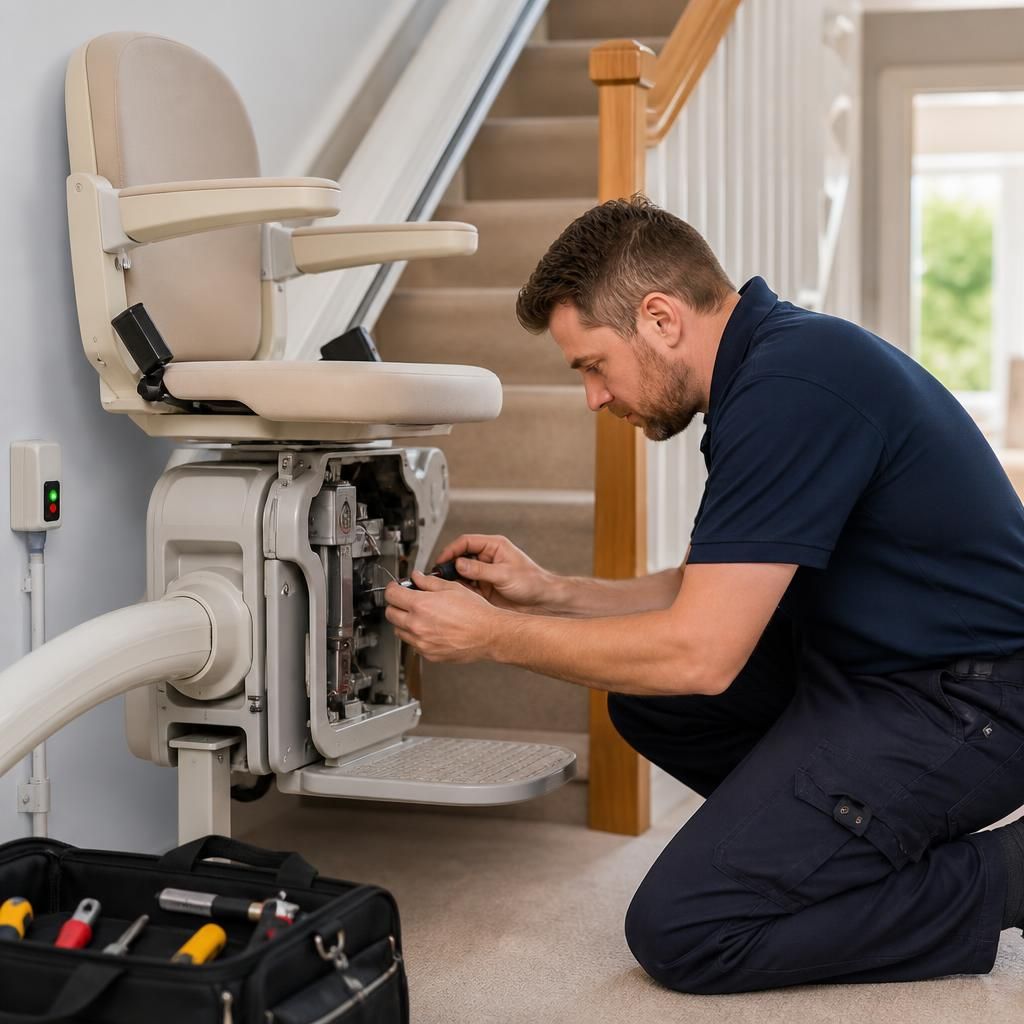
Arrange a maintenance check for your split-level stair lift
Contact Independent Stairlifts to arrange a professional maintenance check for your split-level stair lift or confirm when its next service is due. We can advise on the appropriate servicing interval for your model, usage and installation conditions.