
How do split-level stair lifts ensure user safety during operation?
Split-level stair lifts support safe operation through secure seating, seat belts, responsive controls, obstruction sensors and controlled starting and stopping. Correctly designed and installed systems also manage changes in direction or floor elevation smoothly, with safety features that stop the lift if an obstruction or fault is detected.
Split-level stair lifts ensure safe operation by combining a stair rail designed around the changes in height and direction with secure seating, controlled movement, obstruction detection and easy-to-use controls. A correctly assessed and installed lift should move smoothly between sections of the staircase, stop accurately at landings and stop automatically if it detects an obstruction or a system fault.
Safety depends on the complete installation rather than on one feature alone. The lift, rail, charging points and controls must be selected to suit the staircase layout, the user’s mobility needs and the available space at each landing. Split-level stairs can include intermediate landings, turns, narrow sections or changes in gradient, so the rail is normally measured and configured for the individual home.
How the stair lift manages changes in level
A bespoke rail guides the carriage along the planned route, including changes in direction and transitions between stair sections. The design should provide a stable route while keeping the carriage and seat clear of walls, banisters, doors and other fixed objects. At the upper and lower landings, the rail and stopping positions are arranged to provide a practical place for the user to get on or off.
Where the staircase has a turn or an intermediate landing, the lift may travel around a curved section or use a suitable configuration for the individual layout. The installer checks clearances throughout the journey, not only at the two ends of the stairs. This helps reduce the risk of contact with surrounding surfaces as the lift passes through the split-level section.
Features that protect the user during travel
- Seat belt or safety harness: This helps keep the user securely positioned while the lift is moving. It should be fastened before travel and released only once the lift has stopped at a suitable access point.
- Swivel or powered swivel seat: A seat that turns towards the landing can make getting on and off safer by reducing the need to twist or step sideways on the stairs. The seat should be locked in the travel position before the lift starts.
- Armrests and footrest: These provide support and help maintain a consistent seated position. The footrest also helps protect the user’s feet from the stairs and nearby objects.
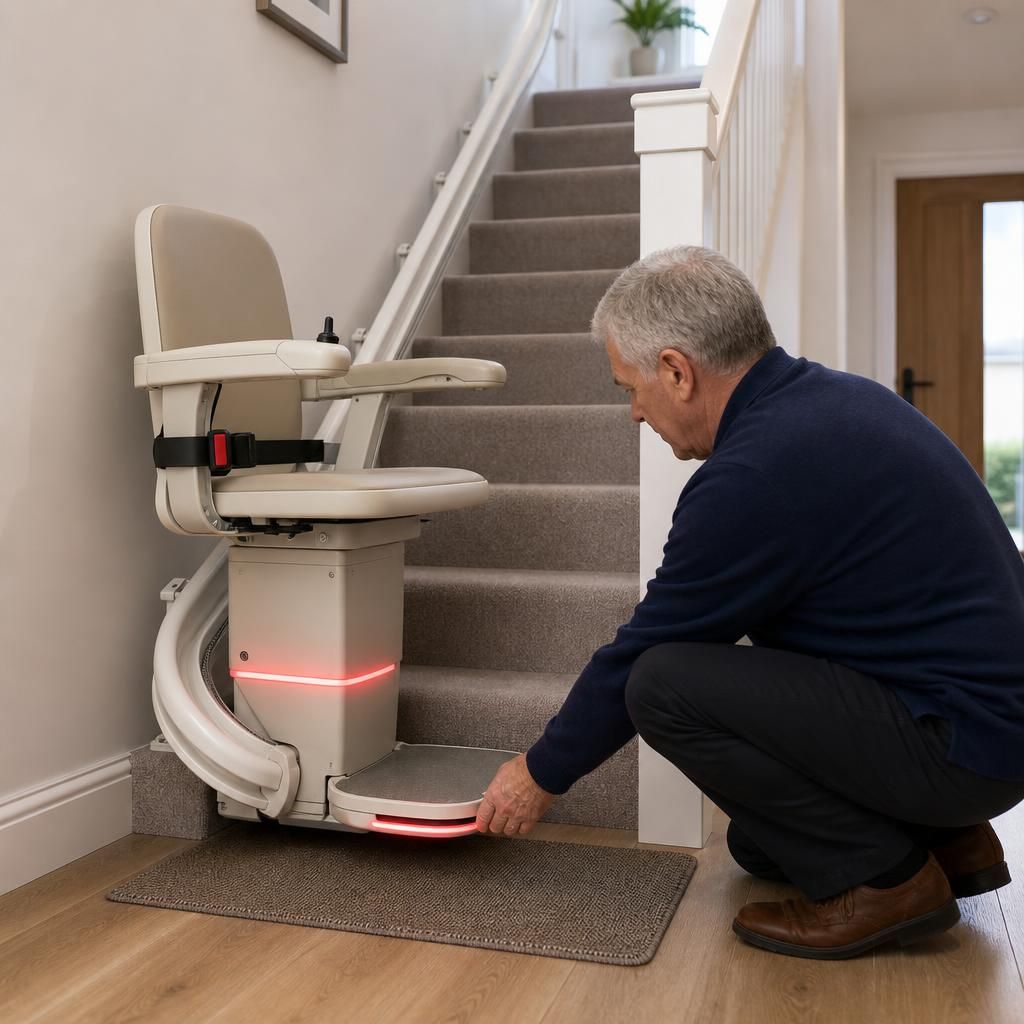
- Obstruction sensors: Sensors or safety edges can detect an object in the lift’s path. When activated, the lift should stop or prevent movement, depending on the system design. The obstruction must be removed before attempting to continue.
- Controlled acceleration and braking: A gradual start and stop helps avoid sudden movements. The lift should maintain a controlled speed through the route, including turns and changes in elevation.
- Safety switches and interlocks: These can prevent movement if the seat, swivel mechanism, armrests or other required components are not in the correct position. The precise safeguards depend on the model.
Controls are designed to reduce operating errors
Most split-level stair lifts use a simple control on the armrest, allowing the seated user to travel in either direction. Remote controls may also be fitted at the landings so the lift can be sent or called when it is parked elsewhere. Controls are generally held in the required direction rather than operated accidentally with a single brief press, although operation varies between models.
The control position and type should be suitable for the user’s hand strength, dexterity and eyesight. During handover, the installer should explain how to start and stop the lift, use the swivel seat, fasten the belt and respond to an obstruction or warning indicator. Users should avoid leaning out, reaching towards the rail or attempting to stand while the lift is moving.
Stopping at landings and in an emergency
The lift is programmed to stop at its intended access points, giving the user time to position themselves safely before standing. It should not be used as a substitute for a level walking surface if the user cannot safely transfer from the seat. Keep the landing area clear and ensure doors, furniture and other household items do not obstruct entry or exit.
Many systems include an emergency stop control, audible alerts or visual indicators. If the lift stops unexpectedly, the user should remain seated, follow the instructions provided at installation and contact the appropriate support service if the issue cannot be resolved safely. They should not force the carriage, bypass a safety switch or attempt to repair electrical or mechanical components themselves.
Power and fault protection
Stair lifts commonly use rechargeable batteries so that the lift can complete its operation during a mains power interruption, subject to the battery condition and model specification. The lift normally charges when parked at a designated charging point. Leaving it correctly parked helps maintain battery readiness and ensures it is available when needed.
Warning tones, indicator lights or diagnostic systems may identify a low battery, charging problem, obstruction or other fault. These warnings should not be ignored. If the lift behaves unusually, makes an unfamiliar noise or fails to charge, stop using it and arrange an assessment rather than continuing to operate it.
Installation and user behaviour are part of safety
Before installation, the staircase should be assessed for its width, gradient, landings, turns, headroom, access points and nearby doors or fixtures. The installer should also consider the user’s height, weight, balance, transfer ability and any difficulty with their hands, knees or hips. These details affect the choice of seat, controls, belt, rail arrangement and optional features.
After installation, keep the stairs and landings free from loose items, trailing cables, pets and anything else that could enter the lift’s path. Use the belt, sit centrally, keep hands and feet within the seat area and wait until the lift has fully stopped before transferring. Visitors and other household members should also understand that the staircase must remain clear while the lift is in use.
Routine checks help preserve safe operation
Regular servicing allows the rail, drive system, batteries, brakes, sensors, seat mechanisms and controls to be checked for wear or deterioration. The appropriate service interval depends on the equipment, usage and manufacturer’s guidance. Between services, report changes such as jerky movement, unusual sounds, reduced battery performance, unreliable stopping, a loose seat or repeated warning signals.
A split-level stair lift is safest when its route is accurately designed, its safety features are used correctly and any faults are dealt with promptly. If your staircase or mobility needs have changed, contact Independent Stairlifts for advice on whether the existing configuration remains suitable and whether an inspection or adjustment is required.
Obstruction sensors help a split-level stair lift stop safely if an object enters its route. Sensors or pressure-sensitive safety edges are positioned around parts of the carriage and footrest that could come close to the stairs, walls, banisters or landing area. If activated, the lift should stop or prevent movement, depending on the model.
Remove the obstruction before trying to continue and keep the staircase clear of shoes, bags, pets and loose items. Never bypass a sensor or repeatedly operate the controls when the lift is showing a warning. If it stops without an obvious obstruction, or the safety feature activates repeatedly, remain seated and contact the appropriate support service for advice.
Arrange a split-level stair lift safety assessment
Arrange a split-level stair lift safety assessment with Independent Stairlifts to review your staircase layout, access points and current safety features. Contact our team for practical advice on maintaining or improving safe operation.