
What safety features should I look for in a stairlift for seniors?
Look for a stairlift with a secure seat belt, reliable obstruction sensors, smooth start-and-stop controls, and a swivel seat that locks safely for getting on and off. Battery backup, easy-to-use controls, footrest protection and safety-certified installation are also important, particularly for seniors with reduced balance, strength or dexterity.
The most important stairlift safety features for seniors are a secure seat belt, obstruction sensors, controlled movement, a locking swivel seat, stable armrests and footrest protection. Battery backup, clear controls, safety interlocks and professional installation are also essential, particularly where a user has reduced balance, strength, vision or dexterity.
A suitable stairlift should be assessed against the user as well as the staircase. A feature that is technically available may not be useful if the controls are difficult to operate, the seat is hard to access or the user cannot position themselves safely. During an assessment, consider how the person will approach the stairlift, sit down, fasten the belt, travel, get off at the top and respond if the lift stops.
Seat belt and seating security
- Choose a strong, adjustable seat belt that is easy to fasten and release without requiring excessive hand strength.
- Check that the seat provides adequate support and that the armrests help the user remain centred while travelling.
- A swivel seat should lock firmly in the travel position and at the landing position. The lift should not move unless the seat is correctly positioned.
- Where transfer ability is limited, a powered swivel or specialised seat may make getting on and off safer, subject to a proper assessment.
Obstruction and footrest sensors
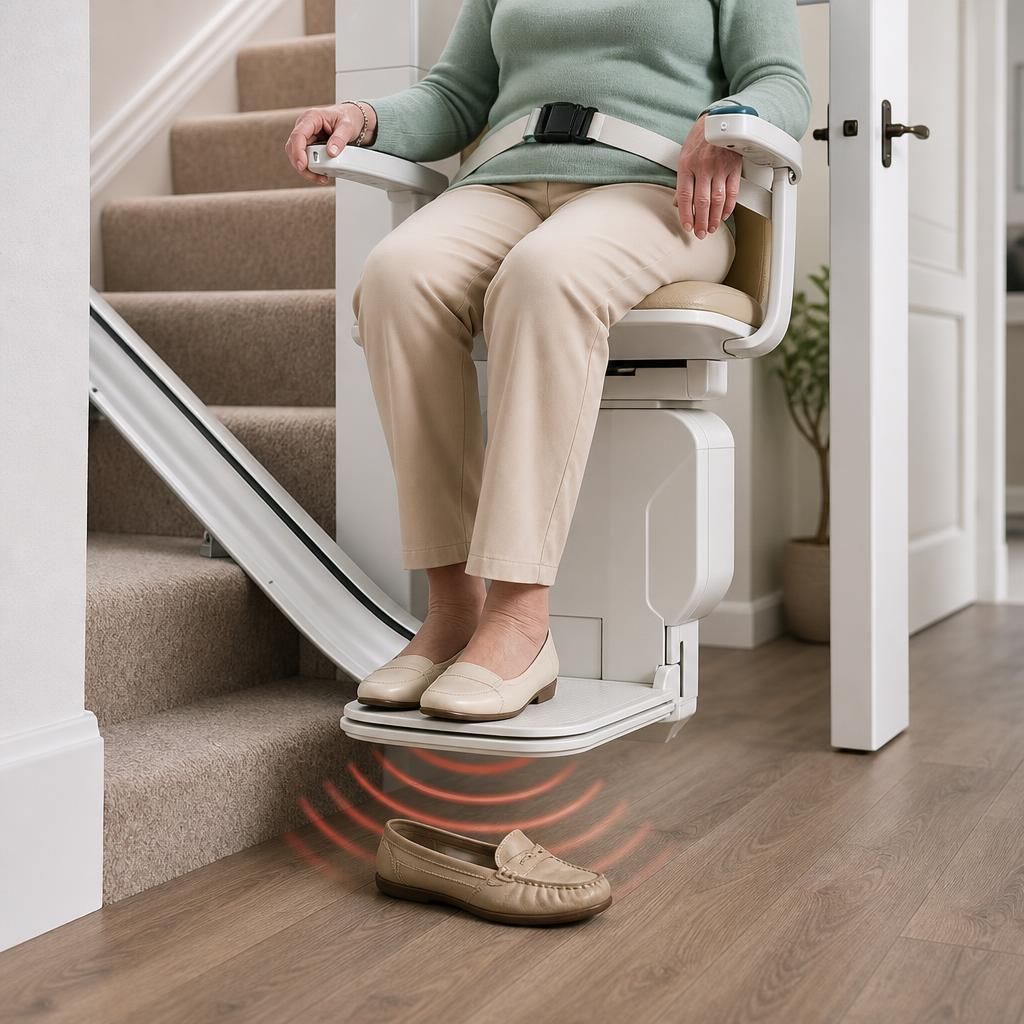
Sensors beneath the footrest and around the carriage should detect objects on the stairs and stop the lift in a controlled manner. This helps reduce the risk of trapping a foot, walking aid, pet or household item. The footrest should also provide a stable platform and, where appropriate, include sensors along its edges. Sensors are a safeguard, not a reason to leave items on the staircase; the route should still be kept clear.
Smooth starting, stopping and speed control
A stairlift should start and stop gradually rather than moving abruptly. Gentle acceleration and braking can reduce the risk of a user losing balance or feeling unsettled. Controls should allow the user to stop safely if required, while the lift should maintain a controlled speed on bends, changes of gradient and at landings.
Simple, clearly marked controls are particularly important for seniors with arthritis, reduced dexterity, visual impairment or memory difficulties. A control on the armrest is often useful, and a remote control can allow the lift to be called to another landing. The controls should be positioned so they cannot be operated accidentally when the user is getting on or off.
Safety interlocks and secure folding parts
Safety interlocks prevent the stairlift from operating when an essential component is not in a safe position. Depending on the design, these may include the seat, swivel mechanism, armrests, footrest or carriage. Folding seats, arms and footrests should move securely and should not create unnecessary pinch points.
On a narrow staircase, check that the folded lift leaves enough space for other people to use the stairs safely. If the stairlift has a manual or powered fold mechanism, the user should be able to operate it without stretching or placing their hands near moving parts.
Battery backup and safe stopping
Most domestic stairlifts charge at designated points on the track and use batteries so that the lift can continue to operate during a mains power cut. Confirm how the lift behaves if the power supply fails, how much travel remains available and how the user should reach a safe landing if the battery is low.
A clear low-battery warning is useful, but the user should not rely on warning lights alone. The lift should be left on its charging point when not in use, and charging contacts should be kept clean and unobstructed. Battery condition should be checked during servicing, particularly if the stairlift is used regularly or has been stored for a period.
Emergency controls and communication
Look for an accessible stop control and clear instructions for what to do if the stairlift stops between landings. Some installations may also benefit from an alarm, telephone or other communication method nearby, especially where the user spends time alone. The user and their family should know how to contact the installer or service team and should never attempt to move the lift manually unless the instructions specifically allow it.
There should be a straightforward way to isolate the stairlift when it is not being used, such as a key switch. This can prevent unintended operation by children or visitors, but the key should be stored where the user or their carer can access it when needed.
Secure track, carriage and landings
The rail and carriage must be correctly installed for the staircase, with sufficient clearance from walls, doors and obstructions. At the top and bottom, the user needs a stable area for turning and transferring. Where the staircase ends close to a doorway or narrow passage, a longer track, hinged rail or alternative parking position may be needed to prevent the carriage obstructing access.
Installation should include checks of the stairs, flooring, electrical supply, landing areas and the user’s transfer route. A professional installer should explain the safe operating position, weight limit, charging points and any limitations of the chosen design. Do not assume that a standard straight stairlift is safe for a staircase with bends, intermediate landings or unusual access without an appropriate assessment.
Controls for specific needs
For someone with reduced vision, choose high-contrast controls, audible indications where available and controls that can be identified by touch. For arthritis or limited grip, large buttons, a simple joystick or a powered swivel may be more suitable than small switches. For a person who has difficulty sitting upright, discuss seat support, belt design and whether a different seating configuration is required.
Consider the user’s walking aid as well. A walking frame or stick must be positioned so it cannot fall onto the stairs or interfere with the sensors. Some stairlifts have safe storage options, but these should be selected during the assessment rather than added in a way that affects balance or clearance.
Installation, testing and ongoing maintenance
Safety features only work reliably when the stairlift is correctly fitted, tested and maintained. After installation, the user should receive a practical demonstration covering the belt, controls, swivel seat, emergency stop, charging and what to do if an obstruction is detected. Family members and regular carers should receive the same guidance.
Arrange servicing in line with the manufacturer’s instructions and contact the service team if the lift becomes noisy, jerky, slow, difficult to start or reluctant to charge. Do not bypass sensors, remove covers or continue using the lift after a safety fault. Keep the track and charging points free from objects, and report any change in the user’s mobility that could affect safe transfers.
When comparing stairlifts, ask for confirmation that the model is suitable for the user’s weight, posture and mobility needs; that it has tested safety systems; that the installation meets applicable UK requirements; and that instructions, servicing and emergency support are available. The safest choice is not simply the model with the most features, but the one whose controls and protective systems the senior user can understand and use consistently.
Obstruction sensors are a key stairlift safety feature because they detect objects in the lift’s path and stop the carriage in a controlled way. Sensors may be positioned beneath the footrest and around the carriage to help prevent contact with feet, walking aids, pets or items left on the stairs.
Sensors are a safeguard, not a replacement for keeping the staircase clear. Before travelling, the user or carer should check that the steps, landings and track are free from loose objects. If the stairlift stops because a sensor has detected an obstruction, follow the manufacturer’s instructions and do not attempt to bypass or remove the sensor.
Arrange a stairlift safety assessment
Arrange a stairlift safety assessment to check that the seat, controls, sensors and installation are suitable for the senior user and their staircase. Our team can identify practical safety requirements and recommend appropriate solutions.