
What safety features are essential in stairlifts for seniors?
Essential stairlift safety features for seniors include a secure seatbelt, a stable seat with swivel and locking functions, obstruction sensors, reliable braking, and controls that are easy to operate. Battery backup and safety sensors on the footrest and armrests also help the stairlift stop safely if it detects an obstacle or loses mains power.
The essential safety features in a stairlift for seniors are a secure restraint, a stable seat with swivel and locking functions, dependable braking, obstacle sensors, accessible controls and battery backup. These features work together to reduce the risk of slipping, unexpected movement, collisions and being left on the staircase if the household power supply fails.
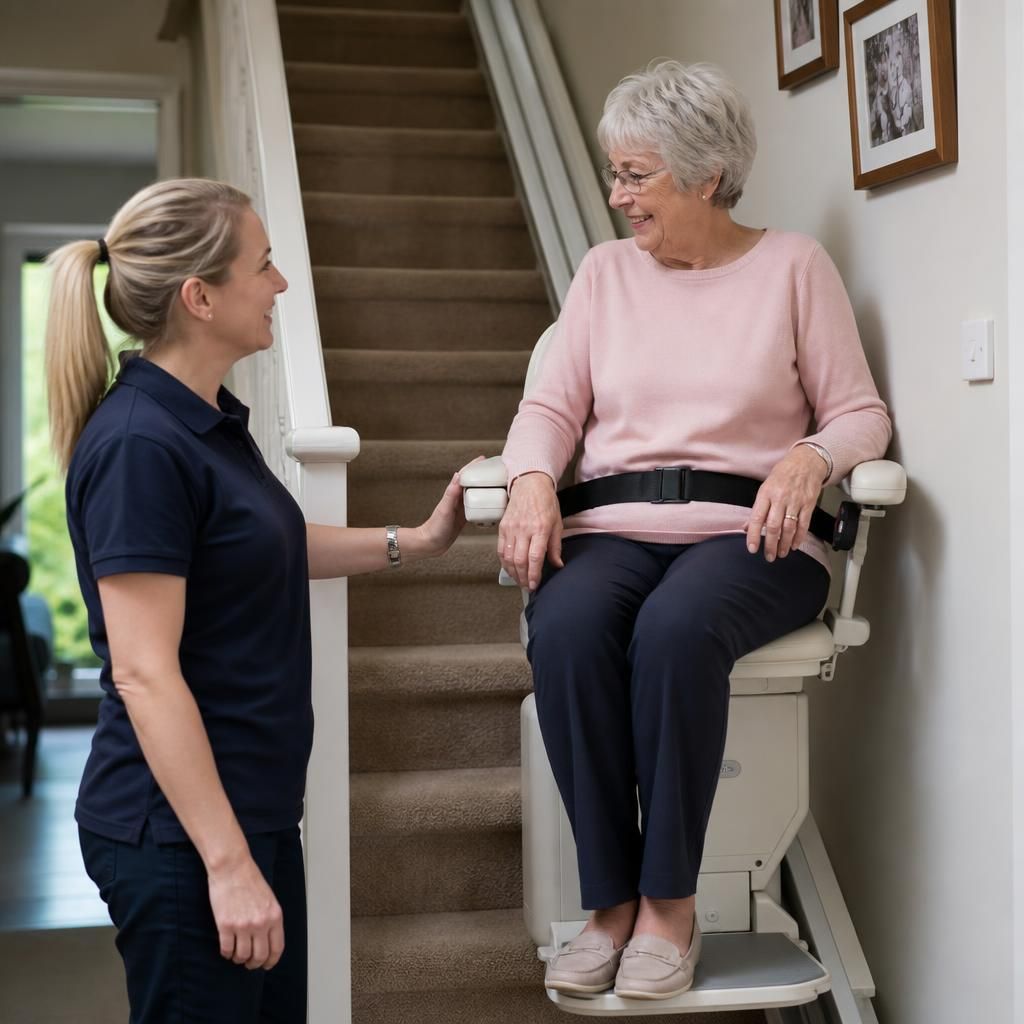
Secure seating and restraint
- Seatbelt or safety harness: A properly positioned belt helps keep the user securely seated while the stairlift is moving. The fastening should be simple to operate but should not release accidentally. A retractable belt can make transferring into and out of the seat easier.
- Supportive seat and armrests: The seat should provide stable support without allowing the user to slide forwards or sideways. Firm armrests can improve balance when sitting down and standing up, particularly for someone with reduced strength or coordination.
- Swivel seat with a locking mechanism: At the top or bottom of the stairs, the seat should turn towards the landing and lock in position before the user leaves it. This helps keep the user facing away from the stair edge while transferring, reducing the risk of stepping off at an awkward angle.
- Adjustable or suitable seating: The seat, armrests and belt should suit the user’s size, posture and mobility. If the user has difficulty bending their knees, maintaining an upright position or transferring from a wheelchair, the seating arrangement may need particular attention during the assessment.
Obstacle detection and protective sensors
Sensors beneath the footrest and around the carriage should stop the stairlift if it encounters an object on the stairs. Sensors may also be positioned around the armrests or other exposed areas. The stop should be controlled rather than abrupt, allowing the obstruction to be removed before travel resumes.
These sensors are an important safeguard, but they do not replace keeping the staircase clear. Walking aids, footwear, toys, parcels and loose rugs should not be left on or close to the stairlift track. The installer should also explain how to respond if the lift stops because a sensor has detected something.
Reliable braking and controlled movement
A stairlift should include a braking system that holds the carriage securely when it stops and prevents uncontrolled movement if the controls are released. Smooth acceleration and deceleration are also important for seniors who may have balance problems, joint pain or limited trunk control. The lift should not jerk when starting, stopping or changing direction.
The stairlift must be able to stop safely at its designated positions. Its speed and operation should remain controlled on changes in gradient and, with a curved model, around bends or transitions. Regular servicing helps confirm that the drive system, brakes and safety circuits continue to operate as intended.
Battery backup and safe power arrangements
Battery-powered travel with charging points at the appropriate ends of the staircase allows a stairlift to continue operating during a mains power cut, provided the batteries are adequately charged. This is particularly important if the user depends on the lift to reach essential rooms or leave the property.
A stairlift should give a clear indication when it is not parked correctly or when its batteries need attention. It is good practice to leave the lift on its charging point when it is not in use and to report repeated low-battery warnings, reduced travel distance or unusual charging behaviour. Battery backup is not a substitute for maintenance: batteries eventually need replacement as they age.
Controls that are easy to use
The main control should be positioned where the user can reach it comfortably from the seated position. It should be clearly marked, require deliberate pressure and be easy to operate without relying on fine finger movement. A simple hand control can be especially useful when the user has arthritis, poor grip or reduced vision.
Call and send controls at the landings should also be straightforward. They allow the stairlift to be brought to the user when another person has left it at the opposite end. If remote controls are supplied, they should be stored consistently and checked periodically so that they are available when needed.
Emergency stop and communication features
An emergency stop control should be easy to identify and use if the user feels unwell or notices a problem. The user and family members should know what happens after the stop is pressed and how the stairlift is reset safely. Controls should never be obstructed by clothing, bags or other items.
Some stairlifts provide audible alerts, status indicators or diagnostic messages for issues such as a seat not being locked, a safety edge being activated or the carriage not being correctly parked. These warnings should be clear enough for the user or carer to understand. Where a user may be alone for extended periods, discuss whether an appropriate communication or emergency arrangement is needed; a stairlift itself should not be treated as a substitute for a personal alarm.
Safe transfer and parking positions
The stairlift should stop in a position that gives the user sufficient room to sit down or stand up safely. On a straight staircase, this may involve parking at the top or bottom landing. On a curved staircase, the installer may recommend a different parking position to keep the staircase or doorway clear.
Where possible, the lift should be folded or parked so that it does not create an avoidable obstruction for other people using the stairs. Folding rails, hinged rails or alternative parking arrangements may be considered where a doorway, corridor or narrow landing is close to the bottom step. The correct solution depends on the layout and must be assessed at the property.
Safety on narrow, curved and outdoor staircases
For a narrow staircase, the seat width, armrest position, folded dimensions and track design all affect how safely the user can transfer and how much space remains for others. A compact design is not automatically the safest choice if it makes the user feel cramped or affects their ability to sit upright.
Curved stairlifts should be designed and installed to follow the specific staircase rather than relying on a standard straight configuration. The track, sensors, seat position and landing clearances need to be checked around corners, intermediate landings and changes in gradient.
Outdoor stairlifts need protection suited to weather exposure, including appropriate covers and materials, while still requiring safe seating, restraint, sensors and emergency controls. Rain, frost, dirt and temperature changes can affect operation, so outdoor equipment needs maintenance suited to its location.
Installation, standards and ongoing checks
Safety features are only effective when the stairlift is correctly selected, fitted and maintained. A professional assessment should consider the user’s balance, leg strength, posture, eyesight, hand control and ability to transfer, as well as the staircase layout and the needs of other household members.
The installation should follow the manufacturer’s instructions and applicable UK requirements for stairlifts and electrical safety. Ask for the operating instructions, warranty information and servicing recommendations, and make sure everyone who may use or supervise the stairlift understands its controls. A competent installer should demonstrate normal operation, emergency procedures, charging, parking and what to do if a sensor stops the lift.
Before each journey, the user should sit fully back in the seat, fasten the belt, keep hands and feet within the protected areas and check that the staircase is clear. Report unusual noises, jolting, unreliable stopping, damaged belts, loose armrests, repeated warning signals or reduced battery performance promptly. Do not attempt to bypass a sensor or carry heavy, unstable items on the stairlift.
The safest stairlift is therefore not simply the model with the longest list of features. It is one whose restraint, seating, controls, sensors, braking and backup power are appropriate for the senior user, correctly matched to the home and supported by regular servicing. An individual assessment is the best way to confirm which safety features are essential in a particular situation.
A secure seat and correctly used restraint are essential safety features for senior stairlift users. The seat should support an upright position, while the seatbelt keeps the user safely positioned during travel. Firm armrests also provide support when sitting down and standing up.
At the landing, a swivel seat should turn away from the staircase and lock before the user transfers. This helps reduce the risk of stepping towards the stair edge or losing balance. During the assessment, check that the seat, belt and armrests suit the user’s posture, mobility and ability to transfer independently.
Arrange a stairlift safety assessment
Arrange a stairlift safety assessment to review the user’s seating, restraint, controls, transfer needs and staircase layout. Independent Stairlifts can help identify the essential safety features and suitable configuration for the home.