
What features should seniors look for in a stairlift to ensure safety and comfort?
Seniors should look for a stairlift with reliable safety sensors, a secure seat belt, easy-to-use controls, a comfortable and supportive seat, and a swivel seat that makes getting on and off safer. Battery backup, adjustable settings, obstruction detection and a suitable footrest are also important, with the final features chosen to match the user’s mobility needs and staircase.
The most important stairlift features for seniors are reliable safety sensors, a secure and comfortable seat, simple controls, a suitable seat belt, a powered or manual swivel seat, battery backup and settings that match the user’s mobility needs. The right combination depends on the person using the lift, the staircase layout and how safely they can transfer on and off the seat.
Safety features to prioritise
- Obstruction sensors: Sensors should detect objects on the stairs and stop the stairlift smoothly before contact. This is particularly important in busy households where items may occasionally be left on the staircase.
- Seat belt: A properly positioned seat belt helps keep the user secure while travelling. The most suitable style depends on the user’s balance, movement and ability to fasten it independently.
- Swivel seat: A swivel seat turns towards the landing, allowing the user to get on and off facing away from the stairs. This can reduce twisting and the risk of stepping sideways at the top or bottom. Some models have a powered swivel mechanism, which may be preferable where hand strength or upper-body movement is limited.
- Stable armrests: Firm, correctly positioned armrests provide support when sitting down and standing up. They should not make the seat feel cramped or prevent the user from transferring comfortably.
- Safety sensors and interlocks: The lift should only operate when the seat, armrests and other relevant components are correctly positioned. Sensors may also help confirm that the stairlift is properly aligned before movement.
- Emergency stop control: A clearly identified stop control allows the user or a carer to stop the lift if required. It should be easy to reach without being confused with the normal operating controls.
Comfort and support
Comfort affects whether a senior can use the stairlift confidently and consistently. Look for a seat with adequate padding, a supportive backrest and a shape that provides stability without restricting movement. The seat should be wide enough for the user’s posture and clothing, while still leaving sufficient clearance on the staircase.
Adjustable features can make a significant difference. Depending on the model, these may include the seat height, armrest position, footrest position and control location. The aim is to support the user’s feet and back without forcing the knees or hips into an uncomfortable position. A demonstration or home assessment is useful because a feature that suits one person may not suit another.
Footrest design
The footrest should provide enough space for both feet and should be at a comfortable height. A non-slip surface can help keep the feet in place during travel. Consider whether the user can lift their feet onto the footrest safely, particularly if they have reduced hip or knee movement. Folding or powered footrests may make parking the stairlift easier, but the practical benefit depends on the user’s strength and the available space at the bottom of the stairs.
Controls that are easy to use
Controls should be intuitive, clearly marked and usable with the fingers and grip the senior has available. A simple press-and-hold control can help prevent accidental movement, provided the user can maintain pressure comfortably. The control may be fitted to either armrest, and additional controls at the top and bottom of the stairs allow a carer to send the lift when it is parked elsewhere.
Check that the handset or armrest control can be reached without leaning forward. Large, tactile buttons may be helpful for someone with poor eyesight, arthritis or reduced dexterity. If the user has a tremor, limited grip or cognitive impairment, the control arrangement should be assessed in person rather than selected from specifications alone.
Battery backup and reliable operation
Most domestic stairlifts use rechargeable batteries so that the lift can continue to operate during a mains power cut. Confirm how the lift charges, where the charging points are located and whether the user can return the stairlift to a charging position. A visible or audible low-battery warning can help prevent the lift being left without sufficient charge.
The stairlift should also provide clear information if it is not ready to operate, for example because it is not parked correctly, the seat is folded or an obstruction has been detected. Clear alerts are more useful than unexplained beeps, especially when the user may be alone.
Features for the staircase and home
The stairlift must fit the staircase without creating an unnecessary trip hazard or blocking doors and walkways. A folding rail or compact folded profile can be useful where there is limited space at the bottom of the stairs. On a curved staircase, the rail should be designed around the bends, landings and available clearance rather than treated as a standard straight installation.
Consider where the stairlift parks when it is not in use. A parking position may need to leave a doorway, hallway or landing accessible. If other household members use the stairs, the folded seat, footrest and armrests should leave adequate room for them to pass safely.
Useful options for particular needs
- A powered swivel seat may assist someone who cannot turn their body easily.
- A powered footrest may help someone who cannot bend down to lower or raise it.
- A perch or standing-style seat may be considered where the staircase is narrow or sitting down is difficult, but it is not suitable for every user and requires careful assessment.
- Weather-resistant components and suitable controls are important for an outdoor stairlift exposed to rain, cold and changing temperatures.
- Remote controls can help a carer move the stairlift between floors, but they should supplement rather than complicate the user’s own controls.
- Diagnostic indicators can help identify charging, sensor or operational issues before they become a larger problem.
Match features to the person, not just the staircase
The user’s mobility is the starting point for choosing features. Consider whether they can stand from a chair, turn towards the landing, bend their knees, fasten a belt, operate a control and keep both feet positioned securely. Also consider visual or hearing impairment, arthritis, balance problems and whether a carer will be present.
A stairlift should not be used to compensate for an unsafe transfer that has not been assessed. If the user cannot sit securely, reach the controls or get off safely at the landing, a different seat configuration, additional support or alternative access arrangement may be needed. A personalised assessment can identify these issues before installation and establish whether a straight, curved or outdoor solution is appropriate.
Check installation, servicing and aftercare
Good features only provide protection when the stairlift is correctly installed and maintained. Ask for the safety features to be demonstrated, including the sensors, seat belt, swivel action, emergency stop, charging system and any warning indicators. The user should practise starting, stopping, parking, fastening the belt and reporting a fault.
Keep the manufacturer’s instructions available and arrange servicing in line with the recommended schedule. Do not continue using the lift if it moves unpredictably, makes an unusual noise, fails to charge, stops repeatedly or shows a fault warning. Report the problem for assessment rather than attempting to bypass a sensor or carry out an unauthorised repair.
In practical terms, the best stairlift is not necessarily the one with the longest list of options. It is the model whose safety systems, controls, seating position and access arrangements the senior can use correctly every time. An assessment at home allows the features to be tested against the actual staircase and the user’s abilities before the final specification is agreed.
A powered swivel seat can make getting on and off a stairlift safer for a senior who finds it difficult to turn, balance or stand from a standard seat. It rotates towards the landing, helping the user transfer while facing away from the stairs rather than twisting across the stairwell.
This feature is particularly useful when hand strength or upper-body movement is limited, as the seat can be turned using a control instead of manually. The user must still be able to sit securely, operate the control and complete the transfer safely, so the seat and swivel action should be assessed at home before installation.
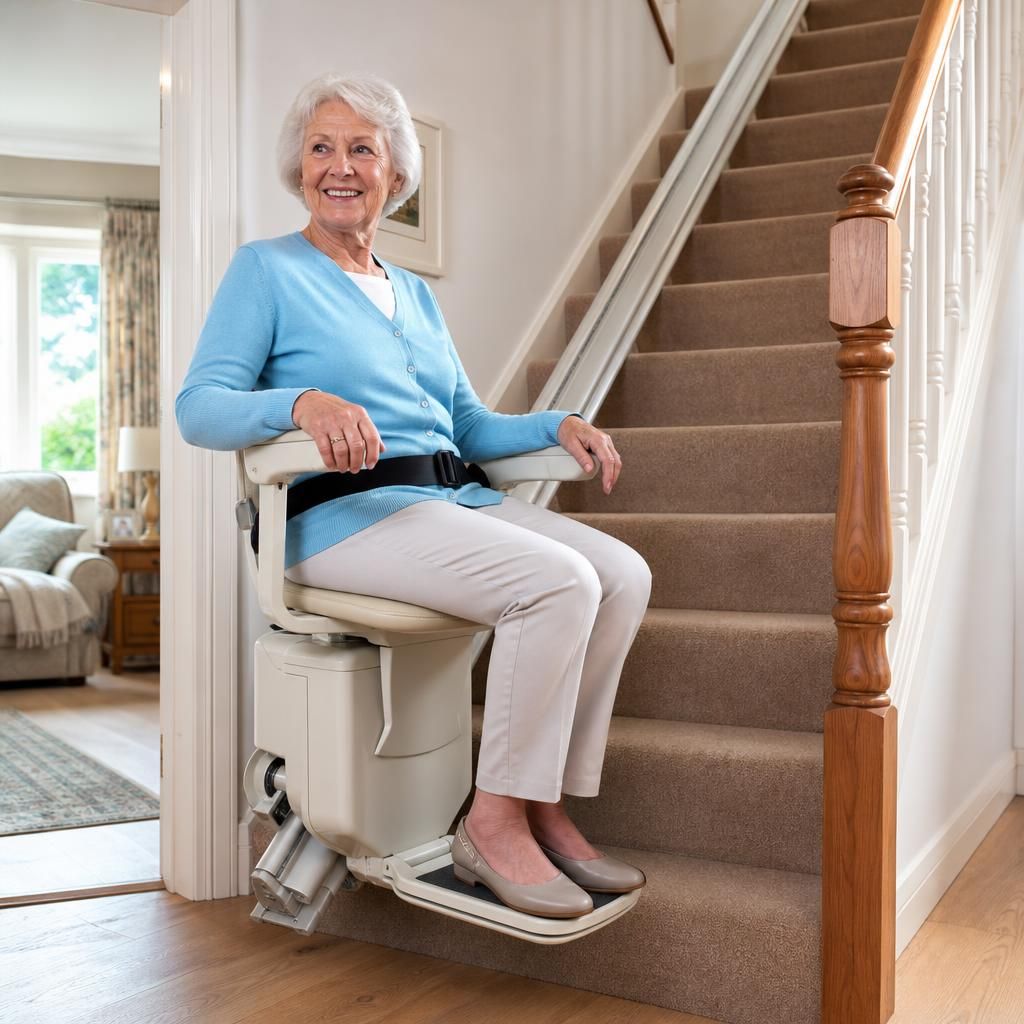
Arrange a stairlift assessment for safer, more comfortable mobility
Arrange a home stairlift assessment with Independent Stairlifts to check which safety, seating and control features suit the user and staircase. We can demonstrate suitable options and confirm the right specification before installation.