
What are the critical factors to consider when selecting a stairlift for an elderly family member?
When selecting a stairlift for an elderly family member, consider the staircase layout, the user’s mobility and posture, essential safety and comfort features, available space, reliability, and total budget. A professional home assessment should confirm whether a straight, curved, outdoor or reconditioned stairlift is appropriate and ensure it is fitted to the person and their home.
The right stairlift depends on the staircase, the older person’s physical needs, the available space and the total cost of ownership. A suitable choice should provide safe, comfortable access without obstructing other household members, and should be confirmed through a professional assessment in the home rather than selected on appearance or price alone.
Assess the staircase layout first
The shape and dimensions of the stairs determine which stairlift designs are practical. A straight stairlift is normally suitable for a staircase with a single, uninterrupted flight. If the stairs include a bend, landing, intermediate steps or more than one flight, a curved stairlift may be needed. Curved systems are made to follow the individual staircase and can be designed around landings, narrow sections and changes in direction.
For steps leading to an external entrance, an outdoor stairlift may be more appropriate. It must be suitable for exposure to rain, cold, sunlight and changing temperatures, with appropriate materials and protective features. The landing and the area at the top and bottom of the stairs also need to be checked, as there must be enough room for the user to get on and off safely.
A survey should consider the width of the staircase, the position of doors, radiators and handrails, the direction in which the seat folds or swivels, and whether furniture or household traffic could interfere with use. Some staircases have restricted space, but this does not automatically rule out installation. Compact rails, folding components or a bespoke design may provide a workable solution where a standard arrangement would be unsuitable.
Match the lift to the person using it
The user’s mobility, balance, strength, height, weight and posture are more important than selecting a model based on general appearance. Consider whether the person can:
- Walk safely to the stairlift and approach the seat without losing balance.
- Sit down and stand up without excessive bending or twisting.
- Keep their feet positioned securely on the footrest.
- Operate the controls with their hands or, if necessary, with an alternative control arrangement.
- Remain seated comfortably for the full journey.
Someone with painful knees, restricted hip movement or a tendency to lean may need a different seat height, support arrangement or swivel-seat configuration from someone with good posture and upper-body strength. If the user has a larger frame, reduced flexibility or a condition that may progress, ask for the available seat, footrest and weight specifications to be checked against their needs.
It is also sensible to consider how the person’s mobility may change. A stairlift that is comfortable now may become difficult to use if standing, transferring or bending becomes harder. Discuss foreseeable changes with the assessor so that the chosen configuration remains practical for as long as possible. Where another person may use the lift, their needs should be considered too.
Prioritise safety features that support independent use
Essential safety features commonly include a seat belt, armrests, a stable footrest, obstruction sensors and controls that stop the lift if an object is detected in its path. A swivel seat can help the user turn towards the landing before standing, reducing the need to twist while getting off. Powered swivel or folding functions may be useful where hand strength or movement is limited.
Other points to check include:
- Whether the controls are easy to see, reach and operate.
- Whether a remote control is available for calling the stairlift to another level.
- Whether the stairlift has a safe manual or powered mechanism for use during a power cut.
- Whether the seat, footrest and armrests provide sufficient support.
- Whether the lift can be parked without blocking a doorway or walkway.
- Whether the user can hear or see the warning indicators clearly.
Safety features are only effective if the user understands how to use them. During the assessment and handover, the older person should be shown how to sit down, secure the belt, operate the controls, stop the lift and respond to an obstruction or power interruption. Family members and regular carers should receive the same guidance.
Check comfort and ease of transfer
Comfort affects whether a stairlift is used consistently. The seat should support the user’s posture without forcing the knees or hips into an uncomfortable position. Seat padding, armrest spacing, back support and the position of the controls should all be assessed in person where possible.
The footrest needs to accommodate the user’s footwear and allow the feet to remain stable throughout the journey. If the stairs are narrow, check that the folded stairlift leaves a safe walking route for other people. A powered folding footrest or seat may be helpful where reaching down is difficult, although it can add to the overall cost.
The start and finish positions matter as much as the ride itself. The user should be able to approach the seat, transfer on and off it, and move away from the stairs without rushing or turning awkwardly. On a curved staircase, the final parking position may be particularly important if the upper landing is small.
Consider the installation environment
Before choosing a stairlift, review the wider home environment. Check whether doors open towards the stairs, whether there is adequate lighting, and whether loose rugs, furniture or stored items could create a trip hazard. The stairlift does not replace the need for a clear route at the top and bottom of the staircase.
For an outdoor installation, the surrounding surface, drainage, weather exposure and access to a suitable power supply should be considered. The equipment will also require cleaning and maintenance appropriate to its environment. A professional survey should identify practical issues that may not be apparent from photographs or measurements taken by the customer.
Compare the total cost rather than only the initial price
The price is affected by the type of stairlift, the shape of the staircase, the seat and control options, installation requirements and whether the equipment is new or reconditioned. A straight stairlift is often less complex to install than a curved one, while a bespoke curved system is designed for the particular route rather than adapted from a standard layout.
When comparing options, ask what is included in the quoted price. This may include the home survey, installation, demonstration, warranty, removal of an old stairlift and follow-up support, but inclusions vary. Also ask about ongoing servicing, call-out arrangements, replacement batteries and what happens if the equipment develops a fault after the warranty period.
A reconditioned stairlift may reduce the initial cost, but it should be inspected, refurbished and installed by a competent provider, with its condition and warranty explained clearly. The most economical option is not necessarily the one with the lowest purchase price if it is uncomfortable, poorly matched to the staircase or expensive to maintain.
Check reliability, servicing and support
A stairlift is an important piece of equipment, so establish how faults are reported and how support is provided after installation. Ask about the warranty, routine servicing, battery replacement, emergency assistance and the availability of suitable parts. A clear handover should include operating instructions, charging guidance and advice on keeping the track and surrounding area clear.
Regular servicing can identify wear, battery problems, loose components and safety issues before they affect reliable operation. The appropriate servicing interval depends on the equipment, how often it is used and the manufacturer’s guidance. Keep the user instructions and service records available for family members and carers.
Use a professional home assessment before deciding
A home assessment should bring these factors together. The assessor can examine the staircase, observe how the older person approaches and uses the stairs, discuss current and future mobility needs, and explain the practical differences between straight, curved, outdoor and reconditioned options. This is also the opportunity to test seating and controls, identify installation constraints and agree on the safest parking positions.
Before installation, confirm the proposed route, seat configuration, safety features, total price, warranty and aftercare arrangements. Involving the elderly family member in the decision is important: the stairlift must be acceptable and manageable for the person who will use it, not simply convenient for everyone else. Taking this structured approach gives you a better basis for choosing a stairlift that fits the home, supports safe transfers and remains useful as needs change.
A professional home assessment is the most reliable way to determine which stairlift will suit an elderly family member, because it considers both the staircase and the person using it. The assessor can check the route, landings, doors, handrails and available space while discussing balance, posture, strength and any difficulty sitting down or standing up.
During the assessment, the user should be involved directly. They can try suitable seating and controls, explain any discomfort and see how the stairlift would be approached and parked. The assessment should also consider how their mobility may change, whether another person may use the lift, and which features are genuinely necessary rather than simply optional.
- Confirm whether a straight, curved or outdoor stairlift is appropriate.
- Check that the seat, belt, footrest and controls support safe, comfortable use.
- Identify potential obstructions, narrow sections and transfer hazards.
- Discuss the installation price, warranty, servicing and aftercare before agreeing to proceed.
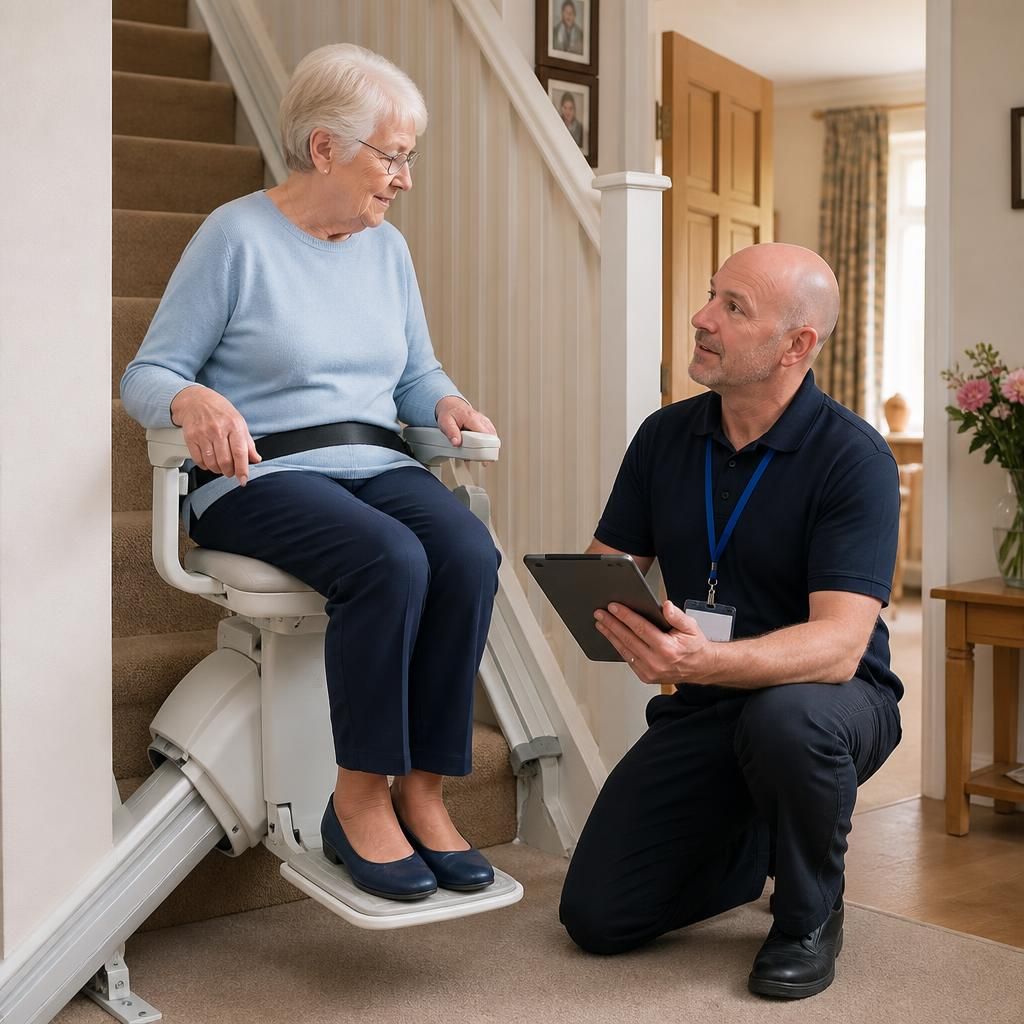
Arrange a professional stairlift assessment
Arrange a professional home assessment to confirm which stairlift suits your elderly family member, staircase layout and mobility needs. We can discuss suitable features, installation requirements, pricing and aftercare before you decide.