
How does a bespoke stairlift installation differ from standard options?
A bespoke stairlift installation is assessed and configured for your staircase, home layout and mobility needs, rather than using a standard model with limited adjustments. It may include a tailored rail, seat, controls and safety features to provide a more suitable, comfortable and reliable fit.
A bespoke stairlift installation is planned and configured around the staircase, the layout of the home and the user’s mobility needs, whereas a standard installation usually uses an off-the-shelf stairlift with fewer fitting options. Bespoke work may involve a made-to-measure rail, different seat or control arrangements, adjusted parking positions and additional safety features, so the finished installation is better suited to the property and the person using it.
The main difference is the assessment and design process. A standard stairlift is generally suitable for a straightforward, single-flight staircase with a consistent width and enough space at the top and bottom. The installer can fit a compatible rail and make routine adjustments during installation. This can be an efficient option where the staircase and the user’s requirements are uncomplicated.
A bespoke installation starts with a detailed survey rather than assuming that one standard layout will work. The assessment considers:
- the number and direction of bends, turns or intermediate landings;
- the width, steepness and shape of each section of staircase;
- available space at the top and bottom of the stairs;
- doorways, radiators, cupboards and other possible obstructions;
- where the stairlift can park without restricting access;
- the user’s height, weight, balance, strength and ability to transfer on and off the seat; and
- who will operate the stairlift and whether controls need to be particularly simple or accessible.
The rail is often the most significant bespoke element. On a straight staircase, a standard rail may be suitable, although its length, start point and parking position still need to be checked. On a curved staircase, the rail usually has to follow the exact line of the stairs, including bends, changes in gradient and landings. A made-to-measure rail can help the stairlift travel smoothly while preserving usable space on the staircase and allowing it to park in a practical position.
In some homes, the rail may need to extend beyond the first or last step so that the user can board or leave the seat on a level section. Alternatively, a folding or differently positioned rail may be considered where a doorway, hallway or frequently used route is close to the stairs. These decisions are specific to the property and should be confirmed during the survey rather than selected from a general product description.
The seat and controls can also be tailored. Depending on the user’s mobility, a suitable configuration may include a powered swivel seat, a manual swivel mechanism, adjustable or supportive armrests, a choice of upholstery, a seat belt and controls mounted on the armrest or supplied as a remote control. A powered footrest or folding mechanism may be useful where bending or reaching is difficult. The correct choice depends on the person’s ability to sit upright, turn safely, use their hands and manage transfers, not simply on the staircase itself.
Controls are particularly important when more than one person uses the stairlift. Remote controls at the appropriate boarding and parking points allow the lift to be called to the required floor. For a single user, the control should be positioned so it can be reached without leaning or twisting. A bespoke assessment should also establish whether the user can understand and operate the controls reliably, or whether a carer will normally assist.
Bespoke fitting does not automatically mean that every component is specially manufactured. It usually means that the stairlift and its installation are selected, configured and fitted for a particular situation. A standard stairlift model may still be used on a simple staircase if it provides the required weight capacity, seat position, controls and safety functions. Conversely, a curved or unusually arranged staircase may require a custom rail and a more individually specified installation.
The installation process may therefore take longer than a straightforward standard fitting. The installer must confirm measurements, agree the rail route and parking points, check electrical requirements and identify any work needed to keep access clear. Once fitted, the stairlift should be tested through its full travel, including stopping points, sensors, seat movement, controls, charging and safety belt operation. The user or carer should receive clear instruction on normal operation, charging, emergency stopping and what to do if the lift stops unexpectedly.
The practical benefits of a bespoke installation are mainly fit, usability and compatibility. A correctly planned stairlift can reduce awkward transfers, avoid unnecessary obstruction, make better use of limited landing space and accommodate a staircase that a basic straight model cannot follow. It can also be specified around changing needs, such as reduced balance, difficulty bending or the need for additional support.
There are trade-offs. Bespoke curved installations are usually more complex to survey, manufacture and install than standard straight options, and the price may be higher because the rail and fitting work are specific to the property. The installation may also involve more decisions about parking, controls and seat configuration. A higher price is not, by itself, evidence that a particular solution is more suitable; the important question is whether the specification solves the actual access and mobility problems in the home.
When comparing options, ask for the proposed rail route, seat type, weight capacity, safety features, parking position, power arrangements, warranty and aftercare to be explained clearly. Check whether the quoted solution leaves doorways and landings usable, whether the user can board and dismount safely, and whether a carer can operate the lift if necessary. If the user’s condition may change, discuss whether the chosen design can accommodate additional support or a different seat arrangement later.
For a simple staircase and a confident user, a standard straight stairlift may provide all the necessary functionality. For a staircase with bends, multiple levels, restricted space or unusual access points, or for a user who needs specific seating and control arrangements, bespoke planning is more appropriate. The right choice is determined by the combination of the staircase, the home and the user’s abilities—not by whether the stairlift is described as standard or bespoke.
A bespoke stairlift installation is designed around the exact staircase and the person who will use it, rather than relying on a fixed standard layout. This is particularly important where the stairs have bends, restricted landing space, nearby doors or unusual boarding points.
During the assessment, the installer checks the rail route, available clearance and the safest places to board, leave and park the stairlift. The seat, controls, swivel mechanism and other features can then be selected to support the user’s balance, strength and ability to transfer safely. This may allow the stairlift to fit more naturally into the home while keeping access to doorways and landings usable.
Bespoke does not necessarily mean that every component is specially made. A standard stairlift model may still be appropriate for a simple staircase if it meets the user’s needs. The important difference is that the installation is assessed and configured for the property, rather than assuming that one standard arrangement will suit everyone.
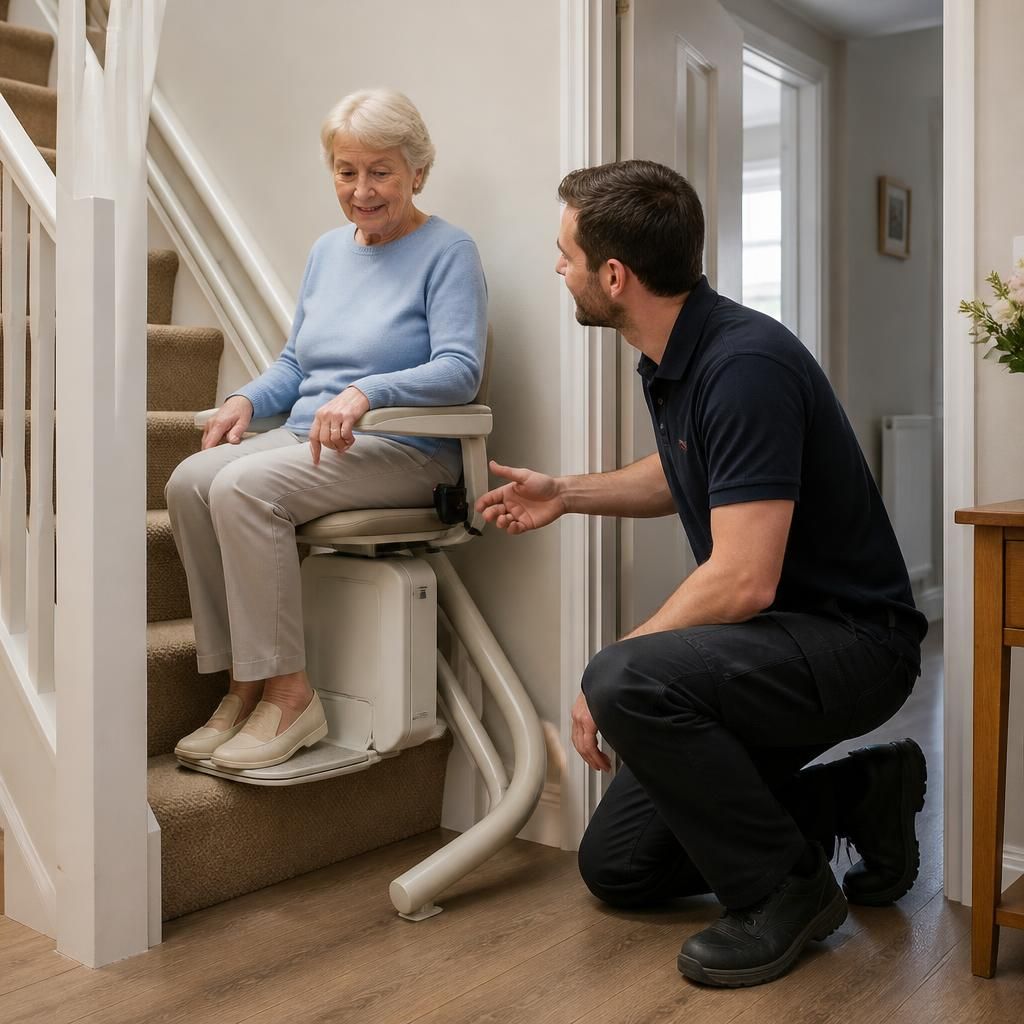
Arrange your bespoke stairlift assessment
Arrange a bespoke stairlift assessment with Independent Stairlifts to review your staircase, access requirements and the most suitable configuration for safe, comfortable use.