
How do I determine which stairlift features are necessary for my elderly parent’s needs? Choose features according to your parent’s mobility, balance, confidence and staircase, with an assessment helping identify practical options such as a swivel seat, powered footrest, safety sensors, adjustable controls or a suitable seat belt.
Choose stairlift features according to your parent’s mobility, balance, confidence and staircase layout. A professional assessment can identify practical options such as a swivel seat, powered footrest, safety sensors, adjustable controls and a suitable seat belt.
The necessary stairlift features depend on your parent’s mobility, balance, strength, confidence, ability to follow instructions and the layout of the staircase. A professional assessment should separate essential safety features from comfort or convenience options, then match the stairlift to how your parent will use it now and how their needs may change.
Start by considering the specific difficulties your parent has on the stairs. Someone who is unsteady when standing may need more support when getting on and off the stairlift, while someone with limited leg strength may benefit from powered controls that reduce the effort required. If they have arthritis, reduced grip or poor coordination, controls and safety equipment need to be usable without twisting, stretching or pressing small buttons.
Features commonly considered essential for safe use include:
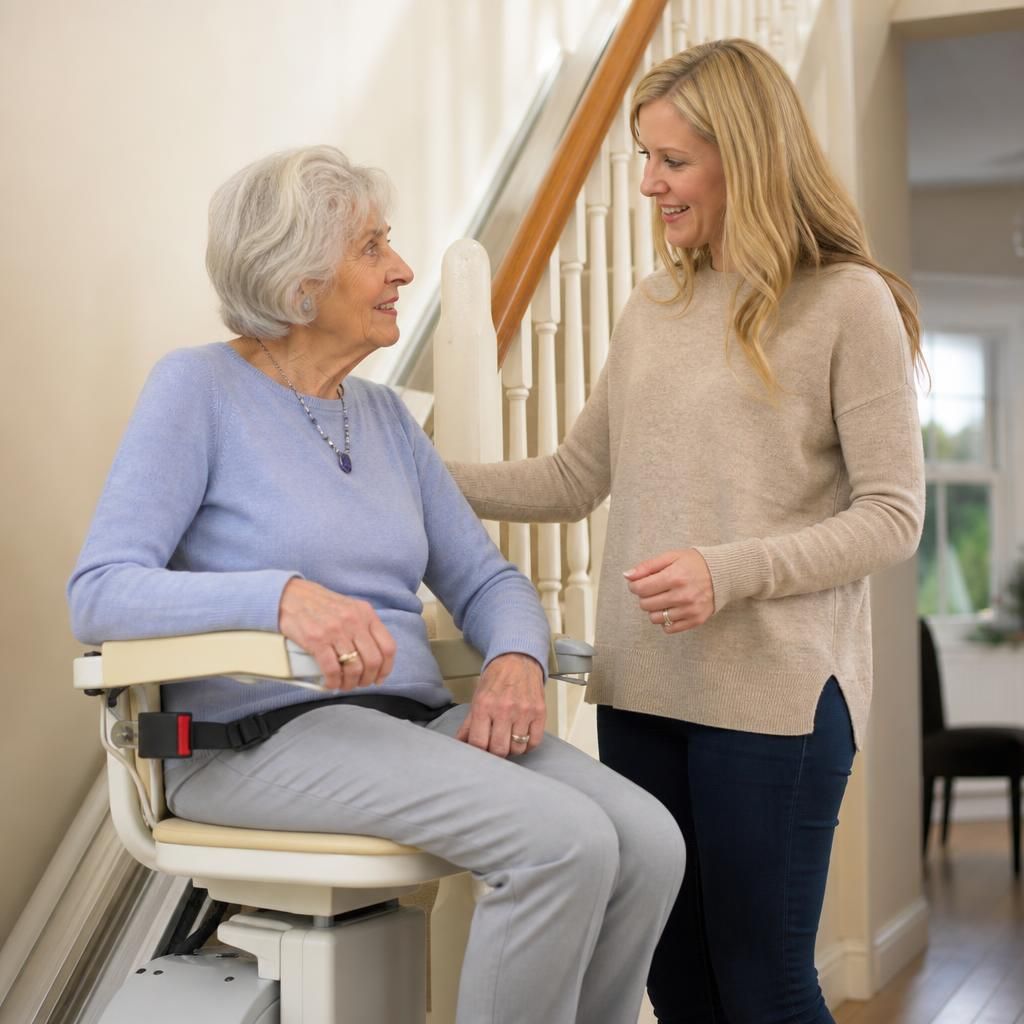
- A secure seat belt or harness: The appropriate restraint should be easy for your parent to fasten and release, while providing a secure seated position throughout the journey.
- Safety sensors: Sensors can stop the stairlift if the footrest, carriage or another part of the lift meets an obstruction. This is particularly important in busy hallways or homes where pets and household objects may be near the stairs.
- Reliable controls: Controls should be simple to understand and positioned where your parent can operate them comfortably. A joystick, button or remote control may be suitable depending on their hand strength, dexterity and eyesight.
- Swivel seat: A swivel seat can help your parent turn towards the landing before standing up, reducing the need to twist on the stairs. A powered swivel may be worth considering if they cannot safely operate a manual release or lack the strength to turn the seat themselves.
- Stable armrests and foot support: Properly positioned armrests help with posture and confidence, while a correctly sized footrest supports the feet and helps prevent them from catching on the steps.
- Emergency stop and diagnostic systems: These allow the stairlift to be stopped if your parent feels unsafe or something unexpected occurs. Fault indicators can also help identify when professional attention is needed.
The seat should be assessed carefully rather than chosen by appearance alone. Your parent should be able to sit upright without feeling cramped, and their knees and feet should remain comfortably supported. The seat height matters too: a seat that is too low may make standing difficult, while one that is too high may make getting on and off less stable. A firm, supportive seat can be helpful, but excessive cushioning is not always beneficial if it makes transfers harder.
For a parent with reduced balance, the position of the seat when it reaches the landing is especially important. A swivel seat, powered swivel or an alternative access arrangement may provide a safer transition. The assessment should also consider whether there is enough clear space at the top and bottom of the staircase for your parent to stand, turn and move away from the lift without obstruction.
Consider the controls in relation to your parent’s abilities. If they have weak hands, tremors, arthritis or reduced sensation, a control that requires sustained pressure may be unsuitable. If they have memory problems or impaired vision, controls should be clearly marked and consistent. Remote controls can allow the stairlift to be called to another floor, but they should complement rather than complicate the main controls. It is useful for your parent and regular carers to practise operating the lift during installation.
Powered features can reduce physical effort, but they are not automatically necessary for everyone. A powered footrest may be helpful when your parent cannot bend down easily or would struggle to fold a manual footrest. A powered swivel can assist with transfers. Hinged or folding rail arrangements may be important where the rail could obstruct a doorway, corridor or entrance at the bottom of the stairs. These options should be selected because they solve a particular access or handling problem, not simply because they are available.
The staircase itself determines which features are practical. A straight stairlift may be suitable for a single, uninterrupted flight, whereas a staircase with a landing, bend or change of direction may require a curved or bespoke system. Narrow stairs, doorways, radiators and limited landing space can affect the rail position, seat design and parking location. An outdoor staircase also requires equipment designed for exposure to weather, with suitable protection and safe access to the controls.
Think about how the stairlift will fit into the wider home. If other people need to use the stairs, a folding footrest, armrests or seat may help preserve usable space. If the lift parks near a doorway, a powered or hinged rail may reduce obstruction. If your parent spends time alone, reliable charging, clear fault indications and an accessible telephone or other means of requesting help should be considered as part of the overall arrangement.
Medical conditions can affect feature selection, but the stairlift is not a medical device assessment. Conditions such as stroke-related weakness, Parkinson’s disease, multiple sclerosis, arthritis, dementia or visual impairment may influence the choice of controls, seat, restraint and transfer support. The installer should be told about relevant limitations, including whether your parent can stand independently, turn safely, follow instructions and remain seated for the full journey. Where there are significant transfer or postural concerns, advice from an occupational therapist or other appropriate healthcare professional may also be useful.
It is equally important to consider future changes without over-specifying the equipment. A parent who currently manages a manual swivel or footrest may later find a powered option easier, but additional features cannot compensate for an unsuitable seat position, poor staircase access or an inability to transfer safely. Choose a system that provides an appropriate margin of support while remaining simple enough for your parent to use confidently.
A practical assessment should therefore cover:
- how your parent approaches, sits on and leaves the stairlift;
- their balance, leg strength, grip, reach, vision and ability to follow controls;
- the correct seat height, width, belt arrangement and foot support;
- the staircase width, curves, landings, obstructions and parking points;
- whether family members or carers also need to operate the lift;
- the need for powered, folding, hinged or weather-resistant components;
- what would happen if the stairlift stopped or your parent needed assistance; and
- how servicing, repairs and future adjustments will be managed.
Before installation, ask your parent to try the proposed controls and transfer movements where possible. Check that they can understand the instructions, fasten the restraint, position their feet and operate the stop control. Do not rely on an additional feature to resolve a fundamental safety issue: if your parent cannot transfer to the seat safely or remain seated securely, the stairlift arrangement needs further review.
The most suitable specification is the one that makes each stage of use manageable: approaching the lift, sitting down, fastening the restraint, travelling, arriving at the landing and standing up. Independent Stairlifts can use an assessment of your parent and the staircase to identify which features are necessary, which are optional and which configuration is safest for the home.
The necessary stairlift features are determined by how your parent approaches, uses and leaves the lift, rather than by the available options alone. Their balance, leg strength, grip, vision, confidence and ability to follow instructions should all be considered alongside the staircase layout.
A swivel seat may support safer transfers at the landing, while a powered swivel or powered footrest can reduce effort for someone with limited strength, arthritis or difficulty bending. Simple controls, a suitable seat belt, safety sensors, stable armrests and adequate foot support are fundamental considerations. Features such as remote controls, folding components or a hinged rail are only needed where they address a specific access or handling problem.
An assessment should also check that your parent can sit securely, operate the controls, remain seated during travel and stand safely at the destination. This helps separate essential safety features from optional conveniences and ensures the final specification remains practical for everyday use.
Arrange a personalised stairlift assessment
Arrange a personalised stairlift assessment with Independent Stairlifts to identify the features your parent needs for safe, comfortable everyday use. We can assess their mobility, the staircase and the practical requirements of the home before recommending a suitable solution.