
What should I do if my stairlift stops working unexpectedly?
If your stairlift stops unexpectedly, remain seated, switch it off, and check that the key, power supply, safety sensors and seat belt are correctly positioned. If it does not restart, avoid forcing the controls or attempting a repair; contact Independent Stairlifts for professional advice and assistance.
If your stairlift stops working unexpectedly, remain seated if it is safe to do so, keep your seat belt fastened, switch the stairlift off and carry out only the basic checks described in your user instructions. Do not force the controls, attempt to bypass a safety feature or dismantle the lift. If it does not restart promptly, contact Independent Stairlifts for professional advice and repair.
What to do immediately
- Stay calm and remain in the seat. Do not try to climb off on the stairs unless there is an immediate risk and you can do so safely with assistance.
- Keep your seat belt fastened and sit centrally, with your arms and feet clear of the moving parts.
- Release the control and switch the stairlift off using the normal power switch or key, if fitted. Wait briefly before switching it back on.
- Check that the control is being used correctly and that the key is inserted and turned to the operating position. If your stairlift has controls on both arms or a remote control, try only the control specified in your user instructions.
Basic checks you can make safely
A stairlift may stop because a safety sensor has detected an obstruction or because it is not in a position that permits movement. Without reaching underneath the carriage or putting your hands near the track, look for obvious items blocking the footrest, seat, arms, track or the area at the top and bottom of the stairs. Remove an obstruction only if it is clearly accessible and safe to do so.
Check that the seat is fully in its travelling position and, where applicable, that it is locked correctly. Some models will not move if the seat is swivelled, an armrest is raised or the footrest sensor is activated. Make sure the seat belt is fastened as required by your model. Never tape down, hold open or otherwise defeat a sensor, switch or interlock.
If the stairlift has stopped at a charging point, check whether the power indicator is showing and whether the mains supply to the stairlift appears to be switched on. You can check an accessible plug, fused spur or switch if you know where it is and can reach it safely, but do not remove covers or investigate wiring. A lift that has been left away from its charging point may have a depleted battery, particularly if it has not been used for some time. Return it to a charging point only if it can move normally and there is no obstruction or warning indication.
When not to continue troubleshooting
Stop using the stairlift and arrange professional assistance if it remains stationary, makes an unusual noise, moves jerkily, stops repeatedly, displays a fault light or code, smells of burning, shows signs of damaged wiring or has been affected by water. Do not repeatedly operate the control in the hope that the fault will clear. Continued use can make a mechanical or electrical problem worse and may compromise safe operation.
Do not attempt to repair the motor, batteries, circuit board, track, safety switches or wiring yourself. Do not use a household charger, replacement part or lubricant unless it is specifically approved for your stairlift and fitted in accordance with the manufacturer’s instructions. A stairlift can appear to have a minor fault while a safety component is preventing movement for a valid reason.
If you are left on the stairs
If you are unable to move safely, use a telephone, pendant alarm or other available method to contact someone in the home or a responsible carer. If you have a serious medical problem, are at immediate risk or cannot remain safely seated, call the emergency services. Avoid asking an untrained person to pull or carry you from the stairlift, as this can cause injury to both of you.
What to tell the service team
When you contact Independent Stairlifts, explain where the lift stopped, whether it was travelling up or down, what happened immediately beforehand and whether there were any lights, sounds, warning tones or displayed codes. It is also useful to provide the stairlift model if known, whether the power indicator is on, whether the lift has recently been serviced or moved, and whether there has been a power cut, water exposure or impact.
Do not rely on the stairlift again until the cause has been assessed if the fault cannot be resolved by the basic checks. A professional can inspect the safety circuits, batteries, charging system, drive mechanism, controls and track, then confirm whether the lift is safe to return to service. Keep the user manual and any previous service information available, as these can help identify the correct procedure for your particular model.
If your stairlift stops unexpectedly, remain seated with the seat belt fastened if it is safe to do so, and switch the lift off. Check only the basics covered in your user instructions, such as the key, power supply, seat position and visible obstructions around the footrest or track. Never force the controls, bypass a safety sensor or dismantle any part of the lift.
If it still will not move, or if you notice unusual noise, burning smells, damaged wiring, fault indicators or repeated stopping, stop using it and contact Independent Stairlifts for professional assistance. If you are stranded and cannot remain safe, use a telephone or alarm to call for help; call the emergency services if there is an immediate risk to your health or safety.
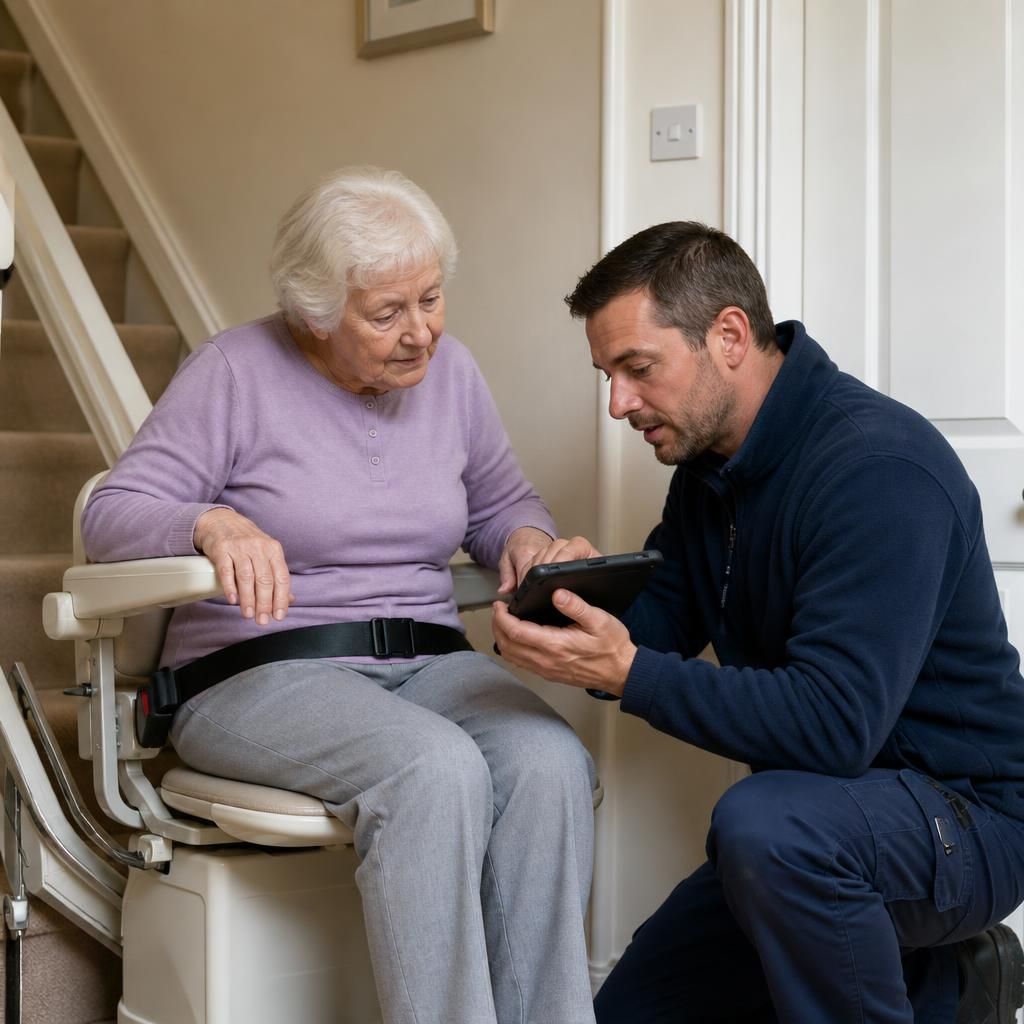
Get Professional Help With Your Stairlift Repair
If your stairlift is still not working after the basic checks, contact Independent Stairlifts to arrange professional stairlift repair and advice. Do not use the lift again until it has been assessed as safe.