
What factors should I consider when choosing between a straight or curved stairlift for my home?
Choose a straight stairlift when your stairs follow one continuous flight, while a curved stairlift is designed for stairs with bends, landings or multiple sections. The key factors are your staircase layout, available space, user comfort and safety, budget, and whether a bespoke rail is needed; a home assessment will confirm the most suitable option.
A straight stairlift is generally suitable for a staircase that runs in one uninterrupted line from one floor to the next. A curved stairlift is made for stairs with bends, intermediate landings, changes of direction or multiple flights. The right choice depends primarily on the shape of your staircase, followed by available space, the user’s mobility and comfort needs, safety, budget and the extent of installation work required. A home assessment is the most reliable way to confirm which solution will fit safely and operate effectively.
Start with the staircase layout
Examine whether the stairs form a single straight flight or whether the route includes a corner, curve, half-landing, split-level section or more than one flight. A straight stairlift travels along a standard rail fixed beside the steps and is usually the simpler option where the staircase has no change in direction. A curved stairlift uses a rail designed to follow the staircase’s individual shape, allowing the seat to travel around bends and between sections.
It is not always possible to decide from photographs alone. Features such as a small turn at the top or bottom, a narrow landing, a doorway close to the stairs or an unusual stair profile can affect the design. The rail may need to finish in a particular position so that the user can get on and off safely without obstructing a passage or doorway.
Consider the available space
The width of the stairs is important, but it is not the only measurement that matters. The assessment should also consider:
- Whether there is enough room for the user to sit comfortably without their knees or feet coming too close to the wall or bannister.
- How much landing space is available at the top and bottom for safe transfers.
- Whether doors, radiators, furniture or other household features could interfere with the stairlift or its parking position.
- Whether the stairlift can be parked away from a doorway or narrow walkway when it is not in use.
- Whether the stairs have unusual dimensions, such as tapered or winders steps, which may require a bespoke curved rail.
A curved rail can be planned to suit the available space and may offer a practical route on a more complex staircase. However, the final design must allow the user to approach, travel and leave the stairlift without twisting awkwardly or standing in an unsafe position.
Match the stairlift to the user
The user’s physical abilities and daily routine should guide the choice as much as the staircase itself. Consider whether they can transfer on to the seat independently, sit upright for the journey, operate the controls and turn safely at the top and bottom. If they have restricted movement, poor balance, joint pain or difficulty bending their knees, seat height, armrest position, footrest design and swivel-seat operation may be particularly important.
For someone who needs to use the stairlift while carrying a walking aid, a suitable parking arrangement and a safe method of handling the aid should be discussed. A stairlift is intended to carry the seated user, not loose household items, so bags and other objects must not obstruct the controls, seat belt or travel path.
Where more than one person will use the stairlift, check that the chosen configuration suits the different users. This may affect the seat style, control position, weight capacity, swivel mechanism and whether a powered or manually operated feature is appropriate. Comfort should be assessed in the actual home rather than judged by appearance alone.
Compare safety and ease of use
Both straight and curved stairlifts should include safety features appropriate to the model and installation. These commonly include a seat belt, sensors that stop the lift if an obstruction is detected, controls that can be used from the seat and charging arrangements that allow the stairlift to remain ready for use. The installer should explain each feature and demonstrate normal operation before completion.
Curved stairlifts require particular attention to the points where the rail changes direction. The user should be able to remain stable and comfortable as the seat follows the curve. A powered swivel seat, powered footrest or other adjustment may be useful for some users, although the best choice depends on their ability to operate it safely. Straight stairlifts may involve a simpler journey, but they still need sufficient clearance and a safe transfer area at each end.
Controls should be positioned where the user can reach them without leaning across the stairlift. Remote controls can allow the lift to be called to another level, which may be useful in a shared household. Ask how the stairlift can be stopped in an emergency, how it behaves during a power cut and what routine checks the user should carry out.
Understand the cost and installation implications
A straight stairlift is normally less complex to manufacture and install because its rail follows one continuous line. A curved stairlift is designed specifically for the individual staircase, so its bespoke rail and additional design work generally make it the more involved and costly option. The exact price depends on the staircase, chosen features, condition of the installation area and whether any additional work is needed.
Do not choose solely on the initial price. A straight lift may appear suitable, but it will not provide a complete solution if the stairs turn or include a landing. Conversely, a curved installation may offer the most practical long-term arrangement where it allows the user to reach all required levels without transferring between separate lifts. Discuss whether a new, reconditioned or alternative configuration is appropriate for the home and the intended period of use.
Installation usually involves fixing the rail to the stairs rather than relying on the wall, although the precise method depends on the system and site conditions. The assessment should identify access requirements, electrical arrangements, parking positions and any potential disruption. Most work is carried out within the stair area, but household members should know when access to the stairs will be restricted and whether furniture or personal items need to be moved.
Think about the longer-term arrangement
Consider how the user’s needs may change. A design that is manageable now may become less suitable if transferring, standing or bending becomes more difficult. Features such as a powered swivel seat, adjustable controls or a folding mechanism can support continued use, but they should only be selected if the user can operate them reliably.
Also consider other people in the home. The stairlift should leave sufficient space for others to use the stairs where possible and should be parked so that it does not unnecessarily block a landing, doorway or escape route. If the staircase is shared or particularly narrow, a folded seat and footrest may help preserve usable space, but this must be checked against the user’s needs.
What the home assessment should confirm
A proper assessment should review the full route rather than just the stair width. It should confirm:
- Whether the staircase is suitable for a straight rail or requires a curved design.
- Where the stairlift will start and finish, including safe transfer positions.
- How the rail will follow corners, landings and changes in direction.
- Clearance for the user, other household members and nearby doors or fixtures.
- The most suitable seat, controls, belt and optional powered features.
- Where the lift will park and how it will charge.
- Any installation limitations, access arrangements or changes needed before fitting.
Before agreeing to an installation, ask for the proposed route to be explained in practical terms. You should know where you will sit, how you will turn or leave the seat at each end, what happens if the lift stops and who to contact for servicing or repairs. The final recommendation should be based on safe access throughout the home, not simply on whether the rail can be attached to the stairs.
In summary, choose a straight stairlift for a straightforward, single-flight staircase when it provides adequate clearance and safe transfers. Choose a curved stairlift when the route includes bends, landings or several sections, or when a bespoke rail is needed to make the whole staircase accessible. If the layout or the user’s mobility makes the choice unclear, an individual assessment will establish the safest and most practical solution.
The staircase layout is the main factor when choosing between a straight and curved stairlift. A straight stairlift is usually suitable for one uninterrupted flight, while a curved stairlift is designed to follow bends, landings, winders or several connected flights. A home assessment will also check clearances, doorways, transfer areas and the user’s comfort, so the recommended option fits both the staircase and the person using it.
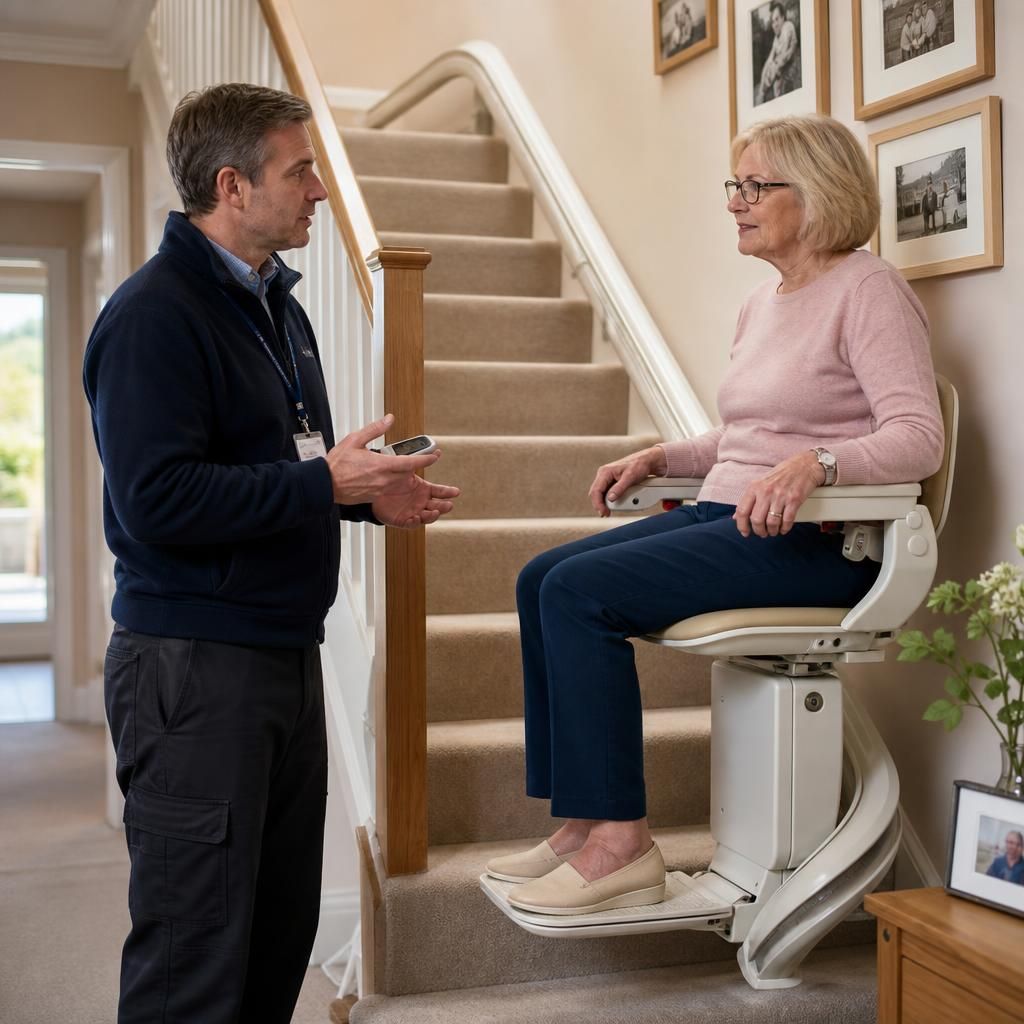
Book Your Stairlift Home Assessment
Book your stairlift home assessment to confirm whether a straight or curved stairlift is suitable for your staircase, space and mobility needs. Our adviser will explain the proposed design, transfer points and installation requirements before you decide.