
What should I consider when comparing the cost of straight stairlifts versus curved stairlifts?
Straight stairlifts generally cost less because they use standard rails, while curved stairlifts require a bespoke rail designed around your staircase. When comparing prices, consider the staircase layout, installation requirements, seat and safety features, and whether a reconditioned option is suitable, rather than comparing the lift price alone.
Straight stairlifts usually cost less than curved stairlifts because they use a standard rail fitted to one uninterrupted flight of stairs. Curved stairlifts require a rail made to follow the exact shape of your staircase, including bends, landings, intermediate floors or changes in direction. The most useful comparison is therefore the complete installed solution, not the price of the stairlift unit alone.
Staircase layout is the main cost difference. A straight stairlift is generally suitable where the stairs run directly from one floor to another without a turn or landing interrupting the route. The rail is measured and cut to the required length, although the staircase still needs to be assessed for available width, obstructions and safe access at the top and bottom.
A curved stairlift is designed for a staircase with one or more bends, a half or quarter landing, multiple flights, or a change in direction. Its rail is manufactured to suit the individual staircase. The more complex the route, the more detailed the design and installation process may be. A curved stairlift can sometimes be the most practical option where a straight model would stop short of the required floor or would leave the user needing to transfer between flights.
Compare what is included in each quotation. Stairlift prices may be presented as a product price, an installation price, or a combined package. Check whether the quotation includes the survey, bespoke rail, fitting, delivery, removal of an existing lift, commissioning and an explanation of how to use the equipment. A lower initial price may not represent better value if essential work or equipment is excluded.
- The stairlift and rail: confirm whether the price covers the complete rail system and the appropriate seat, controls and charging equipment.
- Installation: ask whether fitting, testing and adjustment are included, and whether any unusual access or fixing requirements could affect the cost.
- Electrical work: most stairlifts use a standard domestic power supply, but the installer should identify any requirement for additional work during the assessment.
- Removal or alterations: establish whether removing an old stairlift, adjusting a handrail or dealing with an obstruction is included.
- Aftercare: check the warranty, servicing arrangements, breakdown support and any ongoing charges.
Installation conditions can affect either type of stairlift. Stairlifts are normally fixed to the stair treads or other suitable structural points rather than to the wall. However, narrow stairs, unusual tread shapes, limited space at the top or bottom, doorways, radiators and internal doors can affect the design and fitting process. A curved installation may require careful parking positions so the seat does not obstruct a landing or doorway. A straight installation may also need a hinged, sliding or shortened rail where there is limited space near the bottom of the stairs.
Features should be compared on suitability rather than price alone. Both straight and curved models may be available with options such as powered swivel seats, powered footrests, folding rails, alternative controls, adjustable seat heights and different upholstery choices. These features can increase the purchase price, but they may be important if you have limited flexibility, reduced balance or difficulty standing safely at the top or bottom of the stairs. A manual feature may be adequate for one user, while a powered option may be more appropriate for another.
Consider how the lift will be used every day. For example, a powered swivel seat may make transferring easier, while a folding or hinged rail may help maintain access to a doorway or walkway. On a curved staircase, the rail design and seat position may also affect how comfortably you travel around bends. Ask for the options to be assessed in relation to your mobility and the layout of your home, rather than selecting features simply because they are available.
Reconditioned options can change the price comparison. A reconditioned straight stairlift may be suitable where the staircase matches a standard rail design and the model meets your needs. Some components may be reused, which can make this option more economical. A reconditioned curved stairlift needs closer consideration because the rail is made for a particular staircase. In some cases, the existing rail may be suitable for reuse in the same home, but a curved rail cannot normally be treated as a universal component for a different layout. Confirm the condition, warranty, compatibility, installation scope and future servicing arrangements before making a decision.
Do not overlook the longer-term cost. Ask about battery replacement, routine servicing, warranty coverage and the cost of call-outs after the warranty period. The purchase price is only one part of the overall cost of ownership. A model that is well matched to the user, correctly installed and supported with appropriate maintenance may be more practical than the cheapest available option, particularly if it will be used frequently.
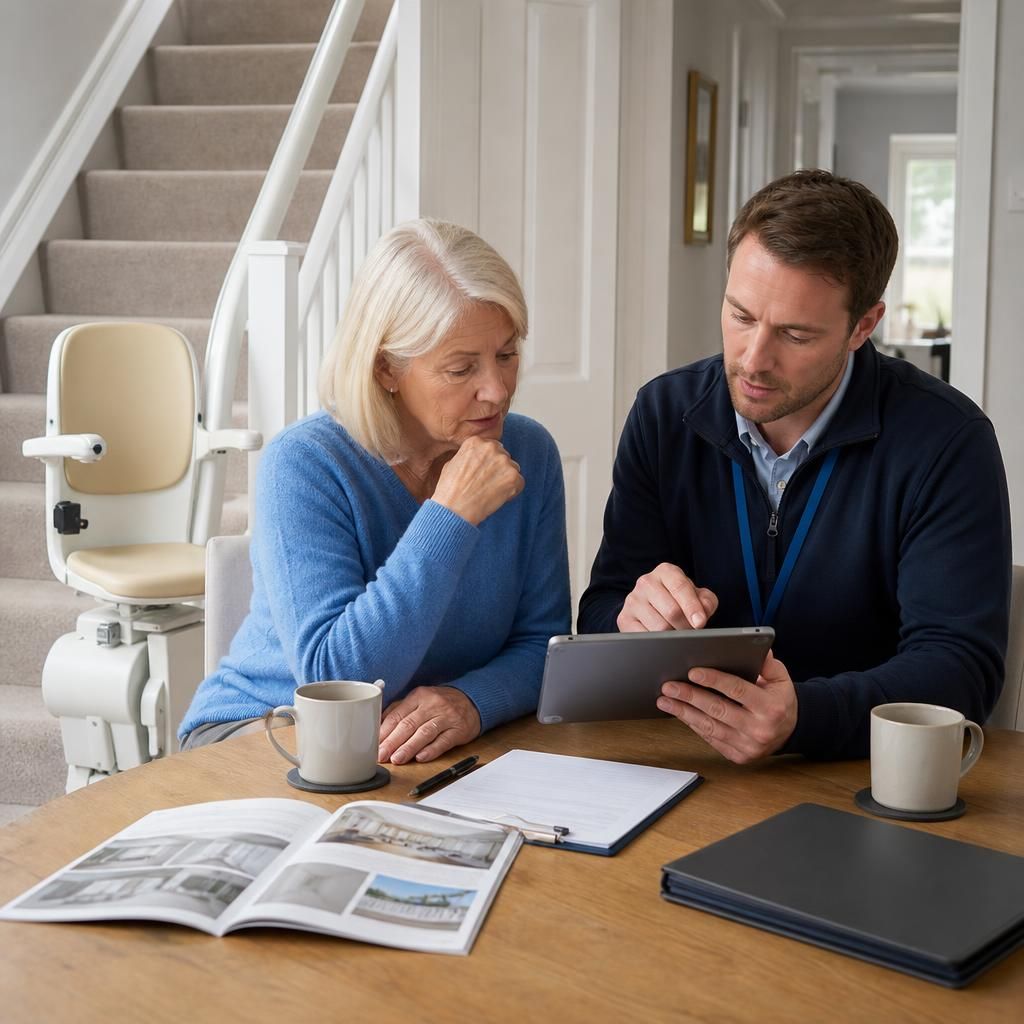
A home assessment is the most reliable way to compare like for like. During an assessment, the staircase can be measured, the route considered and any safety or access issues identified. The assessor can confirm whether a straight stairlift is appropriate or whether a curved design is needed, and can explain where different seat or rail options would affect the quotation. This also provides an opportunity to discuss who will use the lift, how often it will be used and whether other household members need the stairs to remain accessible.
Before accepting a quotation, ask for a clear written breakdown and check the following:
- which type of stairlift has been recommended and why;
- whether the rail is standard or bespoke;
- what installation work and adjustments are included;
- which features are essential and which are optional;
- whether the equipment is new or reconditioned;
- what warranty and servicing support are provided; and
- whether there could be additional charges if the staircase or access conditions are more complex than expected.
In general, a straight stairlift is likely to be the more economical choice when the staircase is a simple, uninterrupted flight and a standard design meets the user’s needs. A curved stairlift usually costs more because its rail and installation are bespoke, but it may provide a continuous and safer route on a more complicated staircase. The right comparison is the total cost of a suitable, properly installed system, including the features and aftercare needed for dependable everyday use.
The main cost difference between a straight and curved stairlift is the rail: a straight stairlift uses a standard rail for one uninterrupted flight, while a curved stairlift has a bespoke rail manufactured to follow the exact shape of the staircase. This means a curved model usually costs more, particularly where the route includes bends, landings or multiple flights.
When comparing quotations, look beyond the stairlift unit price. Check whether the total includes the survey, rail, installation, testing, delivery, removal of an existing lift and any required adjustments around doorways or landings. Also compare the seat and safety features, warranty, servicing and breakdown support. A straight stairlift may be the more economical option on a simple staircase, but a curved model can provide a continuous route where transferring between flights would be difficult or unsafe.
Compare Your Straight or Curved Stairlift Options
Arrange a home assessment to compare a straight or curved stairlift based on your staircase, mobility needs and the full installed cost. We can explain the available options and provide a clear quotation for a suitable solution.