
What are the key considerations when choosing between a new and a reconditioned stairlift?
Choosing between a new and reconditioned stairlift depends on your budget, stairway layout, required features, and the level of warranty and support you want. A new stairlift offers the latest model and configuration options, while a professionally reconditioned lift can provide reliable operation at a lower cost when its condition, safety checks, warranty and suitability have been properly assessed.
Choosing between a new and a reconditioned stairlift involves more than comparing the purchase prices. The right option depends on the stairway layout, the user’s mobility needs, the lift’s condition, the warranty and aftercare provided, and whether the equipment can be installed safely and comfortably in the home. A new stairlift generally offers the widest choice of models and features, while a professionally reconditioned stairlift may provide suitable, reliable assistance at a lower initial cost.
Compare the total value, not only the initial price
A reconditioned stairlift is previously used equipment that has been inspected, cleaned, tested and, where necessary, repaired or fitted with replacement components. Its lower price can make it appropriate where budget is a major consideration, particularly if the stairlift is needed for a straightforward staircase and the available model meets the user’s requirements.
A new stairlift normally costs more because it is supplied as unused equipment and can be configured for the individual installation. The price may include options that are not available on every reconditioned model, as well as the benefit of having the manufacturer’s current specification and a new-equipment warranty. Ask what is included in each quotation, including the survey, fitting, removal of old equipment, warranty cover and future servicing, so that you are comparing like for like.
Check suitability for the staircase
The layout of the stairs is one of the most important considerations. A straight staircase may accommodate a wider range of standard solutions, whereas a curved staircase usually requires a rail made to follow its bends, landings and changes in direction. New equipment may offer more flexibility where the rail or seating position needs to be tailored closely to the home.
A reconditioned stairlift can still be suitable for many staircases, but the available configuration must be checked carefully. In some cases, a reconditioned unit may be paired with a suitable rail; in others, the existing rail may be reusable only if it is compatible and in appropriate condition. A professional home assessment should confirm the measurements, clearances, parking position and whether the lift will allow other people to use the stairs safely.
Consider the user’s mobility and comfort
The stairlift should match the person using it, rather than being selected solely because it is the least expensive option. Important points include the user’s weight and height, ability to transfer on and off the seat, knee and hip movement, balance, grip strength and whether their needs are likely to change.
Consider the seat dimensions, armrest support, footrest design, swivel mechanism, controls and seatbelt. A powered swivel seat, folding or powered footrest, alternative controls or a different seat style may improve independence, but these features are not available on every reconditioned lift. If the user has a progressive condition or expects to use the stairlift regularly for many years, the adjustability and long-term suitability of a new model may justify its higher cost.
Examine the condition and history of a reconditioned lift
Do not assume that all reconditioned stairlifts have the same standard. Ask what inspection and refurbishment work has been completed, which parts have been replaced, and whether the battery, charger, drive system, controls, sensors and safety mechanisms have been tested. It is also useful to establish the approximate age of the equipment and whether replacement parts and batteries remain readily available.
The appearance of a stairlift is less important than its mechanical and electrical condition. Cosmetic marks may be acceptable if the lift operates correctly, but unusual noise, jerky movement, unreliable charging, loose components or intermittent controls should be investigated before installation. The installer should explain any limitations of the equipment clearly and confirm that it is appropriate for the intended user and staircase.
Compare warranties and aftercare
Warranty terms can differ substantially between new and reconditioned stairlifts. Check the length of cover, which components are included, whether labour and call-outs are covered, and whether exclusions apply to batteries, accidental damage or misuse. A warranty is only useful if you understand who provides it and how to request support.
Ask about servicing, fault response, battery replacement and the availability of parts. A reconditioned stairlift from an experienced installer should still be supported with appropriate testing, installation guidance and aftercare. If the equipment is older or has a less common specification, confirm that servicing can be provided for as long as the lift is expected to be used.
Give safety and installation quality priority
Both new and reconditioned stairlifts should be installed by a suitably trained professional and checked before they are handed over. The assessment should consider the condition of the stairs and fixings, the position of the lift when parked, possible obstructions, access to controls and the user’s ability to use the seatbelt and operate the controls.
After installation, the user should receive a clear demonstration of normal operation, charging, emergency procedures and what to do if the stairlift stops. Do not buy a used lift privately without establishing its history, compatibility, safety condition and access to professional installation and support. Equipment that appears inexpensive may become less economical if it needs extensive remedial work or cannot be supported with suitable parts.
Think about the expected length of use
If the stairlift is needed for a temporary period, a reconditioned option may offer practical value, provided it is safe and properly supported. If it is likely to be used frequently over an extended period, compare the expected maintenance needs and remaining service life with the additional cost of new equipment.
It is also worth considering whether the stairlift may need to be removed or adapted later. A home assessment can identify installation arrangements that minimise disruption and clarify what happens if the lift is no longer required. Ask whether removal is included in the agreement and whether any part of the equipment can be reused.
Use the home assessment to make the decision
A home assessment provides the information needed to make a fair comparison. It should cover the staircase, the user’s physical requirements, available parking spaces, electrical supply, suitable model types, optional features, installation work and aftercare. Discuss any concerns openly, including difficulty standing, discomfort when seated, fear of transferring at the top or bottom of the stairs, and the possibility that another person may need to use the staircase at the same time.
Choose a new stairlift when you need a specific configuration, the latest features, maximum choice or a longer period of predictable support. Choose a reconditioned stairlift when a suitable model is available, its condition and history are clear, the warranty is adequate and the installation meets the user’s needs. In either case, the safest decision is based on a professional assessment and the complete cost and support package, rather than the equipment’s headline price alone.
A reconditioned stairlift should be assessed by its condition, safety checks and support package rather than its appearance or lower purchase price. Before agreeing to installation, ask what inspection and refurbishment work has been completed and whether the battery, charger, drive system, controls and safety features have been tested.
Also confirm the lift’s approximate age, parts availability and warranty terms. Check whether the warranty includes labour and call-outs, and ask how servicing and faults will be handled. A professional home assessment should verify that the stairlift is compatible with the staircase and comfortable for the intended user.
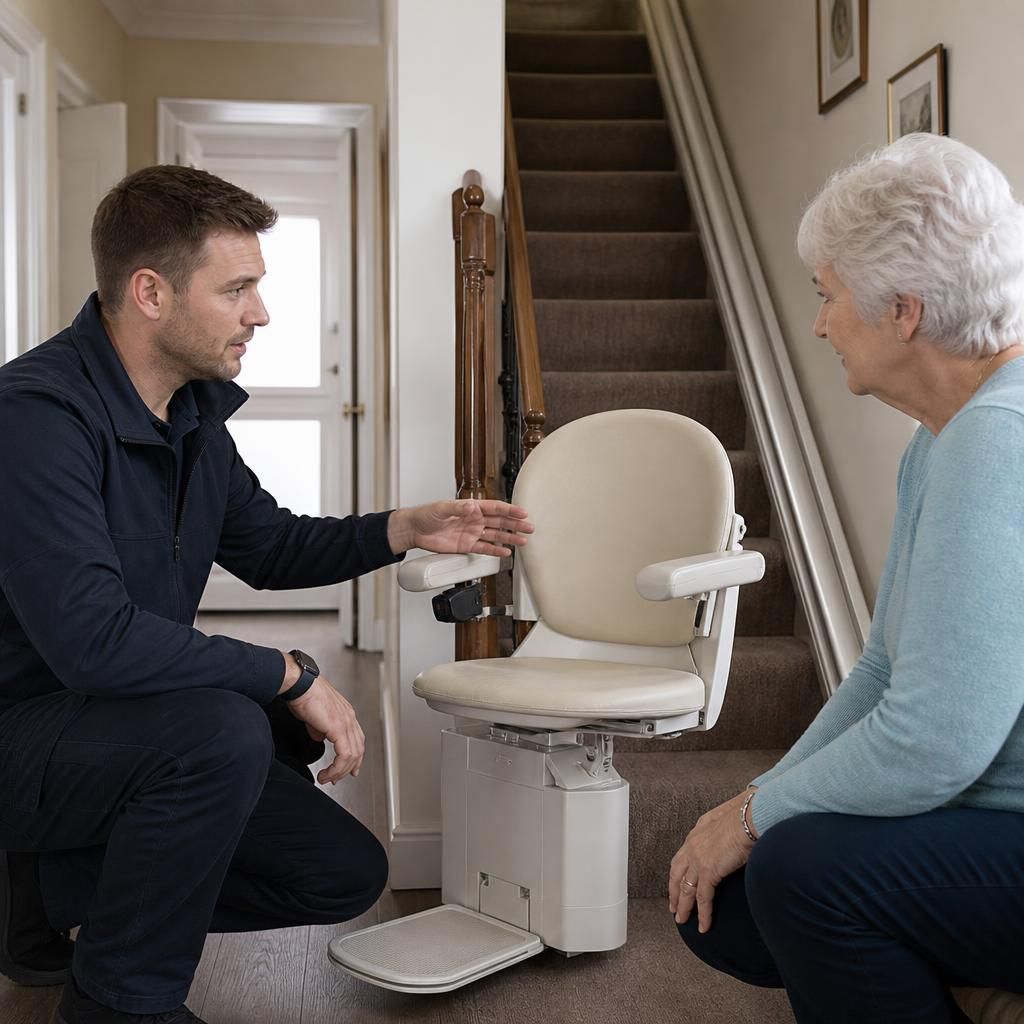
Arrange a home assessment to compare your stairlift options
Arrange a home assessment to compare new and reconditioned stairlift options for your staircase, mobility needs and budget. We can explain the condition, warranty, installation and aftercare included with each suitable option.