
How do you determine which stairlift model is best for an elderly user?
The best stairlift for an elderly user is determined by the staircase layout, the user’s mobility and posture, and the features needed for safe, comfortable daily use. A professional home assessment can compare suitable straight, curved, outdoor or reconditioned models and recommend the safest practical option.
The best stairlift model for an elderly user is the one that matches the staircase, the user’s physical needs and the way the lift will be used each day. A professional assessment should consider whether a straight, curved, outdoor or reconditioned stairlift is appropriate, then specify the seat, controls and safety features that provide a secure and comfortable fit.
There is no single stairlift model that suits every senior user. Two homes may have similar-looking staircases, while the people using them have very different levels of balance, strength, flexibility and confidence. The right choice therefore comes from assessing both the installation environment and the individual user.
Start with the staircase layout
The shape and condition of the staircase determine which type of stairlift can be installed:
- Straight stairlifts are designed for staircases that run directly from one floor to another without bends, landings or intermediate sections. They are usually the simplest option where the rail can follow a continuous straight flight.
- Curved stairlifts are made for staircases with bends, turns, half-landings, multiple flights or unusual layouts. The rail is manufactured to follow the individual staircase, allowing the user to travel between the required levels.
- Outdoor stairlifts are designed for external steps, such as access to a garden, driveway or split-level entrance. They need materials and finishes that can withstand exposure to weather, as well as suitable protection when not in use.
- Reconditioned stairlifts can be considered where a suitable pre-owned model is available and the specification meets the user’s needs. The equipment should be professionally checked, refurbished where necessary and installed with the appropriate warranty and aftercare.
A home assessment also checks the width and condition of the stairs, available space at the top and bottom, doorways, radiator positions, handrails and any obstruction affecting safe boarding or dismounting. On a narrow or complex staircase, the most suitable design may include a compact seat, a rail that parks away from a landing, or a hinged rail where the track could otherwise interfere with a doorway or walkway.
Assess the user’s mobility and posture
The user’s physical ability is just as important as the staircase. An adviser should consider whether the user can sit down and stand up independently, maintain an upright posture, bend the knees comfortably and operate the controls. It is also important to discuss any difficulty with balance, grip, vision, memory or coordination.
Someone who has good mobility but struggles with stairs may be comfortable using a standard seated stairlift. A user with limited hip or knee movement may need a seat that supports a more upright position, a powered swivel seat or additional support when getting on and off. If the user has difficulty transferring from a wheelchair or walking frame, the boarding position and space around the stairlift require particular attention.
Health conditions can change over time, so the assessment should not only reflect what the user can manage on the day. Consider whether the design will remain practical if strength, balance or flexibility decline. The user’s clinician or occupational therapist may also be able to advise on seating posture and transfers where there are more complex mobility needs.
Choose seating and controls for everyday use
Comfort and ease of operation affect whether a stairlift is used confidently and consistently. Important points include:
- Seat size and support: the seat should provide stable support without making it difficult to clear the arms or transfer safely. The backrest, armrests and footrest should suit the user’s posture.
- Swivel seat: a manual or powered swivel can turn the seat towards the landing, helping the user get on and off without twisting on the stairs. The best option depends on the user’s strength and ability to operate the mechanism.
- Seat height: the user should be able to sit down and stand up without excessive effort. A seat that is too low or too high can make transfers less secure.
- Controls: the handset or armrest control should be easy to see, reach and operate. Large, clearly marked controls can help users with reduced dexterity or vision.
- Remote controls: these allow the stairlift to be called to another floor. They can be useful where more than one person uses the lift, but they should be positioned where they are easy to find and use.
- Footrest and armrests: these should provide adequate support and fold or move in a way that does not create an obstacle when the lift is parked.
The user should try the proposed seating position and controls before installation where possible. A model can be technically suitable but still uncomfortable if the seat height, armrest position or transfer arrangement is wrong.
Check essential safety features
Safety features should support safe boarding, travel and dismounting rather than replace good positioning and supervision where needed. Depending on the model and staircase, relevant features may include a seat belt, swivel and locking seat, sensors that stop the lift if an obstruction is detected, a secure footrest and battery backup for use during a power cut.
The stairlift should stop at the correct boarding and exit points, and its controls should prevent accidental operation where appropriate. Safety edges and obstruction sensors need to be kept clear, while the user should understand how to fasten the belt, stop the lift and contact the service team if a fault occurs.
For a user with memory problems, poor vision or reduced dexterity, simplicity is especially important. Too many controls or complicated procedures can increase the risk of incorrect use. The installer should demonstrate the equipment clearly and confirm that the user and anyone supporting them understand its operation.
Consider the user’s routine and the home environment
The best model should fit the way the user moves around the home. Consider whether the stairlift will be used throughout the day, whether another person needs to use the stairs normally, and where the lift can be parked without blocking a landing, door or escape route. A foldable seat, arms and footrest may be useful when the staircase is also a main passageway.
Temperature, damp and exposure must be considered for external installations. For indoor staircases, lighting, flooring and the position of nearby furniture can affect safe transfers. If the user uses a walking aid, there should be a practical place to leave it at the top and bottom of the stairs without creating a trip hazard.
Compare new and reconditioned options carefully
A reconditioned stairlift may be suitable when the model, condition and specification match the user and the staircase. It can be particularly practical for a straightforward layout, provided the equipment has been inspected and prepared by a competent provider. Curved reconditioned options may be less readily available because their rails are made for specific staircases, so a new bespoke rail may be necessary.
When comparing a reconditioned model, ask what work has been completed, whether batteries and safety-critical parts have been checked, what warranty is included and what service support is available. The lowest initial price is not necessarily the best value if the seat, controls or installation do not suit the user.
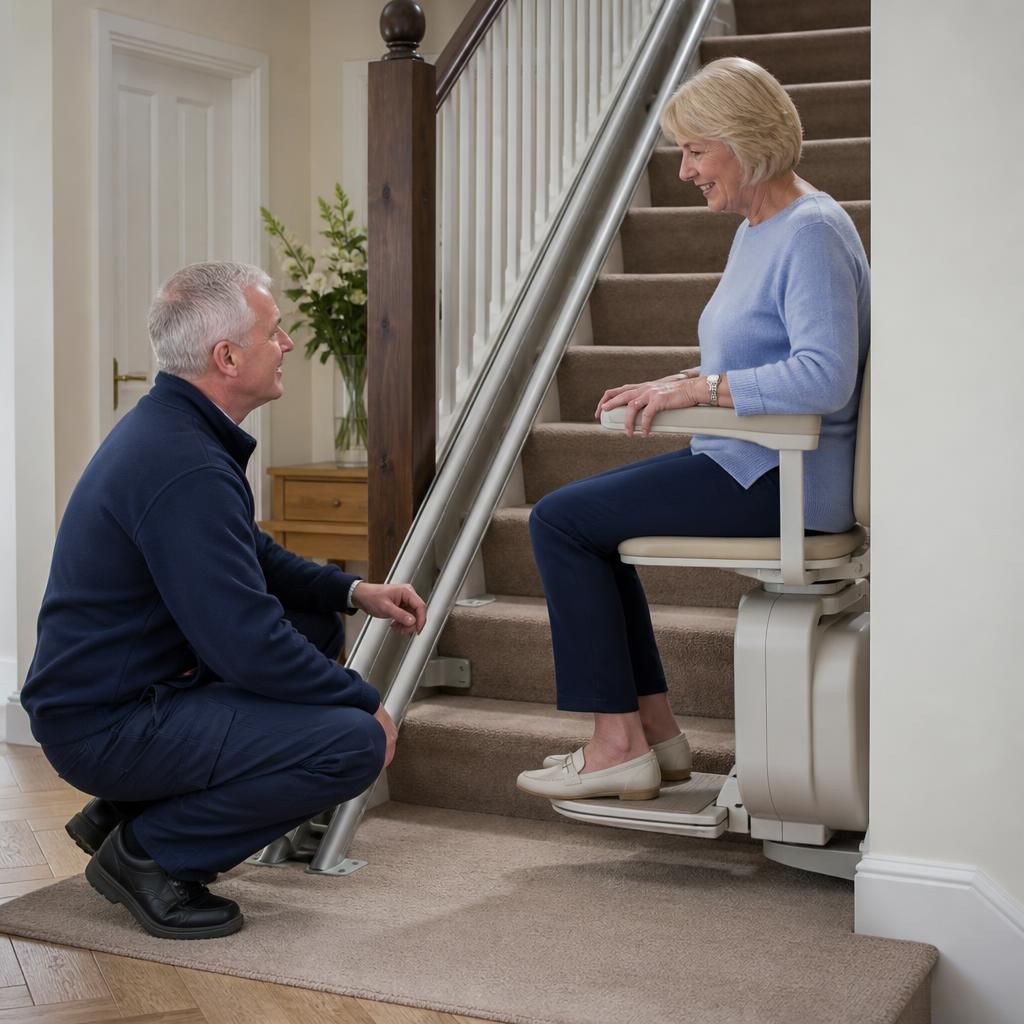
Use a professional home assessment to make the final decision
- Measure and inspect the staircase, landings, access points and surrounding space.
- Discuss the user’s mobility, posture, transfer ability, daily routine and likely future needs.
- Compare suitable stairlift types and seating configurations rather than choosing by appearance alone.
- Check operation, boarding and dismounting positions, safety features and ease of control.
- Confirm installation requirements, aftercare, servicing arrangements and warranty terms.
The recommendation should explain why a particular model and configuration has been selected, including any limitations or adaptations needed. If the user’s condition is changing or their needs are complex, it may be helpful to involve a family member, carer or occupational therapist in the assessment.
In practice, the best stairlift is not necessarily the most advanced or expensive model. It is the model that allows the elderly user to board, travel and leave the seat safely, fits the staircase without obstructing the home, and remains straightforward to use every day. An individual assessment provides the most reliable way to balance safety, comfort, accessibility and cost.
The best stairlift model for an elderly user is the one that matches both the staircase and the user’s ability to sit, transfer, operate controls and maintain a safe posture. A professional home assessment considers these factors together rather than selecting a model by appearance or price alone.
The assessment should check the staircase layout, available space, landing positions and possible obstructions, while also reviewing seating height, swivel operation, support, controls and safety features. This helps identify whether a straight, curved, outdoor or reconditioned stairlift is suitable and whether any adaptations are needed for comfortable daily use.
Book a Professional Stairlift Assessment
Book a professional stairlift assessment to review the staircase, seating position, controls and safety features against the user’s needs. We can then recommend a suitable model and installation arrangement for the home.