
How do I ensure a stairlift installation complies with the specific safety regulations and standards for seniors' mobility aids in the UK?
Ensure the stairlift is supplied and installed by a competent UK provider in accordance with the Supply of Machinery (Safety) Regulations 2008 and the relevant stairlift standard, BS EN 81-40. A proper home assessment, documented safety checks, commissioning, user instruction and ongoing servicing should confirm that the lift is suitable for the staircase and safe for the senior using it.
A compliant stairlift installation should be supplied and fitted by a competent provider in accordance with the Supply of Machinery (Safety) Regulations 2008, the relevant stairlift standard—normally BS EN 81-40—and the manufacturer’s instructions. Compliance should be supported by a suitable home assessment, documented installation and safety checks, conformity documentation, clear user instructions and an appropriate servicing plan.
These requirements are particularly important for senior users because safe operation depends not only on the stairlift itself, but also on the staircase, landing, electrical supply, seating position and the user’s ability to operate the controls.
Understand the main UK requirements
- Supply of Machinery (Safety) Regulations 2008: these require relevant machinery placed on the UK market to meet essential health and safety requirements. A stairlift should be designed and manufactured to reduce foreseeable risks, supplied with appropriate instructions and supported by a Declaration of Conformity.
- BS EN 81-40: this is the principal European and British standard covering the safety rules for the construction and installation of stairlifts and inclined lifting platforms intended for people with impaired mobility. It covers design, installation, safety systems, testing and information supplied to the user. A standard is not legislation by itself, but it is an important technical benchmark for demonstrating safe design and installation.
- Product marking and conformity: the stairlift should have the applicable conformity marking for the market on which it is supplied, together with manufacturer details and product identification. Depending on the product and current UK arrangements, this may involve UKCA or accepted CE marking. The installer should be able to explain what conformity documentation applies to the particular model.
- Electrical and electromagnetic safety: the power supply, charger, controls and electrical installation must be suitable for the equipment and fitted in accordance with the manufacturer’s requirements and applicable electrical safety legislation. Any electrical work associated with the installation should be completed by a suitably competent person.
Start with a proper assessment of the home
A responsible installation begins with an assessment rather than a decision based solely on photographs or a standard quotation. The survey should consider the full staircase and the user’s needs, including:
- the width, gradient, length and configuration of the stairs;
- corners, intermediate landings, doorways, radiators, furniture and other obstructions;
- available space at the top and bottom of the stairs;
- the strength and condition of the fixing surface;
- the position of charging points and the route of the electrical supply;
- the user’s height, weight, balance, flexibility, transfer ability and likely method of getting on and off the seat; and
- whether other household members, visitors or pets could be exposed to a foreseeable hazard.
The proposed model and rail layout should leave safe clearance where practicable and should not obstruct essential access or escape routes. If the staircase is narrow, curved, unusually steep or affected by a doorway, the assessment should record how those specific risks will be controlled.
Check the stairlift’s essential safety features
The exact equipment varies between models, but the installation should include the safety systems specified by the manufacturer and relevant standard. These commonly include:
- a seat belt or other appropriate restraint;
- a swivel seat or powered swivel mechanism that locks securely for boarding and exiting, where required by the user’s situation;
- sensors that stop the lift if the footrest or carriage meets an obstruction;
- secure armrests, a stable footrest and controls that the user can operate without excessive reach or force;
- key switches or controls that help prevent unintended operation;
- automatic braking and controlled stopping;
- battery operation or suitable backup capacity so the user is not left stranded during a normal power interruption;
- charging arrangements that are accessible, safe and not likely to create a trip hazard; and
- an emergency lowering, manual release or assistance procedure appropriate to the model.
These features do not remove the need for correct use. For example, the user should be shown how to position the seat, fasten the belt, keep clothing and objects clear of the rail, and respond if the stairlift stops because its obstruction sensors have activated.
Require documented installation and commissioning checks
When fitting is complete, the installer should test the stairlift throughout its travel and confirm that it operates safely under the conditions found in the home. Checks should include the rail fixings, seat and swivel lock, belt, armrests, footrest, controls, obstruction sensors, stopping and braking, charging points, batteries, remote controls and any hinged or folding rail.
The installer should also check that the lift does not strike walls, doors, furniture or users, and that the boarding and exit areas remain usable. Any alterations agreed during installation should be recorded. A commissioning record, installation checklist or equivalent evidence is useful because it shows what was inspected and provides a reference for future servicing.
Ask for the correct handover information
At handover, the senior user and anyone who may assist them should receive practical instruction, not just a manual. This should cover normal operation, charging, the restraint, safe boarding and exiting, remote controls, obstruction stops, emergency procedures and what to do if the lift will not move.
You should also be given the operating instructions, warranty information, manufacturer and installer contact details, and advice on maintenance. The provider should explain which parts of the installation are the customer’s responsibility, such as keeping the track and landing areas clear, and which faults require a service visit. Do not attempt to bypass a safety sensor, alter the controls or undertake electrical repairs yourself.
Arrange servicing and respond promptly to faults
Domestic stairlifts are not automatically subject to the same statutory inspection regime as lifting equipment used in workplaces. In particular, LOLER and PUWER should not be assumed to create a routine domestic certification requirement for a stairlift in a private home. Different duties may apply in a care home, rented accommodation, workplace or other non-domestic setting.
For a private household, follow the manufacturer’s recommended service interval and arrange an inspection sooner if the lift becomes noisy, jerky, slow, unreliable or difficult to charge. Stop using it and seek advice if the belt will not lock, the seat does not secure, the lift overruns, the obstruction system behaves unexpectedly, or there is visible damage to the rail, wiring or battery. Keep service records, as they help identify recurring faults and demonstrate that the equipment has been maintained responsibly.
Take extra care with reconditioned stairlifts
A reconditioned stairlift still needs to be safe and suitable for the new installation. Ask whether it has been inspected, tested and refurbished by a competent provider, whether replacement parts are appropriate, and whether the supplied documentation and user instructions match the installed model. The conformity status and responsibilities of the supplier should be clear; age alone does not establish compliance.
Know when additional advice is needed
Building control, electrical or tenancy considerations can vary between England, Wales, Scotland and Northern Ireland, and additional requirements may apply where the property is rented, shared, used for care or occupied by several people. Where the installation affects a fire escape route, communal area or structural element, obtain the appropriate advice before work starts. If the installer cannot explain the applicable standard, provide conformity information or show how the site risks will be controlled, request clarification before authorising the installation.
In practical terms, the strongest evidence of a safe, compliant installation is a traceable process: a recorded assessment, a suitable conforming product, competent fitting, completed commissioning checks, an informed handover and planned servicing. Keeping these documents with the stairlift’s manual gives the senior user and their family a clear record of how the equipment was selected, installed and maintained.
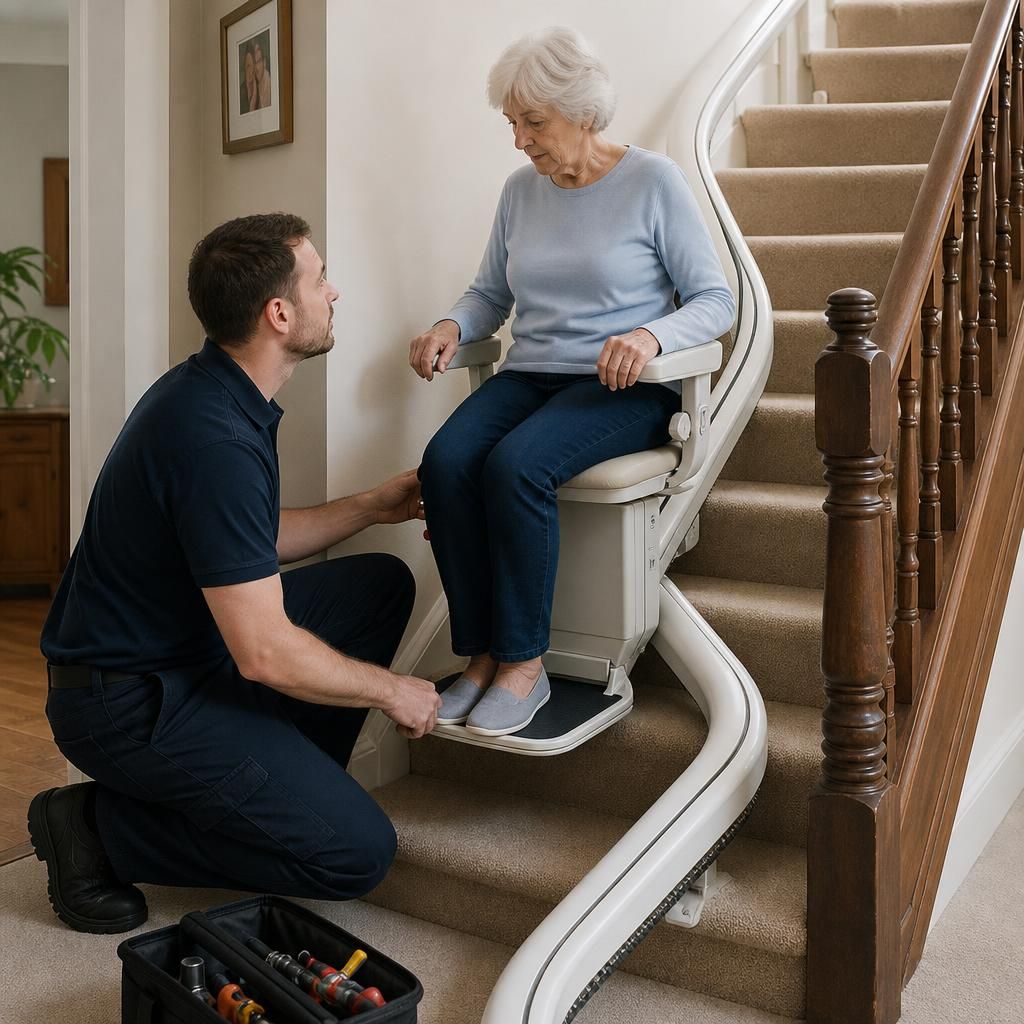
A compliant stairlift installation begins with a documented assessment of the staircase, landing areas, electrical supply and senior user’s mobility needs. This confirms that the chosen model, rail position and boarding points are suitable for the home, rather than relying on a standard installation plan.
After fitting, the installer should commission the stairlift by checking its travel, fixings, seat, restraint, controls, obstruction sensors, braking and charging system. Ask for the assessment and commissioning records, operating instructions and maintenance advice, and ensure the senior user receives practical instruction before using the lift independently.
Arrange a compliant stairlift assessment
Arrange a compliant stairlift assessment with Independent Stairlifts to check your staircase, electrical supply and mobility needs before installation. We’ll explain the relevant safety requirements and provide guidance on commissioning, user instruction and ongoing servicing.