
How can I determine the best stairlift design for narrow or complex staircases in a senior's home?
The best stairlift design for a narrow or complex staircase is determined by an individual home assessment, considering the staircase shape, available width, landings, obstructions and the senior’s mobility needs. A bespoke curved stairlift, compact straight model or tailored rail design may provide the safest and most practical solution, with features such as a folding seat or powered swivel seat considered where space is limited.
The best stairlift design for a narrow or complex staircase is selected through an individual home assessment. The assessment should consider the staircase’s width and shape, the space at the top and bottom, landings, doors and other obstructions, as well as the senior’s mobility, posture and ability to transfer on and off the seat. A compact straight stairlift, bespoke curved stairlift or specially configured rail may be suitable, but the safest choice depends on the complete staircase rather than one measurement alone.
Start with the staircase layout
A stairlift must follow the available route without creating an unsafe obstruction for the user or other people using the stairs. An assessor will normally examine:
- the clear width of the staircase, including handrails, radiators, dado rails and other fixed features;
- whether the stairs are straight, curved, split-level, half-landing or changing direction;
- the size and shape of the landings at the top and bottom;
- the position of doors, door swings, cupboards and entrances near the stairs;
- the height of the ceiling and any areas where head clearance could be restricted;
- the position of electrical sockets and the most suitable route for the stairlift supply; and
- whether the stairlift would leave enough room for safe access and, where appropriate, other stair users.
On a narrow staircase, the usable space can be reduced further by the stairlift seat, armrests, footrest and carriage. The assessment should therefore consider the dimensions of the stairlift when it is travelling and when it is folded away, rather than relying only on the width of the stairs.
Choosing between straight and curved designs
A straight stairlift is generally the simplest option when the staircase runs in one uninterrupted direction. A slimline or compact model may be appropriate where width is restricted, particularly if it has a narrow seat, folding arms and a folding footrest. These features can reduce the amount of space occupied when the lift is parked or when other people need to pass.
A curved stairlift is usually considered when the staircase changes direction, includes a landing, has a bend or follows a more complicated route. Its rail is made to fit the individual staircase, allowing the stairlift to travel around corners or between levels. A bespoke rail can also be designed to position the seat safely at the top or bottom, which may be important where the landing is small or a doorway is close to the final step.
For some homes, separate straight stairlifts on different flights may be possible. This can be practical where the stairs are divided by a landing, although it requires the user to transfer between lifts. Whether that is suitable depends on balance, leg strength, confidence and the amount of assistance available. A single continuous curved stairlift may provide a better solution where transfers would be difficult.
Consider how the senior will use the lift
The staircase is only part of the decision. The design should match the user’s current mobility and likely changes in their condition. The assessor should discuss whether the user can:
- walk to the stairlift and approach it safely;
- turn and sit down without twisting or losing balance;
- remain seated comfortably for the full journey;
- stand up safely at the landing; and
- operate the controls with the available hand strength and movement.
A powered swivel seat can help a user turn towards the landing before standing, reducing the need to twist while close to the top of the stairs. A manual swivel seat may be suitable for someone who can operate it securely. Where bending is difficult, a powered or hinged footrest may make transfers easier, provided the user can operate the controls safely.
Seat width, armrest position, footrest size, seat height and the angle of the seat should also be checked during the assessment. A model that is physically narrow is not necessarily the best choice if it places the user in an uncomfortable or unstable position. The user should be able to sit upright, use the armrests and fasten the seat belt without difficulty.
Look closely at parking and access points
On a narrow or complex staircase, the parking position can be as important as the route itself. The stairlift may need to park beyond the top or bottom step, on a landing or around a bend. An overrun can move the seat to a safer position away from the edge of the stairs, but there must be sufficient landing space for the user to get off safely.
A folding rail or hinged rail may be considered where the lower end of the track could obstruct a doorway, hallway or walkway. These arrangements require careful checking so that the rail can be moved without creating a trip hazard. If a door opens directly onto the stairs, the final position of the seat and the direction in which the user exits should be reviewed particularly carefully.
Assess safety and installation requirements
The stairlift should be fixed securely to the stairs or an appropriate structural surface, with the installation planned around the condition and construction of the staircase. The installer should check for loose or damaged treads, unusual stair dimensions, unsuitable fixing points and any changes that may be needed before installation.
Important safety considerations include a secure seat belt, obstruction sensors, reliable braking, controls that are easy to use and a footrest that supports the feet throughout the journey. Swivel and folding mechanisms should lock correctly before travel. The user should also receive clear instructions on stopping the stairlift, charging it, using the remote control and responding to a power interruption.
Where more than one person uses the staircase, the design should reduce obstruction when the stairlift is not in use. Where the user has visual, hearing or cognitive difficulties, the controls and warning signals should be assessed for suitability rather than assumed to be appropriate.
What happens during a home assessment?
- The assessor examines the full staircase, landings, access routes and nearby doors or furniture.
- The staircase is measured and its shape is recorded so that a suitable rail and seat configuration can be considered.
- The user’s mobility, transfer ability, weight, posture and preferred operating method are discussed.
- Potential parking positions, power requirements and any installation restrictions are identified.
- Suitable designs are compared, including their space requirements, transfer arrangements and practical limitations.
- The proposed installation is explained, including preparation, access, controls, servicing and safe use.
Photographs or measurements supplied remotely may help with an initial discussion, but they cannot always show ceiling clearance, obstructions, fixing conditions or the user’s ability to transfer. An in-home assessment is therefore the most reliable way to determine whether a particular design will work safely.
Do not choose a stairlift solely because it is described as compact or because it fits a similar-looking staircase. Narrow stairs can differ considerably in width, angle, landing arrangement and available parking space. A bespoke assessment allows the design to be matched to both the home and the senior’s abilities, helping to ensure that the stairlift is comfortable to use, leaves appropriate access and provides a practical route between floors.
On a narrow or complex staircase, the safest stairlift design depends on more than the width of the steps. The rail, seat and parking position must be planned together so the user can approach, travel and leave the stairlift without blocking a doorway, hallway or the staircase itself.
A home assessment checks whether a compact straight model, bespoke curved rail, hinged rail or extended parking position is appropriate. The assessor also considers nearby doors, landings, head clearance and the space needed for the user to turn and stand safely. A powered swivel seat or folding components may help where access is restricted, but they must be comfortable and simple for the senior to operate.
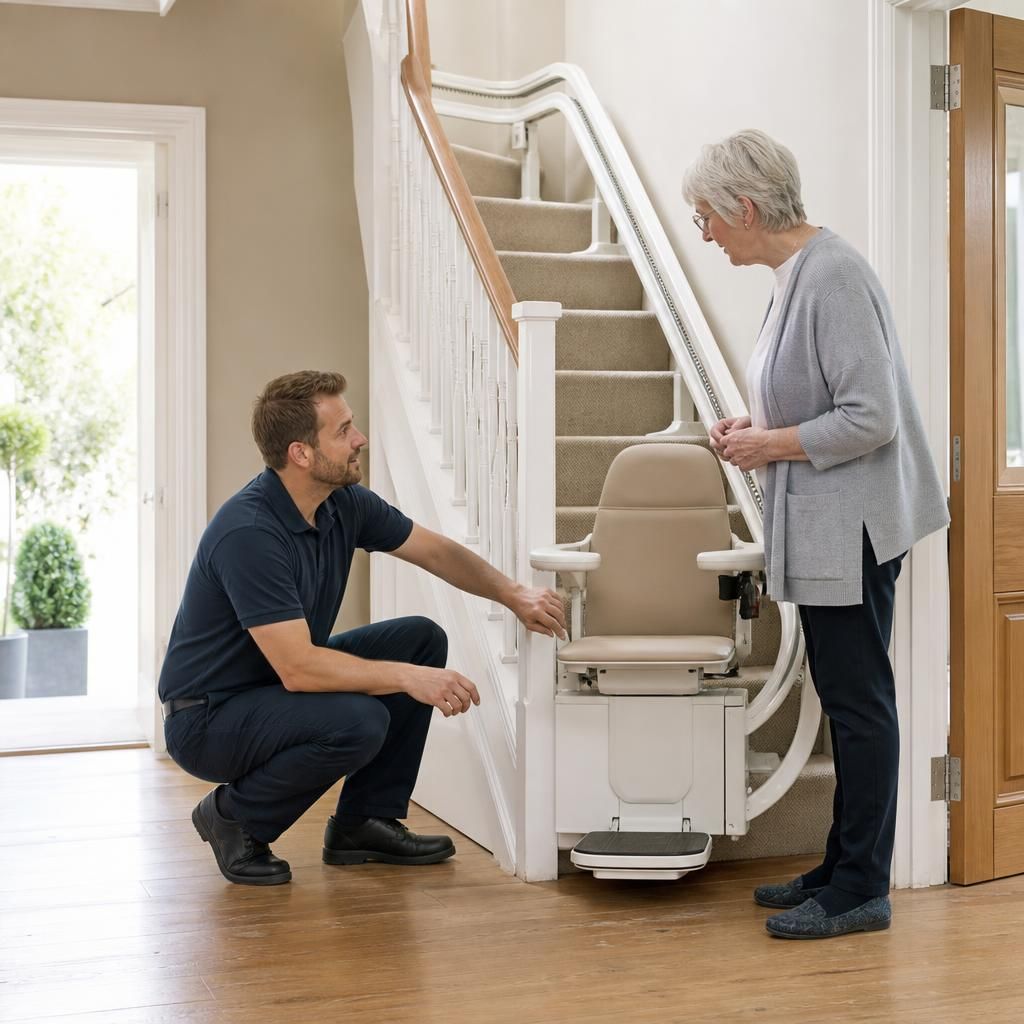
Arrange your stairlift home assessment
Arrange a home assessment with Independent Stairlifts to identify the safest and most practical stairlift design for your narrow or complex staircase. We will assess the staircase, access points and senior user’s mobility before recommending a suitable solution.