
Are stairlifts suitable for all types of staircases in a senior's home?
Stairlifts are suitable for most staircases, including straight, curved, narrow, steep and some outdoor stairs, but the right model depends on the staircase layout, available space and the user’s mobility needs. A professional home assessment will confirm whether a standard or bespoke stairlift can be installed safely, or whether an alternative solution is more appropriate.
Stairlifts are suitable for most staircases in a senior’s home, including straight, curved, narrow, steep, split-level and some outdoor staircases. However, suitability depends on the staircase layout, the available clearance, the condition of the stairs and the user’s mobility requirements. A professional assessment is needed to establish whether a standard stairlift, a bespoke curved model or another access solution is safest.
Straight staircases are usually the simplest installation. A straight stairlift travels along a single rail fixed to the stair treads, rather than the wall. It can often be fitted to stairs of different widths, provided there is enough room for the seated user and other people to pass safely. The position of the controls, the type of seat and the parking location should all be considered, particularly where a doorway or hallway is close to the top or bottom step.
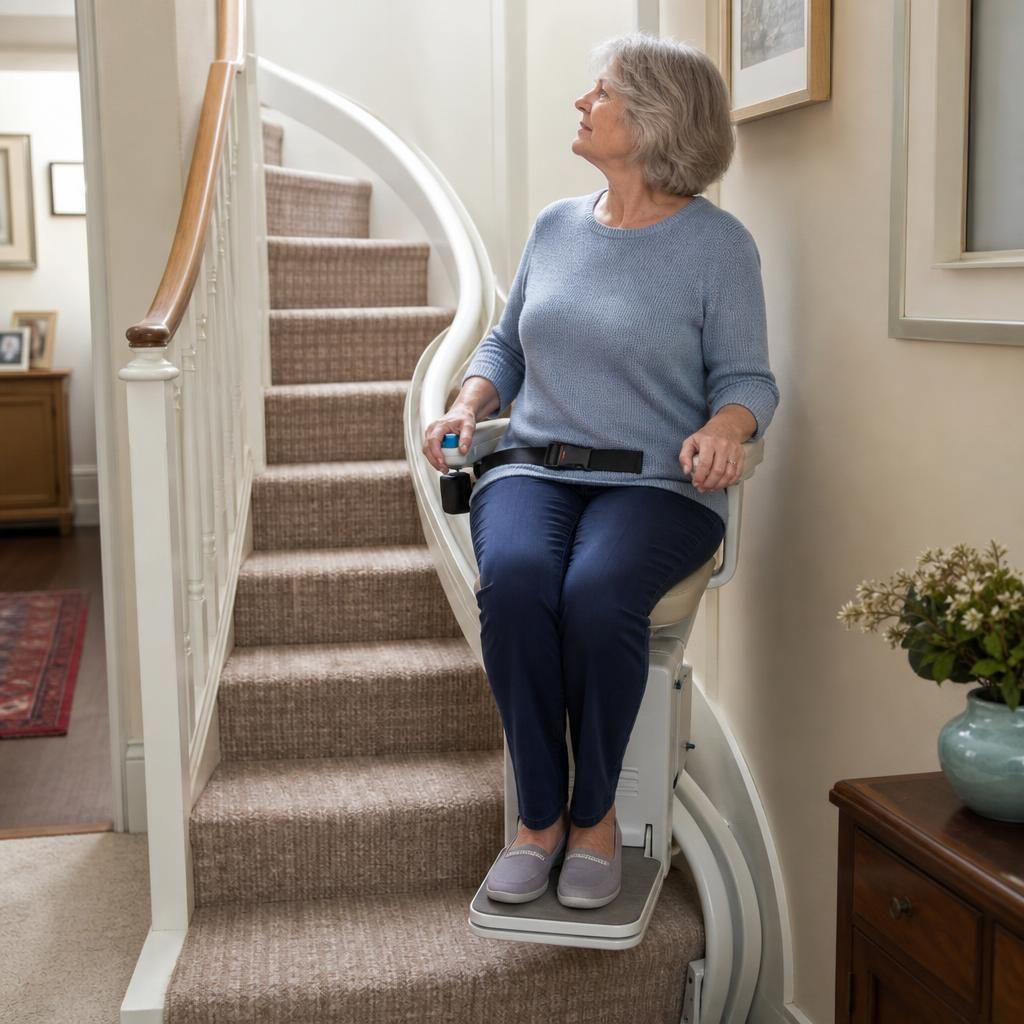
Curved staircases can normally be accommodated with a stairlift made to follow the individual shape of the stairs. This includes stairs with bends, intermediate landings, changes in direction and some split-level arrangements. The rail is designed from measurements of the staircase, so the installation is specific to the property rather than based on a standard straight section. A curved stairlift may also be configured to park around a bend or away from a doorway, helping to preserve access to the landing.
Narrow staircases do not automatically rule out a stairlift. Compact seats, slimline designs, folding arms, footplates and rails that are positioned carefully can help maximise usable space. The assessment must consider the user’s body shape, ability to transfer onto the seat and whether other household members need to use the stairs. A lift that fits physically may still be unsuitable if the user cannot sit securely, operate the controls or get on and off safely.
Steep stairs may also be suitable, but the stairlift must match the gradient and have appropriate safety features. The user should be able to sit in a stable position throughout the journey, with the seat, armrests and footplate supporting safe posture. Depending on the staircase and the user’s balance, a powered swivel seat, a suitable harness or a different seating configuration may be recommended. The stairlift should not be selected solely on whether it can reach the top; safe transfers at both ends are equally important.
Stairs with landings or changes in direction generally require a curved rail, although there may be other possible arrangements. In some homes, separate straight stairlifts can be considered where there is a suitable landing and the user can transfer safely between lifts. This is not appropriate for everyone, particularly someone with limited balance, weakness or difficulty standing. The safest arrangement depends on the complete route and the person using it.
Spiral and unusually shaped staircases require particularly careful assessment. Their tight curves, narrow treads and changing angles can restrict the space available for the seat and footplate. Some may be suitable for a bespoke stairlift, while others may not provide enough clearance for a safe installation. The condition and strength of the staircase also need to be checked, especially where the steps are open, irregular or made from materials that need specialist fixing methods.
Outdoor stairs can sometimes be fitted with a weather-resistant outdoor stairlift. The equipment must be appropriate for exposure to rain, damp, temperature changes and dirt, and it should have suitable protection when not in use. The installation also needs to take account of slippery surfaces, drainage, lighting, handrails and the user’s ability to board safely in changing weather. An outdoor stairlift is not automatically suitable for every external staircase, particularly where the steps are unstable or the route is exposed to severe conditions.
Very short stairs or stairs with limited space at the top and bottom can present different challenges. The lift may need to start or finish at an angle, use a folding or retractable rail, or park beyond the edge of the staircase where space allows. Doorways, radiators, furniture and other obstructions may affect the available parking position. These details should be reviewed before any equipment is chosen, because a safe transfer area is essential.
The staircase itself is only part of the assessment. The installer should also consider:
- the user’s height, weight, posture, balance and ability to bend the knees;
- whether the user can transfer on and off the seat independently or needs assistance;
- the width, depth, gradient and condition of each step;
- the space available at the top and bottom of the stairs;
- access for other people in the home, including children and visitors;
- the position of doors, hallways, radiators and furniture;
- whether the household has pets or equipment that could obstruct the route;
- the location of a suitable electrical supply; and
- the most practical parking position when the stairlift is not being used.
A proper home assessment should involve measuring and inspecting the full staircase rather than relying on photographs or a general description. It should identify potential obstructions, confirm how the rail can be fixed and establish where the user will board and dismount. The assessor should also discuss how the stairlift will be used day to day, including whether the senior user will travel alone, carry small items or need the lift to remain available at particular points.
Staircases with a wall on one side, an open edge or unusual construction may still be suitable, but the fixing method and rail design may differ. Installations should not compromise existing handrails, obstruct fire escape routes or create avoidable trip hazards. Where the staircase is damaged, unstable or undergoing building work, repairs may be required before installation can proceed.
If a stairlift cannot be installed safely, or if the user cannot transfer securely, alternatives may need to be considered. Depending on the property, these could include adapting the layout, improving access to a bedroom or bathroom on the ground floor, or assessing a different mobility aid. A stairlift should support safe movement between levels; it should not be used to overcome a staircase problem that has not been properly assessed.
The most suitable model is therefore determined by both the staircase and the person using it. Straight stairs commonly use a standard straight stairlift, while bends and intermediate landings usually call for a bespoke curved design. Narrow, steep, spiral and outdoor stairs may still be possible, but they require closer attention to clearance, boarding, stability and environmental conditions. An in-home assessment will provide the clearest answer and confirm whether the proposed installation is practical, safe and appropriate for the senior user.
Narrow or unusually shaped staircases are not automatically unsuitable for a stairlift, but they require a detailed assessment of clearance, rail position and safe transfers. A compact seat, folding components or a bespoke curved rail may help preserve access for the stairlift user and other people in the home.
The assessment must consider more than whether the equipment fits on the stairs. The senior user needs enough space to sit securely, operate the controls and get on and off safely at the top and bottom. Doorways, radiators, handrails and furniture can also affect where the stairlift parks.
Where there is not enough room for a safe installation, the assessor can discuss practical alternatives, such as changing the parking position or improving access to essential rooms on one level. The safest option depends on the staircase and the user’s individual mobility needs.
Arrange a Stairlift Assessment for Your Staircase
Arrange a professional stairlift assessment to confirm whether your staircase is suitable and which installation best supports safe boarding, travel and transfers. Our experts can assess the layout, available space and your mobility needs at home.