
What specific features should I look for in a stairlift designed for narrow stairs?
Look for a stairlift with a slim, foldable seat, compact armrests, a narrow or hinged rail, and controls that are easy to operate without obstructing the stairs. Safety features should include a secure swivel seat, seat belt, obstruction sensors and reliable braking, while a tailored assessment confirms the lift will fit your staircase and landing.
The most important features for a stairlift on narrow stairs are a slim folded profile, compact seating, a suitable rail design and controls that do not obstruct the staircase. These features must be combined with essential safety equipment, including a secure seat belt, swivel seat, obstruction sensors and dependable braking. The correct choice depends on the usable width, stair shape, landing space and the person using the lift, so a proper home assessment is needed before a model is selected.
Slim seat and compact folded dimensions
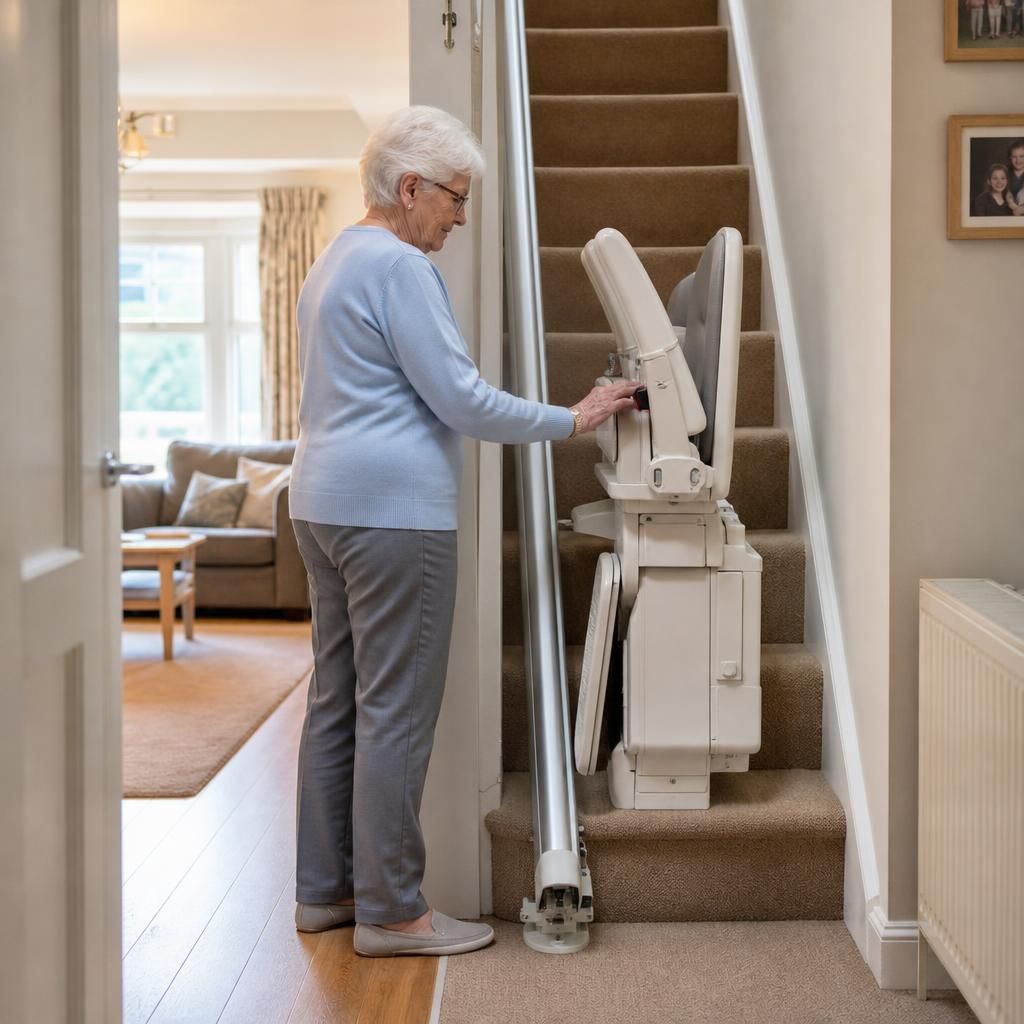
Look for a seat, armrests and footrest that fold neatly when the stairlift is not in use. The folded width is particularly important because it determines how much space remains for other people to use the stairs. A narrow stairlift should not only have a slim seat; its armrests, controls, carriage and footrest must also be considered as part of the overall folded profile.
Some models offer a choice of seat widths or armrest arrangements. A narrower configuration may help on a restricted staircase, but it must still provide adequate support and room for the user to sit safely. The seat should not be reduced beyond what is appropriate for the user’s posture, stability or mobility needs.
Folding or retractable footrest
A compact footrest helps prevent the lower part of the stairlift from becoming an obstacle. It should fold easily and securely, preferably as part of the same movement as the seat or with a simple manual action. Check that the folded footrest does not project into a narrow walkway and that it can be operated without requiring excessive bending or strength.
A rail suited to the staircase
The rail should follow the stairs closely and leave sufficient clearance for people walking past. On a straight staircase, a slim rail may be suitable, while a curved staircase may need a made-to-measure rail that follows changes in direction, gradients or intermediate landings. Where the rail would extend across a doorway or restrict access at the top or bottom, a manual or powered hinged rail may be appropriate.
Rail positioning is not simply a matter of choosing the narrowest option. It must allow the carriage to travel smoothly, maintain the required clearances and finish in a safe position. The installer should assess the staircase, skirting boards, radiators, doorways and landings together rather than measuring the stairs in isolation.
Swivel seat and safe transfer points
A swivel seat is especially useful where the staircase is narrow or the top landing has limited room. It allows the user to turn towards the landing before standing, reducing the need to twist while close to the edge of the stairs. Look for a seat that locks securely in the travel position and at the transfer position.
Depending on the user’s mobility, a powered swivel or powered folding seat may be worth considering. These options can reduce the effort needed to prepare the lift, although they add to the equipment’s complexity and should be assessed alongside the available space.
Controls that are easy to reach
Controls should be positioned where the user can operate them without leaning out over the stairs. A simple hand control, clearly marked buttons and a control unit that can be used from either end of the staircase are practical features. Remote controls may allow a family member to send the stairlift to another floor, but they should not replace the user’s own accessible controls.
For someone with limited grip, reduced dexterity or visual difficulties, the type, size and resistance of the controls may be as important as the stairlift’s physical width. These details should be tested during the assessment rather than assumed from the model specification.
Essential safety features
- A properly adjusted seat belt or harness to help keep the user secure during travel.
- Obstruction sensors that stop the lift if an object is detected on the stairs or near the footrest.
- A swivel-seat safety lock that prevents travel unless the seat is correctly positioned.
- Reliable braking and controlled starting and stopping to reduce sudden movement.
- Battery backup so the stairlift can normally be returned to a safe position during a mains power interruption.
- Safety edges and sensors around the carriage and footrest, where applicable.
These features should be suitable for the individual user, not merely present on a specification sheet. For example, a person who needs additional postural support may require a different seating arrangement from someone who can sit independently.
Comfort without unnecessary bulk
Compact design should not mean an uncomfortable or unstable seating position. Check the seat height, back support, cushioning, armrest height and footrest position. The user should be able to sit upright, keep their feet supported and use the belt without feeling cramped. A slim stairlift that cannot be used comfortably or safely is not an appropriate solution.
Adjustable and custom-fitted design
Useful adjustment may include the seat height, armrest position, footrest arrangement and control location. On a curved or unusually steep staircase, the rail may need to be manufactured specifically for the home. An assessment should also consider whether the user approaches the stairs with a walking aid, where they transfer on and off the lift, and whether other household members need to pass the parked stairlift.
Before installation, ask the assessor to explain the folded width, the clearance available at tight turns and the space needed at both landings. It is also sensible to try the seat and controls, discuss the recommended weight capacity, and confirm how the stairlift is charged, operated and maintained. Comparing these practical details is more useful than choosing solely by the smallest advertised measurement. The best stairlift for narrow stairs is the one that fits the staircase, supports the user correctly and leaves the route as clear and safe as possible.
For narrow stairs, the most important feature is the stairlift’s overall folded profile, not just the width of its seat. The armrests, controls, carriage and footrest must fold close to the staircase so that a safe walking route remains available when the lift is parked.
A suitable model may also use a slim rail or a hinged rail where the track would otherwise obstruct a doorway or landing. The rail must still follow the staircase accurately and provide safe clearance around turns, skirting boards and adjacent walls. During the assessment, check the folded width at the narrowest point and confirm where the lift will park at the top and bottom.
Book Your Narrow-Stair Stairlift Assessment
Book a home assessment to confirm which stairlift features will suit your narrow staircase, available clearances and transfer needs. Independent Stairlifts can discuss suitable options and explain how the lift will fit and operate in your home.