
What features make a stairlift suitable for narrow stairs?
A stairlift is suitable for narrow stairs when it combines a slim, comfortable seat with a compact drive system, fold-up arms, footrest and seat, and a rail designed to preserve usable space. For tighter or more complex staircases, features such as a retractable or hinged rail, powered swivel seat and tailored curved-rail installation can improve access without obstructing the stairs or nearby doorways.
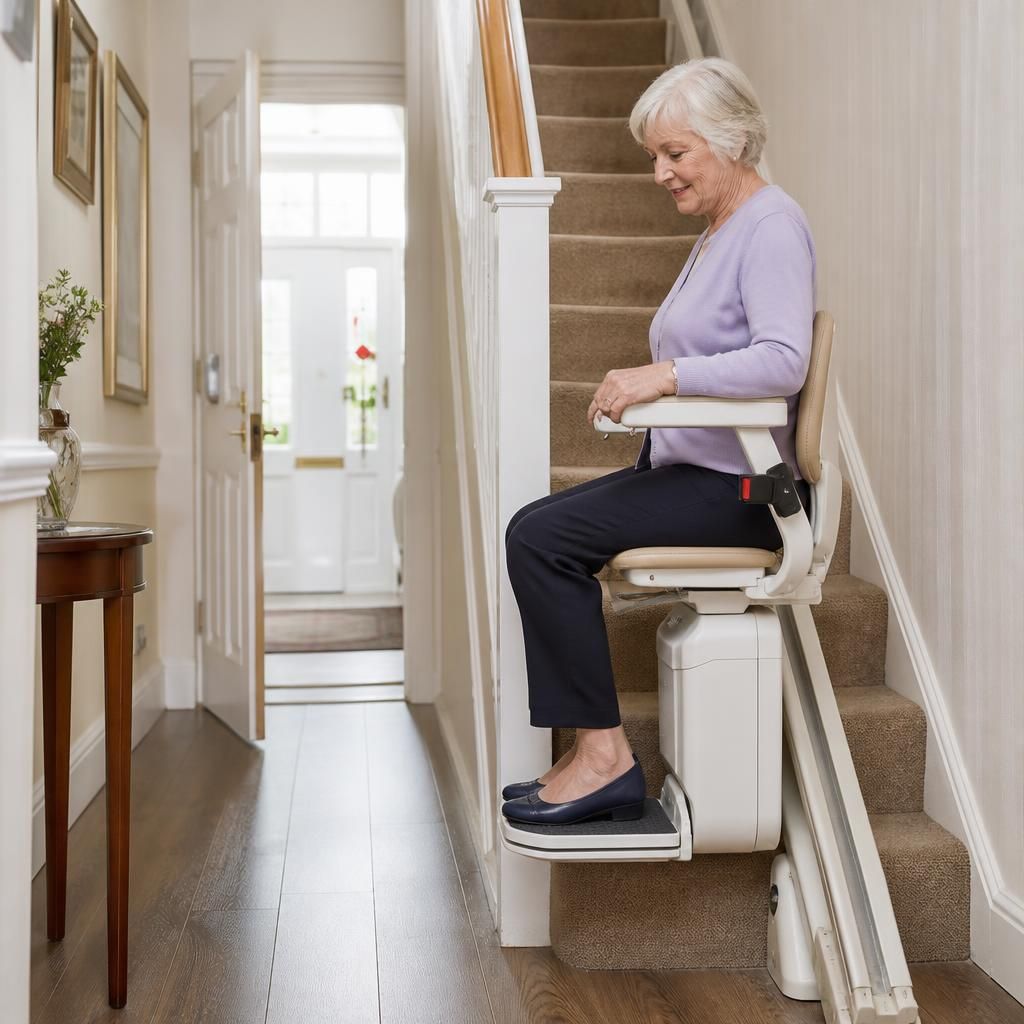
A stairlift is suitable for narrow stairs when its folded dimensions, seat position, rail and controls leave enough usable space for safe movement without compromising the passenger’s stability. The most useful features are a slimline seat, narrow armrests, a compact footrest, a rail positioned close to the steps, and a folding or retractable design. On a particularly tight or awkward staircase, a powered swivel seat, hinged rail or bespoke curved track may also be appropriate.
Suitability depends on more than the width of the staircase. The assessment should consider the shape and gradient of the stairs, available space at the top and bottom, nearby doors and corridors, the user’s height and mobility, and whether anyone else needs to use the staircase. A model that fits physically may not be suitable if it leaves insufficient room to sit down safely, alight at the top, or walk past the parked stairlift.
Slimline seat and narrow armrests
A compact seat reduces the amount of space occupied across the staircase. Look for a seat with a relatively narrow base, arms that fold or sit close to the body, and a backrest that provides support without creating unnecessary bulk. The seat should still be wide and supportive enough for the intended user. Choosing the narrowest possible model is not automatically best if it makes sitting, standing or maintaining balance more difficult.
Folding seats, arms and footrests are particularly important where the stairlift is parked on the stairs rather than at a landing. Once folded, these components reduce the obstruction and can make it easier for other household members to use the staircase. The folded profile should be checked in the places where the stairs are tightest, rather than judged only by the stair width at its widest point.
Compact footrest and drive system
A small, fold-up footrest helps preserve space at the lower end of the staircase. It should provide enough support for both feet and have a surface that reduces the risk of slipping. Some designs incorporate safety sensors around the footrest so that the lift stops if it meets an obstruction.
The drive unit should be compact and positioned so it does not unnecessarily reduce knee or shoulder room. This is especially relevant when the user is taller, has limited flexibility, or needs to keep their body facing forwards while travelling. During an assessment, the installer should consider the user sitting on the lift, not just whether the carriage can physically travel along the rail.
A rail that preserves usable space
The rail is usually installed close to the steps, but its position must be planned around the staircase, skirting boards, doors and landings. A slim rail profile can reduce the obstruction, although the rail must remain strong enough to support the carriage and passenger throughout its travel. The way the rail ends at the top and bottom can be just as important as its width.
Where the bottom of the stairs is close to a doorway or walkway, a hinged rail can allow the lower section to be folded out of the way when the stairlift is not in use. A manual hinge may be suitable where the user can operate it safely; a powered hinge can be considered where bending, reaching or handling the rail is difficult. The folded position should not obstruct a door, create a trip hazard or block an escape route.
On a curved or unusually shaped staircase, a bespoke curved rail can follow the bends, intermediate landings and changes in direction more closely than a standard straight rail. This may reduce the amount of space lost on the landing and allow the lift to park in a more practical position. Curved installations require accurate measurement because small differences in the rail route can affect clearance and the passenger’s position on the stairs.
Swivel, powered and retracted seating
A swivel seat allows the passenger to turn towards the landing before standing up or sitting down. This can be valuable where there is limited space at the top or bottom of the stairs, because the user does not need to twist their body while positioned over the steps. A powered swivel function can be useful when the user cannot safely operate a manual lever, but the control must be easy to reach and understand.
Some stairlifts offer a seat or carriage that travels higher on the staircase or retracts in a way that improves knee clearance. Standing or perch-style designs may also help in certain narrow staircases, particularly where bending the knees is difficult or the staircase is steep. They are not suitable for everyone: the user must be able to maintain a secure standing or semi-seated position and use the support correctly. The choice should be based on physical ability, not staircase width alone.
Controls that are easy to use in a confined space
Controls should be positioned where the user can operate them without leaning across the stairs or reaching behind their body. A simple control on the armrest is commonly useful, while call and send controls allow the stairlift to be moved when it is parked at the other end. Controls should have clear direction markings and require deliberate operation to prevent accidental movement.
For users with reduced hand strength or dexterity, the assessment should cover the size and resistance of the controls. A remote control can be helpful when more than one person uses the lift, but it should be stored where it will not be lost or left on a step.
Safety features must remain effective in the narrower design
A compact stairlift should still include a secure seat belt, supportive armrests, a stable footrest and sensors that stop the lift if the carriage detects an obstruction. The seat should lock in its travelling position, and the swivel mechanism should prevent travel until the seat is correctly aligned. These interlocks are important because reducing the size of a component must not reduce its stability or safe operation.
Battery operation is useful because it allows the stairlift to complete a journey during a power cut, provided the batteries are charged. Charging points should be positioned where the lift can park reliably at either end, and the user should know how to respond to warning sounds or indicator lights. Regular servicing and keeping the rail, sensors and charging contacts clear are also part of maintaining safe performance.
Personal fit and installation details
The stairlift should be adjusted to the user rather than selected from measurements of the staircase alone. Important checks include seat height, footrest length, armrest position, belt access, transfer ability and the amount of space needed to approach the seat. If the user has a walking frame, oxygen equipment or another mobility aid, the parking and transfer arrangements should be discussed before installation.
A proper survey records the narrowest points, changes in direction, landing dimensions, door swings, radiator positions and available electrical supply. The installer can then establish whether a straight, curved, standing or compact model is appropriate and whether a hinged rail or alternative parking position is needed. Where space is extremely limited, it may be necessary to compare a few configurations rather than select a model based solely on its advertised folded width.
In practical terms, the best feature combination is one that keeps the stairway as clear as possible while giving the user a stable, comfortable and independent transfer. A slim seat and folding parts may solve a straightforward space problem, whereas a powered swivel seat, hinged rail or bespoke curved track may be needed when the obstruction occurs at a landing or doorway. The final recommendation should be confirmed by an in-home assessment that considers both the staircase and the person using it.
A hinged rail is a key feature when the bottom of a narrow staircase is close to a doorway, hallway or other busy access point. It allows the lower section of rail to fold away when the stairlift is parked, helping to keep the entrance clear and reduce the risk of someone walking into the rail.
A manual hinge may be suitable if the user can operate it safely and without bending or reaching across the stairs. Where this is difficult, a powered hinge can fold the rail using a simple control. The installation should be checked to ensure the folded rail does not obstruct a door, create a trip hazard or block an escape route.
Arrange an assessment for your narrow stairs
Arrange an in-home assessment for your narrow stairs so we can check the staircase, available clearances and your individual transfer needs. We can then recommend a suitable stairlift configuration, including any folding rail, swivel seat or compact features required.