
What factors should I consider to ensure a stairlift for narrow stairs meets all my safety standards?
To ensure a stairlift for narrow stairs meets your safety standards, check that its rail, seat, controls and safety sensors are correctly matched to the staircase, user and available clearance. A professional assessment should also confirm the safe weight capacity, secure installation, unobstructed access, reliable braking and charging, and suitable features such as a swivel seat, seat belt and obstruction sensors.
A safe stairlift for narrow stairs must be correctly matched to the staircase, the user and the available clearance. A professional assessment should confirm that the rail, seat, controls and safety systems can be installed without creating dangerous contact points, obstructing access or reducing the user’s stability. It should also verify the lift’s weight capacity, braking, charging, restraint and obstruction protection before a suitable model is recommended.
Start with an accurate assessment of the staircase
Stair width alone does not determine whether a stairlift is safe. The assessment should consider the full staircase, including the pitch, number and shape of steps, bends, winders, half-landings, doorways, radiators, bannisters and available space at the top and bottom. On a curved or unusually tight staircase, the rail may need to follow the exact line of the steps so that the seat remains stable and clears surrounding features throughout its journey.
The surveyor should check clearance at the narrowest points rather than relying on a measurement taken in an open section of the stairs. They should also assess whether the folded lift leaves enough room for other people to use the staircase safely. Where the staircase is shared, the lift should be able to fold away or park in a position that limits obstruction without compromising the user’s access.
Check the rail and installation method
The rail must be securely fixed to suitable structural points and installed in line with the manufacturer’s instructions. On narrow stairs, a rail that is positioned too close to the tread edge, wall or bannister can reduce foot and knee clearance. A poorly planned rail can also make it difficult to get on or off the lift safely at a landing.
Ask how the proposed rail will deal with tight turns, the top landing and the bottom approach. A customised curved rail may be needed where a standard straight rail would stop short of a landing or leave the seat in an awkward position. The installer should explain where the lift will park, how it will be charged and whether the parked position affects a doorway, corridor or escape route.
Confirm the lift is suitable for the user
A narrow stairlift should not be selected solely because its folded dimensions are compact. The seat must provide sufficient support for the user’s hips, back and legs, and the user must be able to sit down, fasten the belt and operate the controls without leaning or twisting dangerously. Consider the user’s height, weight, leg strength, balance, joint movement, vision and ability to understand the controls.
The stated safe working load must be greater than the user’s weight and should allow for normal clothing or items carried during use. If the user’s condition may change, discuss this during the assessment rather than choosing a lift with only minimal capacity. A standing or perch-style option may help some people when sitting is difficult, but it is not appropriate for everyone, particularly where balance or knee control is limited.
Look for essential safety features
- Seat belt or harness: This should be easy to fasten and release while seated, with a design that suits the user’s dexterity and posture.
- Swivel seat: A manual or powered swivel can help the user turn towards the landing before standing. It should lock securely in the travel and transfer positions.
- Obstruction sensors: Sensors should stop the lift if it detects an object, person or item in its path. They are particularly important where the folded lift passes close to walls, bannisters or furniture.
- Arm, footrest and side protection: These should help keep the user’s body and feet within the protected area during travel.
- Reliable braking and controlled movement: The lift should start, stop and travel smoothly, without sudden movement that could affect balance or confidence.
- Manual controls and remote controls: Controls should be clearly marked, simple to use and positioned so that the user can reach them without stretching. Remotes can allow the lift to be sent to another floor when needed.
- Battery backup: A battery-powered lift should continue to provide safe operation during a mains power interruption, subject to its available charge. The charging points must be accessible and kept clear.
- Diagnostic and emergency functions: The user should know how to stop the lift, summon assistance and report a fault. Any emergency lowering or manual release procedure should be explained to the household.
Pay particular attention to transfers
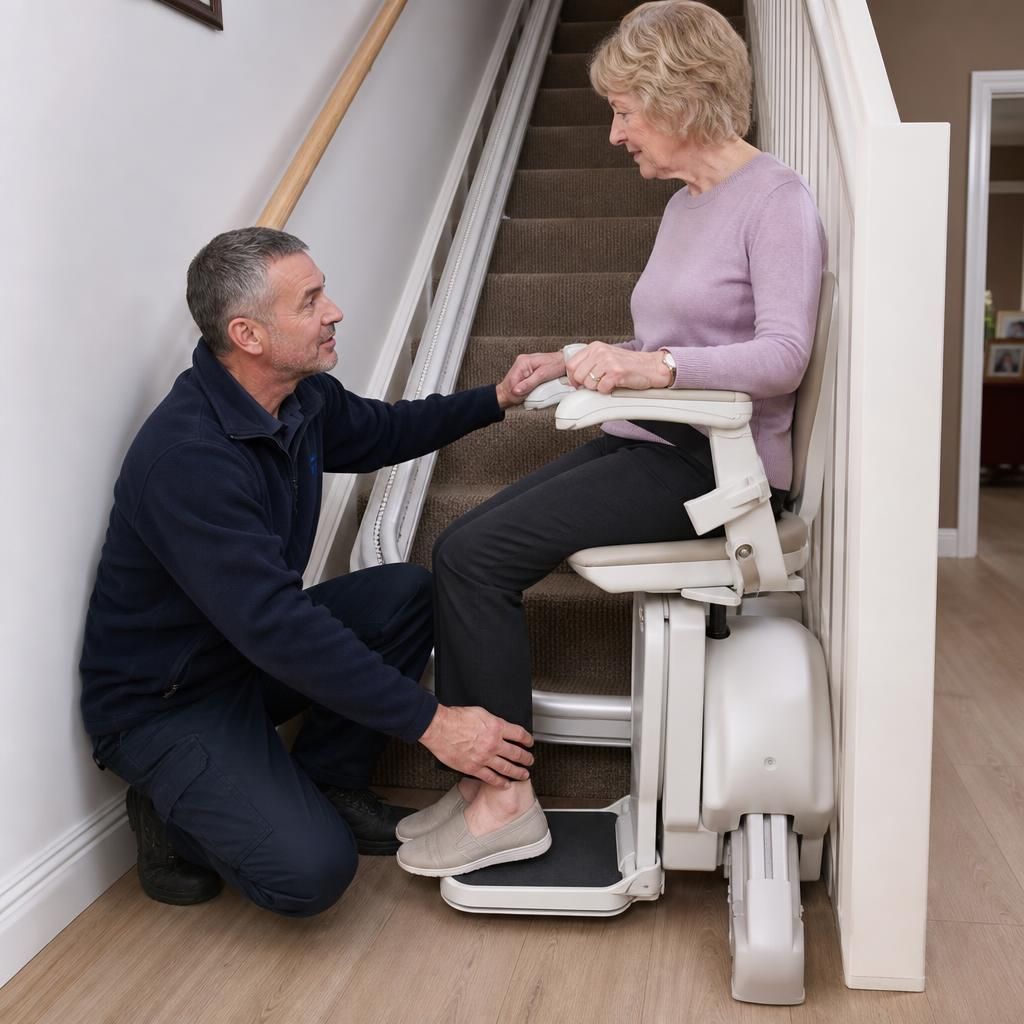
Many stairlift incidents occur during getting on or off rather than while travelling. Check that the user can approach the seat without catching their feet on the footrest or rail, and that the seat can be positioned correctly at both ends. A powered swivel, hinged rail or automatic footrest may be useful where the landing is short or access is restricted, but each feature must be assessed for reliability and ease of operation.
The landing should have enough clear, level space for the user to stand, turn and move away from the stairlift. If the user needs a walking frame or another aid, include it in the assessment. A stairlift may operate correctly yet still be unsuitable if the user cannot safely transfer to or from it.
Ensure the staircase remains usable for others
A stairlift must not create a new hazard for people walking up or down the stairs. Check the folded seat, armrests, footrest and rail at their closest points to the usable walking line. The installer should consider whether the lift can be parked out of the way and whether a powered folding mechanism would reduce the need to reach across the stairs.
Do not use the stairs to store bags, furniture or other objects once the lift is installed. Items left on the steps may activate the obstruction sensors or create a trip hazard for both the stairlift user and other household members.
Check electrical safety and the surrounding environment
The installation should include a suitable power supply and charging arrangement, with cables protected from damage and positioned away from walking areas. The lift should not be used if it shows signs of electrical damage, unusual noise, jerky movement or repeated stopping. Keep the charging points clear and follow the operating and maintenance instructions supplied with the lift.
For an external or damp location, the equipment must be designed for the environment and protected from weather conditions as specified by the manufacturer. Outdoor steps may also require additional attention to lighting, surface condition, handrails and drainage. These factors affect safe use even when the stairlift itself is operating correctly.
Ask what checks are completed after installation
After fitting, the installer should test the lift along the entire route, including every bend, landing and stopping position. They should confirm that the seat locks, the belt works, the sensors stop the lift, the controls respond correctly and the batteries charge. The fixings, rail alignment and clearances should also be checked before handover.
You should receive clear operating instructions, maintenance guidance and information about what to do if the lift stops or develops a fault. Ask how servicing is arranged, which parts require inspection and how to report a safety concern. Keep the instructions available for anyone who may assist the user.
Use the assessment to make the final decision
The safest choice is not necessarily the smallest lift. It is the model that provides adequate support and control while maintaining safe clearance on the particular staircase. Before agreeing to an installation, ask the surveyor to explain the proposed seat position, rail route, parking points, transfer arrangements, safe working load and safety features in relation to the user’s needs.
If the staircase is especially narrow, steep, curved or obstructed, request a detailed bespoke assessment rather than assuming that a compact model will fit. Independent Stairlifts can use the survey to identify the practical restrictions in the home and recommend a configuration that balances user safety, comfortable transfers and access for everyone else.
On narrow stairs, safe transfers are just as important as safe travel. The seat should leave enough room for the user to approach, sit down, fasten the belt and turn towards the landing before standing.
A professional assessment should check the clear space at both ends of the staircase, including room for a walking frame or another mobility aid. A swivel seat, powered swivel or hinged rail may improve access where the landing is restricted, but only if the user can operate the feature safely and it does not obstruct a doorway or shared access route.
Arrange your narrow-stair safety assessment
Arrange a personalised narrow-stair safety assessment with Independent Stairlifts to confirm the best rail, seat, controls and safety features for your staircase and mobility needs.