
What are the safety features of stairlifts for narrow stairs?
Stairlifts for narrow stairs use safety features such as a secure seat belt, swivel and locking seat, obstruction sensors, controlled speed and smooth start-and-stop movement. A professional assessment also ensures the rail, controls and safety systems are configured correctly for your staircase and the user’s needs.
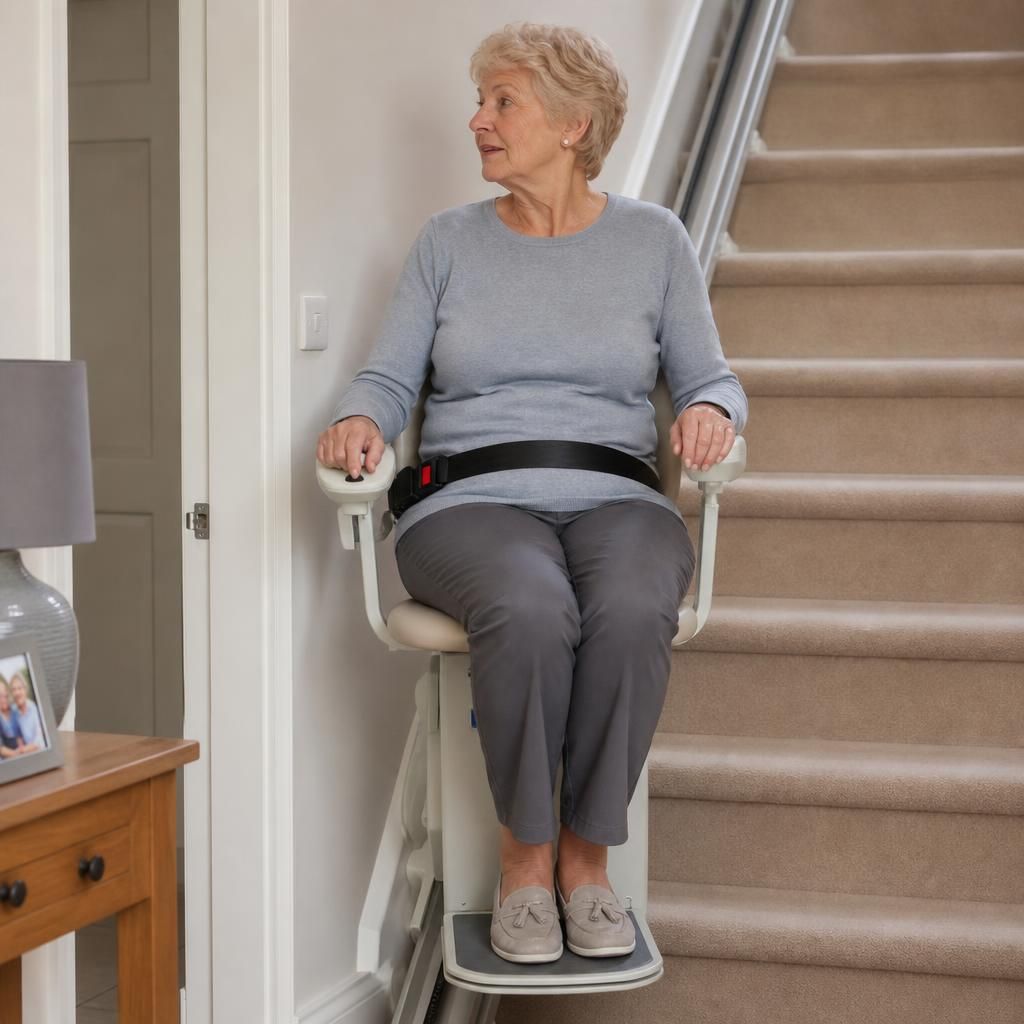
Stairlifts for narrow stairs are designed to protect the user while keeping the equipment as compact and predictable as possible. Key safety features include a correctly fitted seat belt, supportive armrests and footrest, a swivel and locking seat, obstruction sensors, controlled movement, automatic braking, and clearly positioned controls. A professional survey is essential because the safety of these features depends on the stairlift being matched to the staircase, available clearance and the individual user.
Secure seating and positioning
A stairlift for a narrow staircase should hold the user in a stable, upright position throughout the journey. A seat belt or lap belt helps prevent the user sliding forwards, particularly when starting, stopping or travelling on a steep section. Armrests provide additional support when sitting down and standing up, while a shaped seat and backrest can help maintain a comfortable position without requiring a wide seat.
Some models have adjustable or retractable armrests and other compact seating arrangements. These can improve clearance when the stairlift is parked, but they must still provide adequate support for the person using the lift. The seat should be set at an appropriate height so that the user can transfer on and off safely.
Swivel and locking seat
A swivel seat allows the user to turn towards the landing before standing up or sitting down. Once turned, the seat locks in position so the user is not stepping off while facing the stairs. This is particularly useful where the top or bottom landing is restricted, as it can reduce twisting and limit the need to manoeuvre close to the stair edge.
Depending on the stairlift design and the layout of the home, a powered swivel or powered footrest may be considered. These options can help people who have limited strength or movement, although the most suitable configuration should be confirmed during the assessment.
Obstruction sensors
Sensors around the footrest and, on some designs, other parts of the carriage detect objects in the stairlift’s path. If an obstruction is encountered, the lift should stop rather than continue over it. This helps reduce the risk of trapping or damaging items such as shoes, toys, furniture or loose flooring.
On a narrow staircase, careful installation and good housekeeping remain important. Sensors are a protective feature, not a substitute for keeping the stairs clear. The installer should check that the sensor arrangement works with the shape of the stairs, bends, landings and any nearby doors or fittings.
Controlled speed and smooth movement
Stairlifts use controlled acceleration and deceleration to avoid a sudden jolt when the journey begins or ends. A regulated travel speed helps the user remain steady and gives time to respond if they feel uncomfortable. Automatic braking holds the lift securely when it stops, including at the normal parking positions.
For narrow, steep or curved staircases, the rail must follow the staircase accurately. A correctly designed rail helps the stairlift maintain a consistent path and keeps the user’s position predictable around bends or changes in gradient. The track should not be positioned purely for maximum compactness if doing so reduces safe clearance or makes transfers difficult.
Footrest and clearance protection
A properly sized footrest supports both feet and reduces the risk of them moving towards the stairs or adjacent wall. Some footrests include sensors that stop the lift if they meet an obstruction. Folding or retractable components can help preserve access to the staircase when the stairlift is parked, which is useful in a shared hallway or narrow domestic stairwell.
The survey should consider the clearance between the user, the stairlift and the wall or banister. It should also assess whether other people can use the stairs safely when the lift is parked or travelling. Compact equipment must not create a new trip or collision hazard.
Controls and safety switches
Controls should be easy for the user to operate without stretching or leaning. A control on the armrest usually starts and stops the lift, while remote controls may allow the stairlift to be called to the required landing. Controls should be intuitive, clearly marked and suitable for the user’s grip, vision and dexterity.
A key switch or isolation control can prevent unintended use. Emergency stop controls are also fitted to many stairlifts, allowing the user or another person to stop the lift if necessary. The installer should explain how to use these controls and what to do if the lift stops unexpectedly.
Battery backup and fault protection
Most domestic stairlifts have rechargeable batteries so that the lift can continue to operate during a mains power cut, provided the batteries are charged and maintained correctly. Charging points are normally positioned at one or both ends of the rail, depending on the model. The user should be shown how to park the stairlift correctly so it returns to a charging position.
Stairlifts also include electrical protection and diagnostic systems designed to identify certain faults. Warning tones or indicator lights may signal a low battery, an obstruction, an incorrectly positioned seat or another condition that prevents safe operation. These warnings should not be ignored; the user should follow the supplied instructions and contact the service team if the issue does not clear.
Safety at transfers and landings
Many incidents occur when getting on or off a stairlift rather than during travel. The stairlift should stop at a suitable position, the seat should swivel and lock where appropriate, and the user should have enough landing space to stand securely. Where a standard parking position is not suitable, a different rail arrangement or an extended section may be considered, subject to the property layout.
Doors, radiators, newel posts, banisters and changes in floor level all need to be checked. In some homes, a hinged or folding rail may be needed to keep the bottom of the staircase clear. The correct solution depends on the available space and should be assessed rather than assumed from the stair width alone.
How the assessment protects safety
A professional assessment checks more than whether the stairlift physically fits. It considers the staircase profile, landings, headroom, doorways, power supply, likely foot traffic and the user’s height, weight, mobility, balance and ability to transfer. The assessor can then recommend suitable seating, controls, belt arrangements, rail design and parking positions.
Tell the assessor about any difficulty with bending, standing, reaching, vision or remembering controls. If more than one person will use the stairlift, the assessment should account for the needs of each user. A narrow-stair installation may require a compromise between maximum seat size, available clearance and ease of transfer, so these priorities should be discussed before the model is selected.
Using the stairlift safely
- Secure the seat belt before travelling and keep hands, feet and loose clothing within the seat area.
- Use the stairlift facing in the intended direction and do not attempt to stand while it is moving.
- Keep the footrest and track clear of bags, pets and other objects.
- Park the lift in its designated position so it does not obstruct the stairs or prevent battery charging.
- Do not use the lift if a safety warning remains active, the seat does not lock, or the movement is unusual.
- Arrange servicing and report changes in the user’s mobility or the home environment that could affect safe use.
A narrow staircase does not automatically require fewer safety features; it requires a carefully selected configuration. The safest stairlift is one that provides secure seating and transfers, detects obstructions, moves and stops smoothly, leaves appropriate clearance, and is installed and maintained for the specific staircase and user.
Obstruction sensors help protect narrow stairlift users. Sensors, commonly positioned around the footrest and carriage, are designed to detect objects in the lift’s path and stop movement when an obstruction is encountered. This can help prevent contact with items such as shoes, toys, loose flooring or furniture.
Sensors are not a replacement for keeping the staircase clear. During the assessment, the installer should check that the stairlift’s sensor arrangement works with the staircase shape, landings, bends, doors and nearby fittings. The user should also be shown how to respond if the lift stops or gives a warning.
Arrange a professional stairlift safety assessment
Arrange a professional stairlift safety assessment to confirm that the rail, seating, controls and clearance are correctly configured for your narrow staircase and mobility needs. Our team can recommend a suitable solution and explain how to use its safety features.