
How do I determine the best stairlift model for my narrow stairs among various options?
The best stairlift for narrow stairs is the model that provides safe, comfortable travel while leaving sufficient space for access, usually identified through a professional assessment of the staircase, landing and user’s needs. A compact or low-profile design may suit a straight staircase, while a bespoke curved stairlift can be adapted around bends, tight turns and unusual layouts.
The best stairlift for narrow stairs is the one that combines a suitable rail design, compact equipment and safe, comfortable operation for the person using it. Staircase width is important, but it is not the only deciding factor. The position of doors, radiators and handrails, the shape of the stairs, available space at the top and bottom, and the user’s mobility all affect which model will work best.
A professional assessment is therefore the most reliable way to choose between a compact straight stairlift, a standing or low-profile model, and a bespoke curved stairlift. The assessment should consider the complete route rather than measuring the tread width in isolation. A model that appears narrow may still obstruct a doorway, reduce access on a landing or leave insufficient room for the user to get on and off safely.
Start by identifying the staircase design. The main options are:
- Straight stairlift: Suitable where the stairs run in one continuous direction without a bend, half-landing or change in angle. Compact straight models can often be configured to reduce how far the seat and footrest project into the staircase.
- Curved stairlift: Designed for stairs with bends, intermediate landings, multiple flights or unusual geometry. The rail is made to follow the individual staircase, allowing the lift to travel around corners rather than stopping at each section.
- Standing or perch stairlift: Intended for people who find sitting down or standing up difficult, or where a conventional seat would take up too much room. It requires the user to be able to stand securely or perch throughout the journey, so it is not suitable for everyone.
- Outdoor stairlift: Relevant only where the narrow or steep route is outside. The equipment must be designed for external conditions and positioned to avoid obstructing paths, gates or entrances.
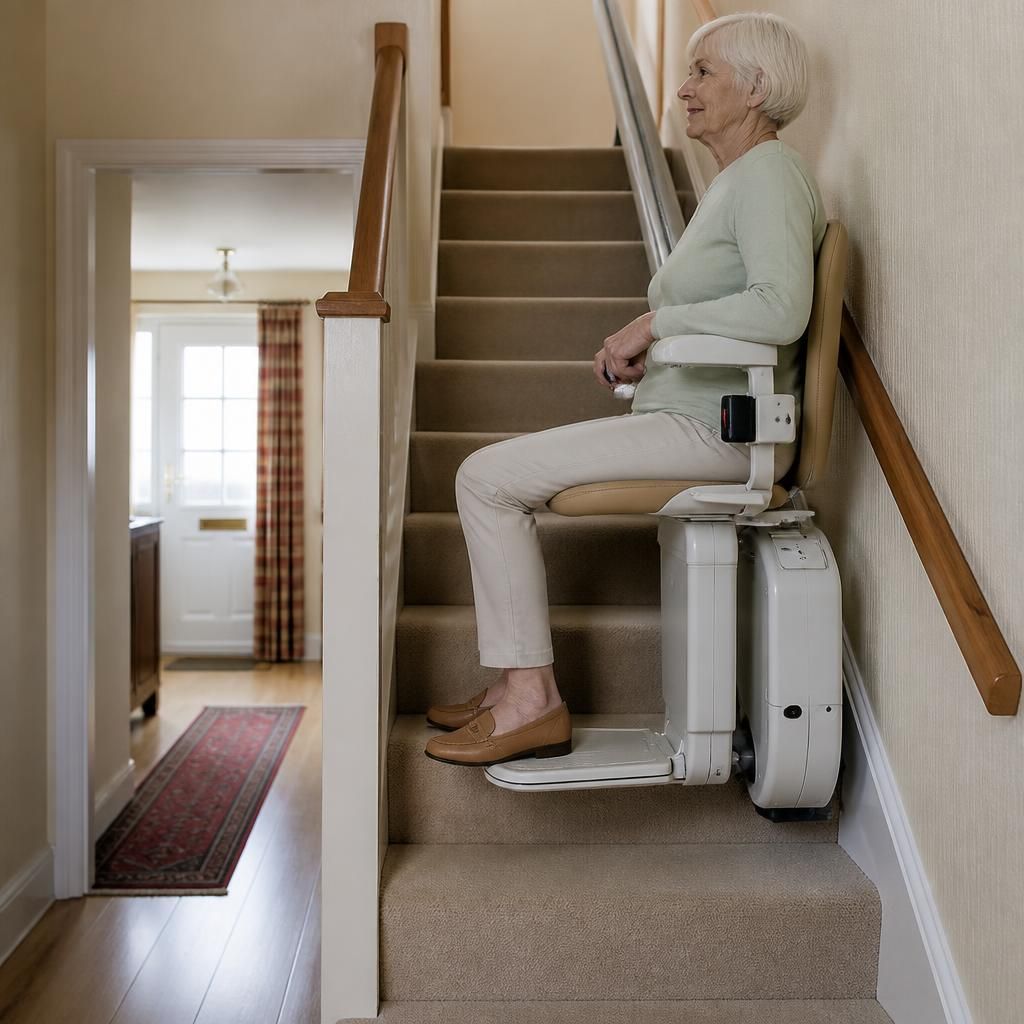
Compare the features that affect usable space. On narrow stairs, the folded dimensions of the seat, arms and footrest can be as important as the overall width of the unit in use. Useful features may include a slim seat, folding arms, a compact or hinged footrest, and a rail position that keeps the stairway as clear as practical. A powered swivel seat can also help the user turn towards the landing before getting off, although the space required at the top must be checked carefully.
Some stairlifts can be parked at the top or bottom, or beyond the first step, to keep a landing or doorway clear. A hinged rail may be considered where the rail would otherwise extend across an entrance. These features do not make every staircase suitable, and they can change the installation requirements, so they should be assessed in the context of the actual home rather than selected from a specification sheet alone.
Match the lift to the user, not just the staircase. Consider how easily the user can sit down, stand up, turn, bend their knees and operate the controls. Seat height, armrest position, footrest support, seat width and the ease of fastening the safety belt can all influence whether the stairlift is practical for daily use. Someone with painful knees may need a different arrangement from someone whose main difficulty is balance. If more than one person will use the stairlift, the assessment should account for both users’ requirements.
Controls should be reachable and straightforward to operate. A remote control can allow the lift to be called to another level, while controls on the armrest let the user operate it during travel. The most suitable control style depends on hand strength, dexterity, vision and any conditions affecting movement. A professional should also check that the user can release the control safely and understands the journey procedure.
Check safety and access at both ends. A narrow staircase still needs safe boarding and exit areas. The user must have enough room to approach the seat, turn where necessary and move away from the stairlift after reaching the landing. Safety equipment commonly considered includes a seat belt, sensors that detect obstructions, controlled movement, secure armrests, a stable footrest and a swivel or powered swivel seat where appropriate. The final arrangement should not block essential routes or create a new trip hazard.
For curved staircases, the rail route is particularly important. The installer should examine the inside and outside of each bend, the width of the landings and the clearance beneath or beside the lift. A bespoke rail may be preferable to trying to adapt a straight model to a layout it was not designed to follow. In some homes, the rail can be positioned to preserve access around a bend; in others, a different seat style or parking position may be needed.
Ask how the installation will be customised. A proper recommendation should explain where the rail will be fixed, how the stairlift will park, whether the handrail or other fittings affect the design, and what access will remain after installation. The installer should also identify electrical requirements, charging positions and any practical limitations before you commit to a model. Stairlifts are normally fixed to the stairs or adjoining structure rather than relying on the wall, but the proposed fixing arrangement should still be explained for your particular staircase.
If cost is a consideration, a reconditioned stairlift may be an option for some straightforward layouts. However, availability and suitability depend on the staircase and the user’s needs. A reconditioned unit is not automatically the best choice for a narrow or curved staircase if it cannot provide the required rail route, seating position, controls or safety features. The condition, warranty, servicing arrangements and suitability of the specific equipment should be confirmed before purchase.
When comparing recommendations, look beyond the narrowest published measurement. Ask whether the quoted dimensions refer to the lift folded, occupied or parked; what clearance remains for other people; whether the seat and footrest can be adjusted; and what happens if the user stops on the stairs or there is a power failure. You should also confirm what alterations, maintenance and aftercare are included.
In practice, the selection process is: assess the staircase and landings, establish the user’s physical requirements, identify the least obstructive suitable design, then confirm the rail route and safety arrangements through a home survey. This approach is more dependable than choosing a model solely because it is described as slimline. The final recommendation should provide safe travel and straightforward transfers while retaining as much everyday access to the stairs and surrounding areas as the home allows.
For narrow stairs, the space a stairlift leaves when folded can be just as important as its width while travelling. A compact seat, folding arms and a slim or folding footrest may help preserve access for other people, but the actual clearance must be checked in your home.
Ask the installer to assess the full route, including doors, handrails, radiators and the areas where you get on and off. A stairlift that fits the treads may still obstruct a doorway or leave too little room to turn safely at the landing. The most suitable model is therefore the one that balances compact dimensions with the user’s seating, transfer and safety requirements.
Arrange a Home Assessment for Your Narrow Stairs
Arrange a home assessment for your narrow stairs so we can check the staircase, landings, access points and your individual mobility needs before recommending a suitable stairlift.