
What safety measures and features should I consider when selecting a stairlift to ensure maximum security for elderly users?
Choose a stairlift with obstruction sensors, a secure seatbelt, a powered swivel seat, reliable braking, easy-to-use controls and battery backup for safe movement during a power cut. A professional assessment should also confirm that the seat, footrest, controls and track position suit the user’s mobility and staircase.
For maximum security, choose a stairlift with effective obstruction sensors, a secure seatbelt, a powered swivel seat, dependable braking, simple controls and battery backup. These features should be matched to the user’s balance, strength, vision, hearing and ability to transfer on and off the seat. A professional home assessment is essential because safe operation depends on the complete installation, not just the stairlift specification.
Obstruction detection and controlled stopping
Sensors beneath the footrest and around the carriage should detect objects on the stairs and stop the lift smoothly before contact. This is particularly important where pets, loose rugs, footwear or other household items could enter the lift’s path. Ask how the stairlift responds when a sensor is activated and ensure the obstruction can be removed without placing the user at risk.
A stairlift should also have controlled acceleration, deceleration and stopping. Movement that starts or ends abruptly can affect an older person’s balance, confidence or ability to remain correctly positioned. Reliable braking should hold the lift securely when it stops, including when the user pauses part-way along the staircase.
Seatbelt and seating security
A properly positioned seatbelt is a core safety feature. It should be easy for the user to fasten and release, while remaining secure during travel. A retractable belt can be useful where limited dexterity makes handling a loose strap difficult. The belt position, seat width, armrest spacing and back support should all be checked during the assessment rather than selected by appearance alone.
For anyone who finds standing or turning difficult, a powered swivel seat can make transfers safer. It rotates the seat towards the landing at the top of the stairs, allowing the user to sit down or stand up while facing away from the stair edge. The seat should lock in the correct position before the user transfers. Where a powered swivel is not suitable, a manual swivel mechanism may still help, provided the user can operate it safely and reliably.
Footrest and armrest protection
A stable, suitably sized footrest should support both feet throughout the journey. Look for a design that reduces the risk of a foot slipping beneath the footrest or catching against the stairs. Sensors on or around the footrest provide an additional safeguard by stopping the lift if an object is detected.
Armrests should provide steady support without restricting access to the controls. They need to be positioned so the user can sit centrally and maintain a balanced posture. Folding or retractable sections may be helpful where the staircase is narrow, but they must not make getting on or off the lift more complicated.
Controls that suit the user
Controls should be clearly marked, easy to reach and simple to operate. A user with reduced grip strength, arthritis or limited vision may benefit from a large, tactile control or a simple directional switch rather than a small, multi-function handset. The controls should require deliberate activation to prevent unintended movement, and the handset should be available at the relevant landings if more than one person uses the stairlift.
Check whether the user can stop the lift quickly and understand the audible or visual indicators. If hearing or sight is impaired, the installation should use a combination of clear physical feedback, lights, tones or spoken guidance as appropriate. The emergency stop control should be identifiable and accessible without requiring the user to lean forward or twist.
Battery backup and power reliability
Battery operation allows most stairlifts to complete a journey during a mains power cut, provided the batteries are charged and maintained. Confirm where the stairlift parks to charge, whether it charges at both ends of the track and what happens if it is left away from a charging point. The user should know how to respond to a low-battery warning and who to contact if the lift will not operate.
Battery backup is not a substitute for servicing. Batteries gradually lose capacity, and a warning signal, slower operation or failure to hold a charge should be reported promptly. The charger, electrical connections and safety cut-outs should be checked as part of routine maintenance.
Track position and staircase clearance
The track should be positioned to provide adequate clearance from walls, doors and the stair edge while preserving access for other household members. On a narrow or unusually shaped staircase, a folded seat, compact design or alternative parking position may reduce obstruction when the lift is not in use. The chosen position must still allow the user to approach, sit down and leave the seat without stretching or turning dangerously.
At the top and bottom of the stairs, consider whether the user can transfer safely onto level flooring. A longer track, powered swivel, hinged rail or alternative parking arrangement may be appropriate where a doorway, hallway or narrow landing creates a hazard. These decisions should be made during an on-site assessment rather than relying on measurements alone.
Safety features for particular needs
- Reduced balance or trunk control: prioritise supportive seating, a secure belt, steady acceleration and a powered swivel that locks before transfer.
- Limited leg movement: check that the footrest supports the legs comfortably and that the user can sit fully back against the seat.
- Arthritis or reduced hand strength: choose controls, belts and swivel mechanisms that can be operated without excessive force.
- Visual or hearing impairment: confirm that controls, warnings and the direction of travel are communicated in a way the user can recognise.
- Higher body weight or a larger frame: verify the manufacturer’s stated safe working load and ensure the seat and track configuration are suitable for the staircase.
- Outdoor access: select equipment designed for outdoor conditions, with suitable protection from moisture and temperature changes, and follow the recommended charging and maintenance arrangements.
Installation, testing and ongoing support
Safe installation includes checking the staircase structure, fixing points, landings, electrical supply and travel path. The installer should test sensors, braking, seat locking, the belt, controls, charging system and emergency functions before handover. The user and any regular carer should receive practical instruction, including how to position themselves, use the belt, stop the lift, deal with an obstruction and report a fault.
Choose a provider that can explain the servicing schedule, battery replacement process, fault reporting arrangements and emergency support. Keep the track and charging points clear, avoid placing objects on the stairs, and report unusual noise, vibration, jerky movement, warning lights or repeated stopping. Do not bypass a safety sensor or attempt electrical repairs yourself.
Finally, reassess the stairlift if the user’s mobility, weight, posture or ability to transfer changes. A feature that is suitable today may need adjustment, additional support or a different seating arrangement later. The safest choice is therefore the combination of suitable safety features, a correctly assessed installation, clear user training and dependable aftercare.
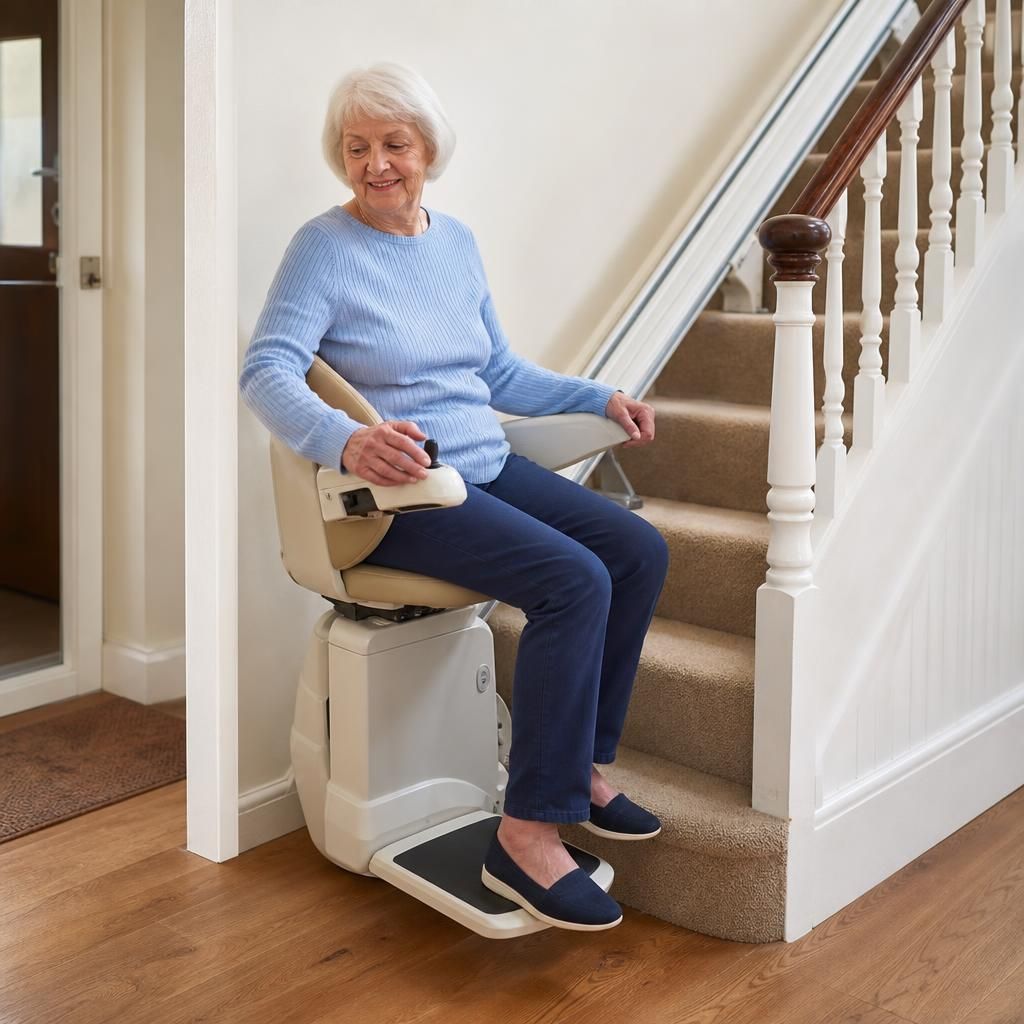
A powered swivel seat helps an older user transfer on and off a stairlift more safely by turning towards the landing at the top of the stairs. The seat should rotate smoothly and lock securely before the user stands, reducing the need to twist or balance near the stair edge.
During the assessment, check that the user can sit fully back, use the seatbelt and operate the swivel control without excessive force. The landing must provide enough space for a stable transfer, and the seat, armrests and footrest should support the user’s posture throughout the journey. If a powered swivel is unsuitable, a manual option may be considered only when the user can operate it reliably.
Arrange a stairlift safety assessment
Arrange a stairlift safety assessment with Independent Stairlifts to check that the seating, controls, safety features and installation suit the user and staircase. We can also explain suitable options and ongoing support before you make a decision.