
What key features should I look for in a stairlift to ensure it meets the unique needs of elderly users in my home?
For elderly users, the most important stairlift features are dependable safety systems, comfortable seating, simple controls and a layout that suits the staircase and the user’s mobility. Look for a powered swivel or level seat, adjustable supports, secure restraint, obstruction sensors, smooth starting and stopping, and controls that are easy to operate from either end of the stairs.
The most important stairlift features for an elderly user are reliable safety systems, comfortable and supportive seating, straightforward controls, and a design that fits both the staircase and the person using it. A suitable lift should allow the user to travel steadily, get on and off safely, and operate the controls without excessive reaching, gripping or bending.
Start with the user’s mobility and confidence
Features should be selected around the user rather than treated as a standard checklist. Consider whether they have difficulty bending their knees, turning, standing from a chair, using their hands, judging distances or sitting upright for the length of the journey. Also consider whether their mobility is likely to change. Someone who currently manages a manual swivel may later benefit from powered operation, while a person with limited hand strength may need a larger, simpler control.
An assessment in the home helps identify these requirements alongside the shape, width and access points of the staircase. It should also consider where the user will sit before starting the journey and where they will step off at the top or bottom.
Prioritise safe entry and exit
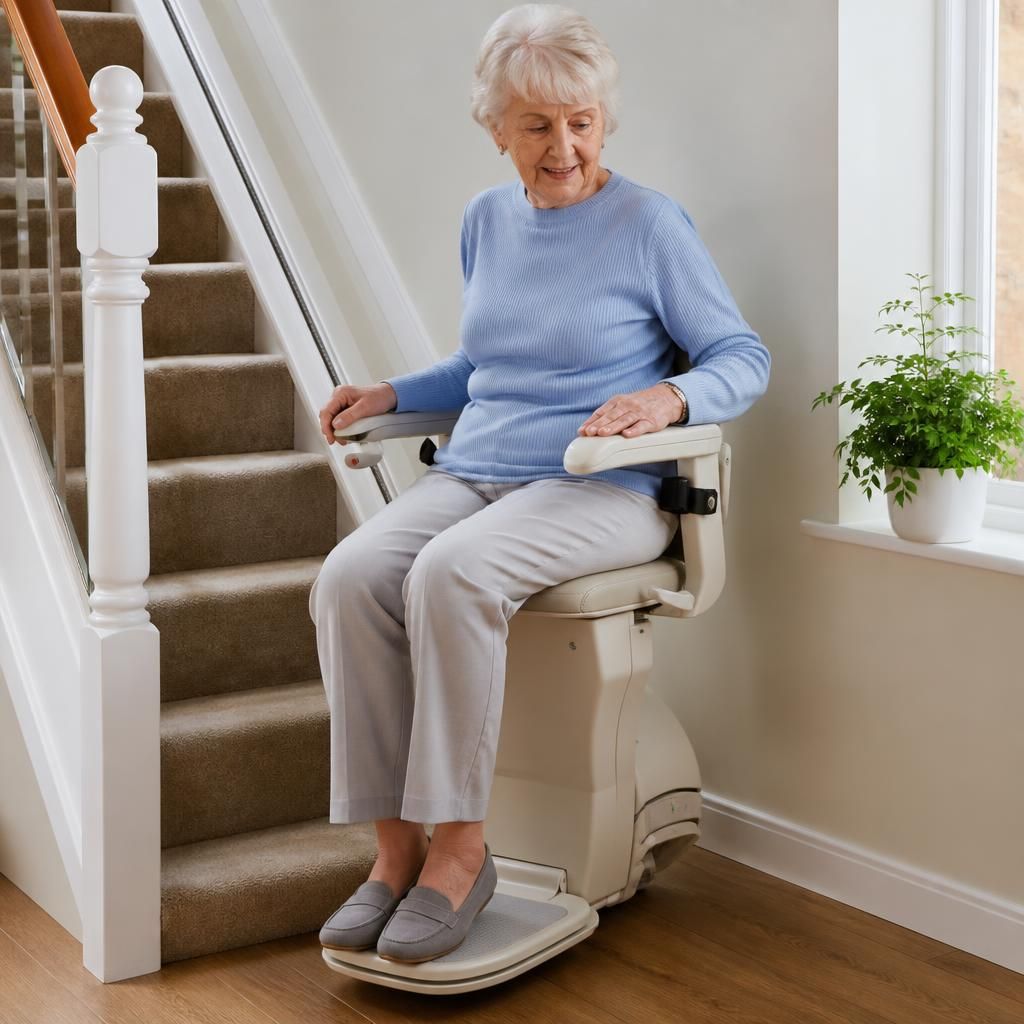
- Swivel seat: A manual or powered swivel seat can turn the user towards the landing, helping them get off without twisting towards the stairs. A powered swivel may be preferable where the user has limited balance, strength or upper-body movement.
- Level or powered swivel options: Depending on the staircase and landing, a seat that helps the user reach a safer position before standing can make transfers easier. The exact arrangement needs to be checked during a survey.
- Secure armrests: Firm, suitably positioned armrests provide support while sitting down and standing up. They should not make the seat feel cramped or obstruct the user’s transfer.
- Footrest protection: A stable footrest supports the feet during travel. Some models include sensors that stop the lift if the footrest meets an obstruction.
- Seat belt or restraint: The restraint should be easy to fasten and release, sit comfortably across the user, and remain secure throughout the journey. If the user has reduced dexterity, the buckle should not require fine finger movements.
Look for a smooth and controlled ride
Gentle starting and stopping reduces sudden movement when the lift sets off or reaches the landing. A controlled speed and stable seat can make the journey more comfortable for users who are unsteady, anxious about movement or affected by joint pain. The stairlift should also stop accurately at the intended landing position, allowing the user to dismount without stepping into an awkward space.
Obstruction sensors are an important feature. They are designed to stop the lift if an object is detected in its path, although the stairs should still be kept clear. A diagnostic or fault indicator can also help identify a problem before the lift is used again.
Choose controls that are easy to understand
Controls should be usable without complicated sequences or small, closely spaced buttons. A simple directional control on the armrest is often easier to operate than a control requiring precise finger movement. The user should be able to understand which way the lift will travel and release the control easily to stop.
Call and send controls at the top and bottom of the stairs allow the lift to be brought to the required level. This is particularly useful in a household where more than one person uses the staircase. Remote controls should have clear buttons and be kept where they can be reached safely, rather than requiring the user to lean across the stairs.
If the user has reduced vision, controls with clear contrast and tactile differences may be helpful. If they have reduced hearing, visual status indicators can supplement audible alerts. The assessment should include a practical demonstration so the user can operate the controls confidently.
Check the seat, support and adjustment
Comfort is not simply a matter of padding. The seat width, height, back support, armrest position and footrest length should suit the user’s body and posture. Adjustable elements can be valuable where the user is particularly tall or short, or where more than one person may use the lift.
A supportive backrest helps the user remain upright, while a firm seat can make standing easier than a very soft cushion. The user should be able to sit squarely with their feet supported and their arms inside the armrests. If they use a walking aid, wheelchair or other mobility equipment, check where it can be left safely at each end of the stairs; it should not be carried on the stairlift unless the equipment is specifically designed and approved for that purpose.
Match the lift to the staircase and home
A straight staircase may accommodate a different rail arrangement from a curved or multi-flight staircase. For narrow stairs, a folded seat and compact design may help preserve access when the lift is not being used. Where the staircase opens directly into a doorway or walkway, a hinged or retractable rail may be needed to avoid creating an obstruction, subject to a proper site assessment.
For an outside staircase, the equipment must be suitable for outdoor exposure and positioned where drainage, weather protection and safe access can be managed. The installation should also account for lighting, floor surfaces and the user’s ability to reach the seat in changing weather conditions.
Consider power and reliability
Rechargeable batteries allow many stairlifts to operate during a mains power cut, provided the batteries are charged and maintained correctly. Charging points should be positioned so the lift can charge at the appropriate end or ends of the rail. Ask how the lift behaves when the battery is low, what warning it gives, and what support is available if it stops working.
Useful reliability features include clear fault indication, accessible emergency stopping controls and a design that permits routine servicing. Regular maintenance should check the batteries, charging points, drive system, safety sensors, restraint and mechanical fixings. Keeping the rail and stairs clear also supports safe operation.
Allow for changing needs
A stairlift should be assessed against likely future requirements, not only the user’s current ability. Ask whether the seat and controls can be adjusted, whether powered options can be added or selected from the outset, and whether the arrangement will remain suitable if the user needs more support when transferring. If needs change substantially, a new assessment may be necessary rather than assuming the original configuration will remain appropriate.
Before making a decision, the user should try the seat, belt, controls and swivel mechanism in a position that reflects the actual staircase. Confirm the maximum user weight specified for the model, the available support arrangements, warranty terms, servicing process and what happens in a power or equipment failure. The best feature combination is the one that provides safe transfers, comfortable travel and uncomplicated daily use within the particular home.
A powered swivel seat is an important feature for elderly users who find it difficult to twist, balance or stand safely at the top or bottom of the stairs. It turns the user towards the landing before they leave the seat, reducing the need to step off while facing the staircase.
Check that the seat, armrests and footrest provide stable support and that the restraint is easy to fasten and release. The user should be able to sit upright, keep their feet supported and operate the swivel without excessive reaching or gripping. During a home assessment, the transfer should be tested at both ends of the staircase to confirm that the seat position and landing space are suitable.
Arrange a Stairlift Assessment for Your Home
Arrange a stairlift assessment in your home to review the user’s mobility, staircase layout and essential safety features. Independent Stairlifts can help you identify a suitable configuration and explain the available options.