
What factors should I consider when choosing an assisted chair lift for elderly use?
When choosing an assisted chair lift for elderly use, consider the user’s mobility, balance, height, weight, comfort and ability to operate the controls, as well as the available space and the chair’s safety features. A professional assessment should confirm whether a lift chair or stairlift is the more suitable solution and ensure it is correctly sized, positioned and supported.
An assisted chair lift, usually called a riser recliner or lift chair, is a powered armchair that raises and tilts to help a person stand and lowers them into a seated position. The most suitable model depends on the user’s mobility, balance, body measurements, comfort, the space available and the level of assistance required. It is important to confirm that a lift chair is the right solution; it supports sitting and standing but does not provide access between floors, which is the role of a stairlift.
Start with an assessment of the user’s needs. Consider how the person currently gets in and out of a chair, whether they can bear weight through their legs, and whether they need help from a carer. A lift chair may be appropriate for someone who can stand with controlled assistance but struggles to push up from a low seat. If the user has very limited weight-bearing ability, significant balance problems or difficulty following instructions, a professional assessment should establish whether a different transfer aid or additional care support is needed.
- Consider strength in the legs, hips and upper body.
- Assess balance, coordination and the ability to remain safely positioned while the chair moves.
- Check whether the user can operate a handset, recognise the buttons and release the controls when required.
- Take account of arthritis, joint stiffness, pain, swelling, circulation problems or pressure-care requirements.
- Ask whether the chair will be used independently or with help from a family member or carer.
Choose the correct size and seating position. A chair that is too large may leave the user unsupported, while one that is too small can restrict movement and create pressure on the knees or hips. The user’s height, weight, leg length, hip width and preferred sitting position should be measured rather than estimated. When seated, the feet should rest securely on the floor or footrest, the knees should be comfortably bent and the back should be supported without forcing the user forwards. The armrests should be at a useful height for support when sitting down and standing up.
Check the maximum user weight specified for the chair and consider whether the seat, frame and mechanism are suitable for the intended level of use. A heavy-duty model may be necessary where additional strength or width is required. This should be established during an assessment, as a higher weight capacity alone does not guarantee that the chair will provide the correct posture or transfer support.
Compare the lift and recline actions. Different mechanisms provide different types of assistance. A two-position chair may offer an upright position and a raised footrest, whereas a multi-position or dual-motor chair can allow the backrest and footrest to be adjusted more independently. The best option depends on whether the user mainly needs help standing, wants to rest with their legs raised, or needs to change position regularly.
- The lift action should raise the user steadily and bring them to a position where both feet can be placed safely before standing.
- The recline action should support the head, neck, back and legs in the user’s preferred resting position.
- The footrest should extend and retract without trapping feet, clothing or nearby objects.
- The handset should allow simple, controlled movements rather than requiring complicated sequences.
- The chair should stop when the control is released, in accordance with the manufacturer’s operating design.
Prioritise safety features and safe transfers. Look for a stable base, secure armrests, an appropriate seat height and controls that are easy to reach. The chair should not move while the user is getting in or out unless its instructions specifically allow that function. Keep the floor around the chair clear, ensure the chair is positioned on a stable surface and avoid using loose rugs or trailing cables nearby. A carer should follow the manufacturer’s guidance and should not pull the user by the arms during a transfer.
Some chairs include features such as battery backup, handset locking, removable covers or pressure-relieving upholstery. These can be useful, but their suitability depends on the user and the home. Battery backup can allow the chair to be returned to a safe position during a power cut, but it should not be treated as a substitute for safe transfers or regular servicing. Ask how each feature works and whether it can be maintained or replaced when necessary.
Check the available space before choosing a model. Measure the area where the chair will stand, including the clearance needed behind it when reclining and in front when the footrest is raised. Leave enough room for the user or carer to approach from the safest side. Check the position of doors, radiators, windows, sockets and other furniture. A chair that fits when upright may block a walkway or prevent access to a cupboard when reclined.
Also consider the route into the property and the intended room. The chair may need to pass through doorways, hallways or around corners during delivery. The floor must be able to support the chair, and the mains cable should reach a suitable socket without creating a trip hazard. Installation and positioning advice can identify these issues before delivery.
Consider comfort, upholstery and pressure management. The user may spend a substantial part of the day in the chair, so cushioning, lumbar support, head support and leg positioning are important. The upholstery should be appropriate for the user’s needs and easy to clean. If the person is at risk of skin damage or spends prolonged periods seated, obtain advice from an appropriate healthcare professional about pressure care. A standard lift chair may not provide the specialist support required for a complex clinical condition.
Comfort should be checked in every available position, not only when the chair is upright. Confirm that the head is supported when reclined, the knees are not raised uncomfortably and the user does not slide forwards. A trial or detailed assessment is preferable to choosing solely from photographs or general dimensions.
Make sure the controls are suitable. Handsets should have clear, tactile buttons that can be identified without precise finger movement. Consider reduced vision, tremors, arthritis, hearing loss or memory difficulties. The handset cable should be long enough to reach the user without stretching, but should be routed so it cannot become a trip or entanglement risk. If more than one person will use the chair, agree how the controls will be stored and operated safely.
Ask what happens if the handset is lost or stops working, and whether manual release procedures are available. A user who cannot operate the chair independently should not be left reliant on controls they cannot understand or reach. Make sure family members and carers receive clear operating instructions.
Plan for changing mobility needs. A person’s ability to stand, transfer and operate the chair may change over time. Consider whether the selected chair will remain useful if the user needs more support, spends longer seated or begins using a walking aid. It may also be necessary to review the position of other furniture, the availability of space for a carer and access to essential rooms.
For someone who has difficulty reaching the chair because the bedroom and living areas are on different floors, an assisted chair lift will not solve the access problem. In that situation, discuss whether a stairlift, a different seating arrangement or a combination of equipment is more appropriate. The chair and any stairlift should be assessed together where transfers between them are likely.
Check installation, servicing and aftercare. Before committing, ask who will assess the user and room, what delivery and installation involve, and how faults will be dealt with. Find out whether servicing, replacement handsets, batteries and upholstery repairs are available. Keep the operating instructions and service information where carers can find them, and report unusual noises, jerky movement, overheating, damaged cables or a change in the lift action promptly.
Finally, compare the total cost rather than only the purchase price. Include delivery, installation, servicing, consumable parts and any adaptations needed in the room. A professional assessment should confirm the correct chair size, explain the available mechanisms and identify whether a lift chair, stairlift or another mobility solution best matches the user’s circumstances.
An assisted chair lift, also known as a riser recliner or lift chair, helps an older person sit down and stand up by raising and tilting the seat. It does not transport the user between floors, so it should not be confused with a stairlift.
Before choosing one, assess how the user transfers, including their leg strength, balance, height, weight and ability to operate the handset. The chair should raise steadily, provide secure support for the feet and arms, and leave enough space for the user or carer to move safely. If the person cannot bear weight reliably or has complex posture or pressure-care needs, seek a professional assessment to confirm whether a lift chair or another transfer aid is most suitable.
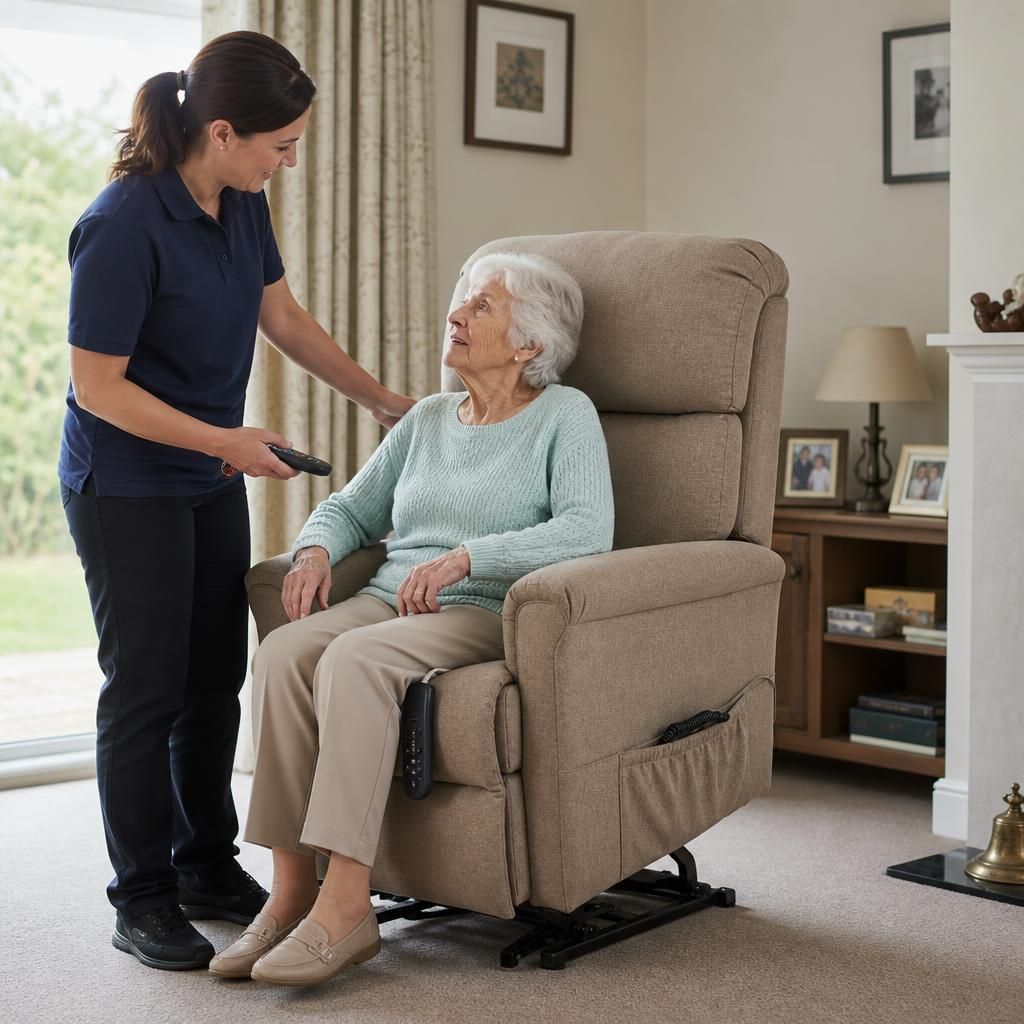
Discuss your assisted chair lift requirements
Discuss your assisted chair lift requirements with our team so we can assess the user’s needs, available space and the most suitable support option.