
How do recliner lift chairs accommodate different body sizes and weights?
Recliner lift chairs accommodate different body sizes and weights through varied seat widths, depths, heights and weight capacities, helping provide proper support while the powered mechanism assists with standing and sitting. An individual assessment ensures the chair’s dimensions, cushioning, controls and lifting action are suitable for the user’s posture, mobility and available space.
Recliner lift chairs accommodate different body sizes and weights by offering variations in seat width, seat depth, seat height, cushioning, frame strength and maximum user weight. The correct chair should support the user’s posture without restricting movement, while allowing the powered lift mechanism to raise them safely into a standing position.
Seat dimensions are central to a good fit. A chair that is too narrow can place pressure on the hips and thighs, while one that is too wide may not provide enough lateral support. Seat depth is equally important. When seated fully back, the user should be able to keep their back against the backrest without the front of the seat pressing behind the knees. If the seat is too deep, the user may slide forwards or adopt a slouched posture; if it is too shallow, the thighs may not be adequately supported.
Seat height affects both comfort and transfers. A lower seat may suit someone with shorter legs, whereas a taller user may need additional leg support and a higher seat. The user’s feet should rest securely on the floor when the chair is upright, rather than dangling or being pushed too far forwards. This helps provide stability when sitting down and standing up.
Weight capacity must be checked against the user’s actual requirements. Every lift chair has a maximum recommended user weight set by its manufacturer. This rating relates to the chair’s frame, motor, lifting mechanism and recline system, so it should not be treated as a guideline to exceed. The assessment should consider the user’s current weight, any likely changes, clothing and personal equipment, and how the chair will be used. A heavy-duty or bariatric model may be more suitable where a standard chair does not provide an appropriate margin of support.
Weight alone does not determine suitability. Two people with a similar weight may require different chairs because of differences in height, hip width, leg length, posture, muscle strength or the way they transfer from sitting to standing. A person with a broader build may need a wider seat and stronger lateral support, while a taller person may require a deeper seat, higher backrest and longer footrest.
The lift action should match the user’s mobility and balance. When operated, the chair gradually tilts and raises the user forwards, reducing the effort needed to stand. The movement should be steady and controlled, with the user remaining supported by the backrest and armrests. A suitable model should not place the user too far forwards, cause their feet to lose contact with the floor prematurely or require them to pull themselves up using the controls.
Backrest height and shape also affect support. Some users need a high backrest to support the head and upper body, while others may be more comfortable with a lower or contoured design. The amount of padding should provide support without allowing the user to sink so deeply that standing becomes more difficult. Firmness is a personal consideration, but the cushion should remain supportive when the chair is fully reclined as well as when it is upright.
Armrest position is particularly important for people with limited strength, arthritis or reduced balance. The armrests should be at a comfortable height and wide enough to support the forearms without forcing the shoulders upwards. They also need to be positioned so the user can place their hands securely when the chair lifts. Controls should be easy to reach and operate, including where hand strength or dexterity is limited.
Leg and foot support must be suitable for the user’s height. The footrest should support the lower legs without leaving the heels unsupported or pressing against the calves. On some chairs, the footrest length and recline angle are better suited to particular body proportions than others. The chair should also have sufficient room to recline fully without the user’s feet extending beyond the supported area.
An individual assessment normally considers:
- the user’s height, weight, hip width and leg length;
- how they currently sit down, stand up and transfer;
- their posture, balance, strength and range of movement;
- any back, hip, knee or joint problems that affect positioning;
- the required seat height, width, depth and backrest support;
- the position and ease of use of the handset or other controls;
- the room layout, including clearance for reclining and the lifting movement; and
- the chair’s manufacturer-approved maximum user weight.
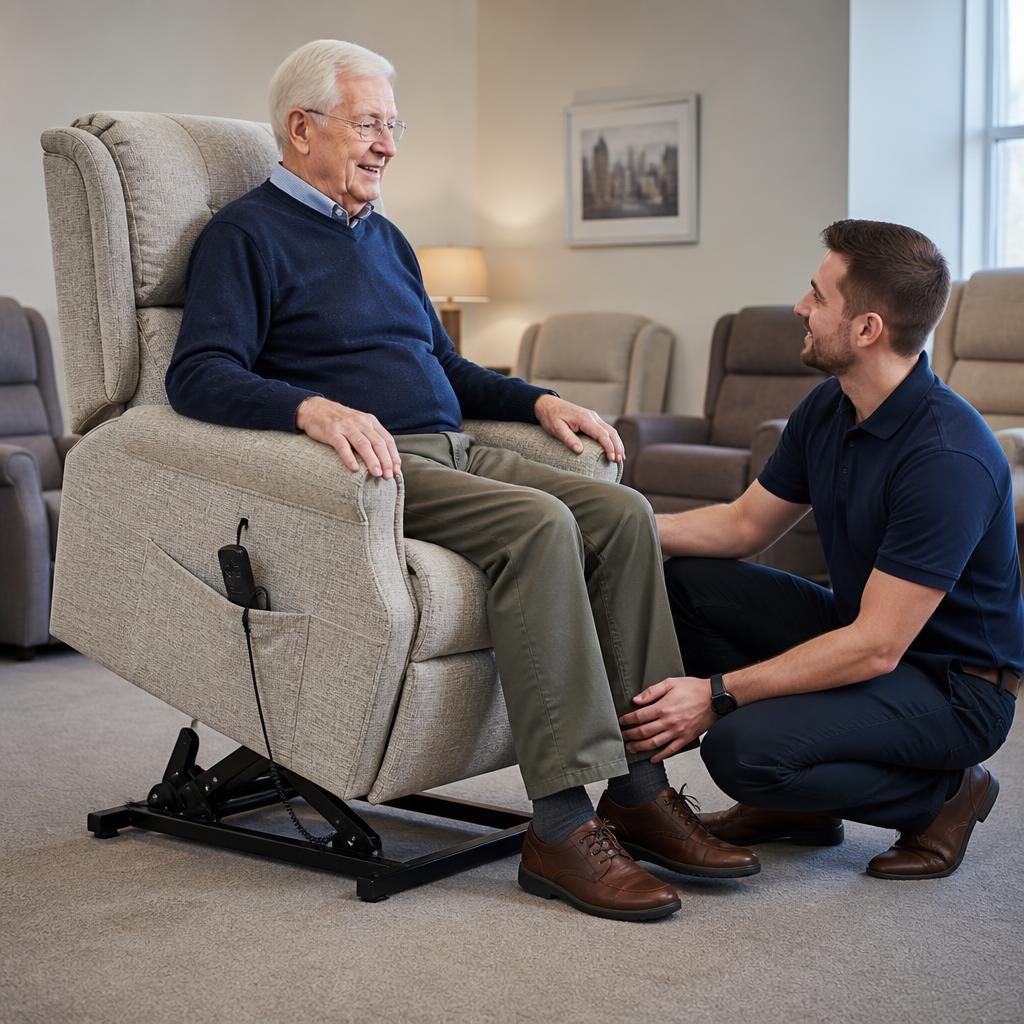
Trying the chair in the upright, partially reclined and fully reclined positions can identify problems that may not be obvious from measurements alone. The user should be able to sit back comfortably, operate the controls, maintain a stable position and return to standing without excessive effort. Where the chair is for someone who cannot attend an assessment, accurate measurements and information from a carer or family member are especially useful.
Do not choose a lift chair solely because it looks similar in size to an existing armchair. External dimensions do not show how much usable seating space is available, and a chair that fits the room may not fit the user correctly. It is also important not to add cushions or raised supports without professional advice, as these can alter the user’s position relative to the lifting mechanism and affect stability.
The most suitable choice is therefore based on the complete combination of body measurements, weight capacity, posture, mobility and room requirements. Independent Stairlifts can help assess these factors and identify a recliner lift chair that provides appropriate support, comfortable positioning and a safe, practical lifting action.
Recliner lift chairs accommodate different body sizes and weights through variations in seat dimensions, cushioning, frame strength and manufacturer-approved weight capacity. Choosing the correct combination is important because a chair that supports weight but does not fit the user’s height, hip width or leg length may still be uncomfortable or unsafe.
Check the usable seat width and depth rather than relying only on the chair’s external measurements. The user should be able to sit fully back with their feet supported, while avoiding pressure behind the knees or excessive sideways movement. The seat height should also allow the feet to rest securely on the floor when the chair is upright.
The maximum user weight must never be exceeded. Where a standard model does not provide suitable support or enough capacity, a heavy-duty or bariatric lift chair may be more appropriate. An assessment should also consider posture, balance, transfer technique and any changes in weight or mobility, so the lift movement and seating position work together safely.
Arrange an assessment for the right lift chair
Arrange an assessment with Independent Stairlifts to check the chair’s seat dimensions, weight capacity, lift action and positioning against your requirements. We can help identify a recliner lift chair that provides suitable support and allows safer, easier transfers.