
Do recliner lift chairs require professional installation or can they be set up at home?
Most recliner lift chairs are delivered largely assembled and can be set up at home, but professional installation is recommended to ensure correct positioning, safe electrical connection and proper operation. An installer can also check that the chair suits the user, clears surrounding furniture and is safe to use before demonstrating its controls.
Most recliner lift chairs are delivered largely assembled and can be set up at home, but professional installation is recommended wherever possible. A trained installer can position the chair safely, complete any required assembly, check the electrical connection and demonstrate the lifting and reclining functions. This is particularly useful when the chair will be used by someone with limited mobility, reduced balance or difficulty understanding new controls.
What home set-up usually involves
The exact process depends on the chair model. Some chairs only require the back section, handset or power connection to be fitted, while others may need additional components attached before use. Home set-up should always follow the manufacturer’s instructions. The chair should be placed on a level, stable surface with sufficient clearance behind and in front of it for the backrest, footrest and lifting mechanism to move without contacting walls, tables or other furniture.
The power supply should be connected as instructed, with the transformer and cables positioned where they cannot be trapped by the mechanism or create a trip hazard. Use a suitable mains socket and avoid making changes to the electrical components. Extension leads or adaptors should not be used unless they are specifically permitted by the manufacturer and are suitable for the chair’s requirements.
Why professional installation is advisable
- Safe positioning: the installer can check that the chair has enough operating space and will not obstruct doorways, walking routes, radiators or other essential furniture.
- Correct assembly: any detachable sections, handset connections and power components can be fitted in accordance with the manufacturer’s instructions.
- Operational checks: the lift, recline and return-to-standing movements can be tested to confirm that the chair operates smoothly and stops correctly.
- User assessment: the installer can check that the user’s feet, knees and back are supported appropriately and that the chair reaches a practical standing and sitting position.
- Practical demonstration: the user and, where appropriate, a family member or carer can learn how to use the handset, stop the chair’s movement and deal with the power supply safely.
Professional installation also provides an opportunity to identify problems that may not be obvious when the chair is unpacked, such as insufficient clearance, an unsuitable socket location or a position that makes it difficult for the user to approach the chair safely.
When home set-up may be suitable
Home set-up may be reasonable when the chair arrives fully assembled, the delivery instructions specifically allow self-installation and the person carrying out the work can safely move and position it. The room should be prepared first, with a clear route from the entrance to the intended position. A chair should not be dragged across flooring or lifted without suitable assistance, as it may be heavy and awkward to handle.
Even when no assembly is required, the chair should not be used immediately without checking that the handset is connected, the power lead is secure, the mechanism has clear space and all functions work as intended. The user should be shown how to sit centrally, keep feet and hands clear of moving parts, and operate the chair only when properly seated.
Situations where professional help is especially important
Arrange professional installation if the chair needs significant assembly, is being placed in a confined room, or must be positioned close to other furniture. It is also strongly advisable when the user has poor balance, weakness, cognitive impairment, severe arthritis, back problems or difficulty following instructions. A professional assessment can help confirm that the chair is suitable for the user rather than simply checking that it powers on.
Do not attempt to repair a lifting or reclining mechanism, alter the wiring or bypass a safety feature during set-up. If the chair makes an unusual noise, moves unevenly, fails to respond to the handset or becomes trapped against an obstruction, stop using it and contact the supplier or a suitably qualified service professional.
In practice, self-installation is possible for some models, but professional installation offers greater assurance that the chair is assembled, positioned and demonstrated correctly. It is the safer choice when the user’s mobility needs are complex or when there is any uncertainty about the room layout, electrical connection or operation of the chair.
Most recliner lift chairs can be connected and prepared at home, but professional installation is advisable when safe positioning, assembly or user suitability is uncertain. An installer can place the chair on a stable surface, check that the lifting and reclining movements have adequate clearance, connect the power supply correctly and test the handset before use.
This support is particularly valuable for anyone with limited mobility, poor balance or difficulty following new instructions. The installer can also demonstrate how to sit centrally, operate the lift function safely and keep hands and feet clear of moving parts, helping the user and any carer feel confident using the chair.
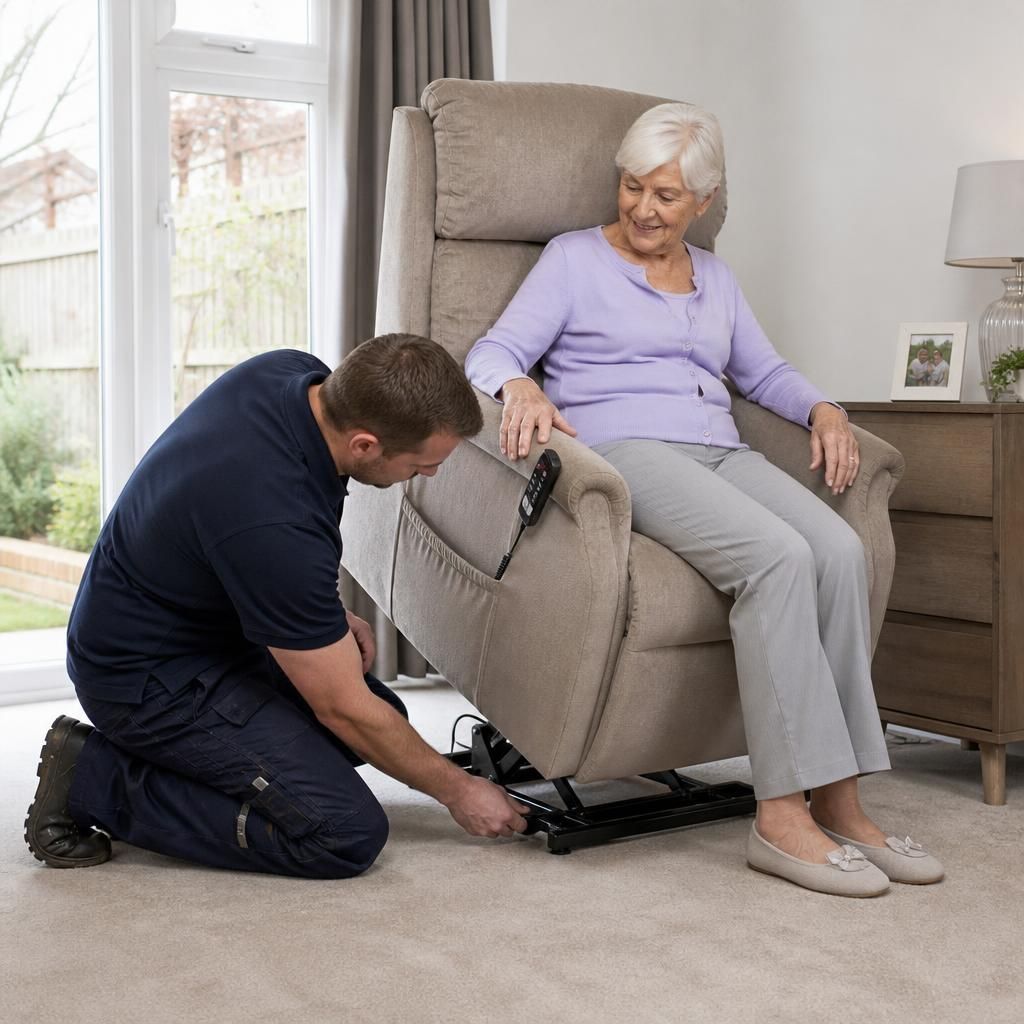
Arrange professional advice for your recliner lift chair
If you are unsure whether your recliner lift chair can be safely set up at home, arrange professional advice before using it. We can help check the room layout, positioning, power connection and operation so the chair is suitable for you.