
What should I consider when choosing between a new and a reconditioned stairlift?
Choosing between a new and reconditioned stairlift depends on your budget, the features and customisation required, the stairlift’s condition, and the warranty and aftercare included. A reconditioned model can provide a cost-effective solution where a suitable unit is available, while a new stairlift offers the latest options and a wider choice of configurations.
The choice between a new and a reconditioned stairlift should be based on the layout of your staircase, the user’s mobility needs, the features required, the condition of the equipment and the warranty and aftercare provided. A reconditioned stairlift can reduce the initial cost where a suitable model is available, while a new stairlift generally offers the widest choice of configurations, finishes and features. The right option is the one that can be safely installed, used comfortably and supported throughout its expected service life.
Consider the shape and configuration of your staircase
A reconditioned stairlift is often easier to match to a straightforward staircase, particularly where a standard rail and commonly available equipment are suitable. Curved, multi-flight or unusually shaped staircases require a rail designed for the individual staircase. A reconditioned curved stairlift may be available, but its existing rail may not match your home and may not be suitable for alteration. In some cases, a new bespoke rail and stairlift will provide a more practical solution.
The same principle applies to outdoor installations, narrow staircases, landings and staircases with restricted access. An assessment identifies whether the lift can be positioned safely without obstructing steps, doorways or escape routes, and whether there is sufficient space for the user to get on and off comfortably.
Compare the total cost, not just the purchase price
Reconditioned equipment usually has a lower initial price because the main components have been previously used and prepared for another installation. However, the overall cost also depends on the rail, installation work, alterations to the staircase or electrics, delivery, warranty and future servicing. A new stairlift may cost more initially but could include features or a warranty that make it better value for your particular circumstances.
Ask for a clear explanation of what is included in the quotation. This should cover the stairlift, rail, fitting, testing, user instruction and any applicable aftercare. If removal or relocation may be needed later, ask how those services are handled and whether they carry separate charges.
Check the condition and history of a reconditioned model
Reconditioning should involve more than cleaning the equipment. The stairlift should be inspected, safety-tested and prepared by a suitably qualified technician. Important areas include the drive system, charging equipment, controls, seat, armrests, swivel mechanism, sensors, safety belt and batteries. The condition of the rail and any moving parts should also be checked.
Ask whether the stairlift has been previously installed, how it has been assessed, which components have been replaced or refurbished and whether replacement parts remain available. You should also receive an explanation of any limitations, such as a restricted choice of upholstery or controls. A reputable assessment should make clear whether the equipment is appropriate for the intended user rather than treating a reconditioned model as a standard fit for every staircase.
Look carefully at the warranty and aftercare
Warranty terms can differ between new and reconditioned stairlifts, so check the duration, what is covered and whether labour, call-outs, batteries and replacement parts are included. It is also important to understand any exclusions and the process for reporting a fault.
Ask who will provide ongoing maintenance and technical support. A stairlift is an important piece of mobility equipment, and prompt access to assistance can be particularly important if the user cannot safely manage the stairs without it. Confirm whether servicing is recommended, how faults are diagnosed and whether engineers can support the model installed in your home.
Match the features to the user’s needs
New models may provide a broader choice of options, but the most advanced specification is not automatically the most suitable. Consider the user’s balance, leg strength, flexibility, eyesight, dexterity and ability to transfer on and off the seat. Useful features may include powered swivelling or an extending seat, a powered footrest, different control arrangements, a suitable seat height, a perch-style seat or a harness where appropriate.
Controls should be easy to reach and operate. If more than one person uses the staircase, consider whether a remote control is needed at the top and bottom, and whether the stairlift can be parked without restricting access. The seat, armrests and footrest should provide sufficient support without making transfers difficult.
Consider reliability and future servicing
Both new and properly reconditioned stairlifts can provide dependable service when correctly installed and maintained. Reliability depends on the model, its condition, how frequently it is used, the environment and the quality of installation. For a reconditioned stairlift, the age of the equipment and availability of compatible parts are particularly relevant.
Ask whether the model is still supported and whether batteries and other serviceable components can be obtained when required. Batteries are consumable items and may eventually need replacing regardless of whether the stairlift is new or reconditioned. Following the manufacturer’s charging guidance and keeping the rail and sensors clear can help support safe operation.
Allow for changes in circumstances
Choose with the likely duration of use in mind. If the stairlift is needed for a temporary recovery period, a reconditioned model or a suitable rental arrangement may be considered, subject to availability and suitability. If it is likely to be used for many years, a new model with the right seating, controls, warranty and parts support may be more appropriate.
It is also worth considering whether the user’s mobility or physical needs may change. A model that is comfortable now may become difficult to use if transferring becomes harder. Discuss foreseeable changes during the assessment so that the chosen stairlift does not simply meet today’s requirements but remains practical for as long as possible.
Use a professional assessment before deciding
A home assessment should compare suitable new and reconditioned options rather than presenting price alone as the deciding factor. The assessor should examine the staircase, landing space, electrical supply, user access and any safety issues, then explain which models can be installed and why. You should be able to try the relevant seat and controls where possible, ask questions about warranty and servicing, and receive a quotation that distinguishes included and optional items.
In practical terms, a reconditioned stairlift may be the sensible choice when a compatible model is available, its condition is fully assessed and the warranty and aftercare meet your needs. A new stairlift is more likely to be preferable where the staircase is bespoke, the user needs specific features, the required model is difficult to source or long-term support and customisation are priorities. Independent Stairlifts can assess your home and explain the available options so that the decision is based on safety, suitability and total value rather than the initial price alone.
The main difference between a new and reconditioned stairlift is the equipment’s previous use, not necessarily its suitability or safety. A reconditioned model can be a practical, lower-cost option when it has been professionally inspected, tested and matched to the staircase and user.
Before deciding, compare the complete package rather than the purchase price alone. Check what the quotation includes, such as the rail, installation, testing, user instruction, warranty, call-outs and future servicing. For a reconditioned stairlift, also ask about its age, service history, replaced components and the availability of compatible parts. A new model may be preferable where bespoke fitting, specific features or longer-term support are priorities.
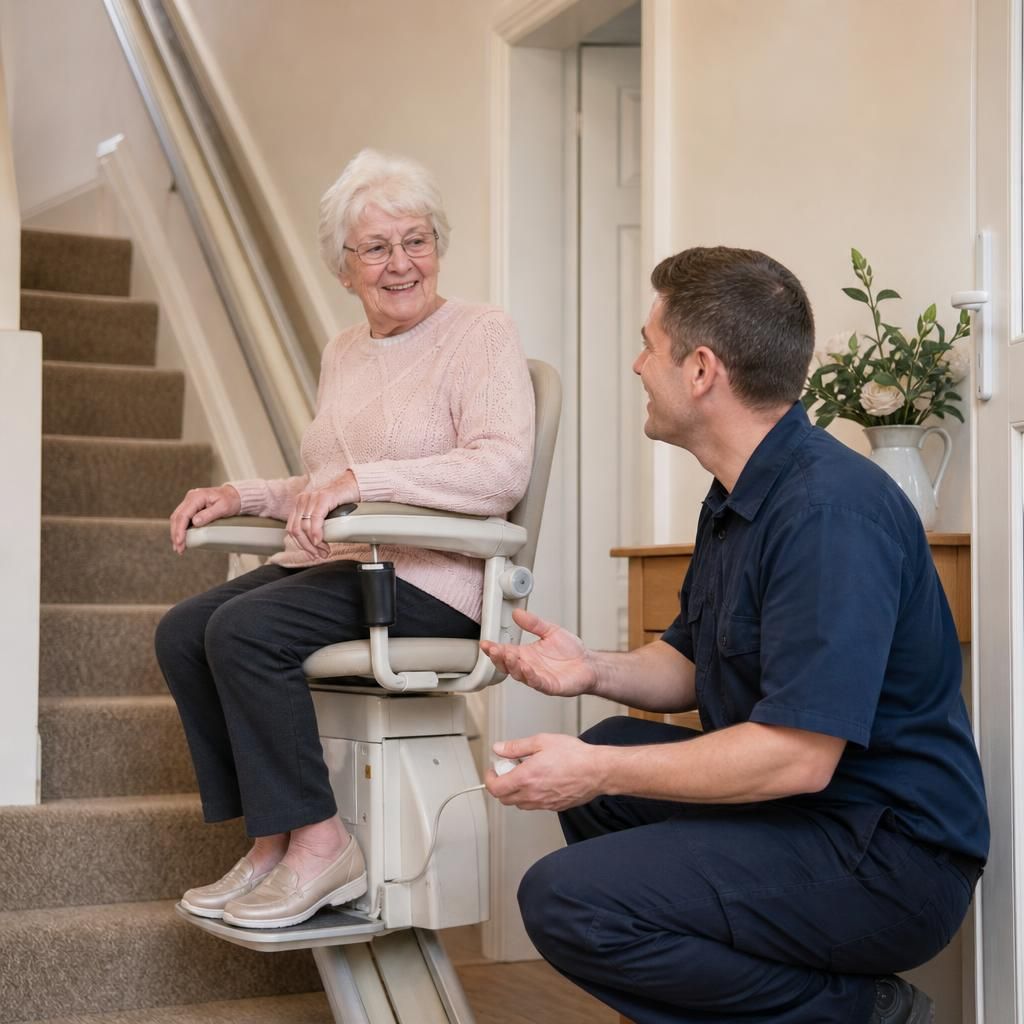
Compare new and reconditioned stairlift options
Arrange a home assessment with Independent Stairlifts to compare suitable new and reconditioned stairlift options for your staircase, mobility needs and budget. We can explain the condition, warranty and aftercare included with each option before you decide.