
Can stairlifts be customised for users with specific physical needs or limitations?
Yes, stairlifts can be customised to accommodate specific physical needs and limitations, including reduced strength, balance difficulties, limited knee or hip movement, and difficulty sitting or standing. An individual assessment can help determine suitable features such as a powered swivel seat, adjustable footrest, supportive seat design, harness, or alternative controls.
Yes. Stairlifts can be customised for many physical needs and limitations, including reduced strength, poor balance, restricted movement in the hips or knees, difficulty sitting or standing, and limited hand function. The most suitable configuration depends on the user’s mobility, posture, transfer ability and the shape of the staircase, so an in-home assessment is an important part of choosing the right stairlift.
Customisation usually involves selecting a suitable seat, controls and safety features rather than changing the stairlift’s basic purpose. During an assessment, the installer should consider how the user approaches the stairs, sits down, travels and gets off at the top. They should also discuss whether anyone needs to assist with transfers, whether the user can remain upright during the journey, and whether there is enough space to use the lift safely at each landing.
Features that may help with specific limitations include:
- Powered swivel seats: the seat turns towards the landing, helping the user face away from the stairs when getting on or off. This can reduce the need to twist or reach while transferring.
- Powered or hinged footrests: these can make it easier to position the feet and may reduce the need to bend down manually. A hinged footrest can also help where a doorway or walkway is close to the bottom of the staircase.
- Adjustable seat height and supportive seating: the seat position and design can be selected to provide suitable support and make sitting down or standing up more manageable.
- Different armrest and control arrangements: controls can be positioned for convenient operation, subject to the design of the stairlift and the user’s hand and arm movement. Simple, clearly positioned controls may be preferable where dexterity or grip is limited.
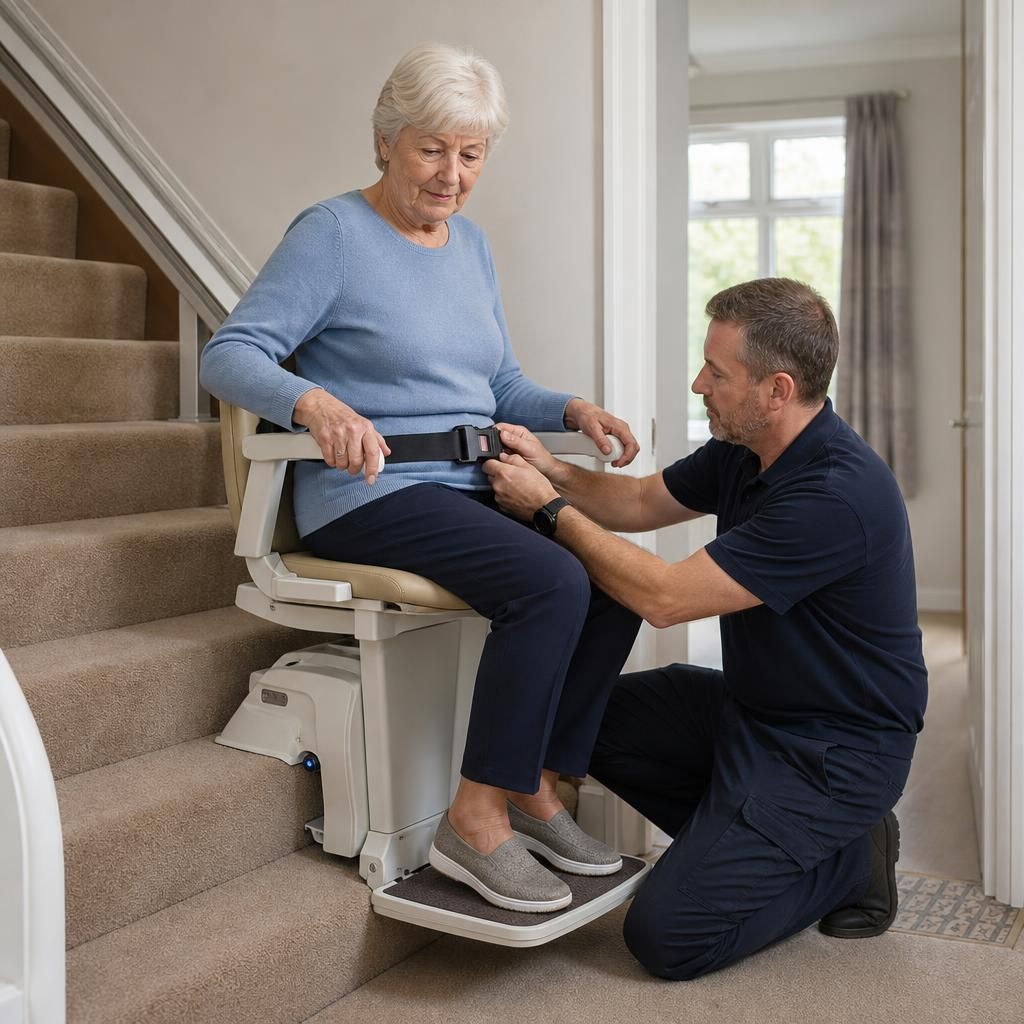
- Seat belts or harnesses: a standard seat belt is commonly used, while a different restraint may be considered where additional upper-body support is needed. The restraint must be used as intended and should not replace correct positioning or supervision where assistance is required.
- Folding or compact components: suitable folding options can help preserve access to the staircase for other household members, particularly where space is restricted.
Users with limited knee or hip movement may benefit from a seat that supports a comfortable travelling position and from features that reduce the effort required to transfer. However, the stairlift still needs sufficient clearance for the legs and feet. If the user cannot bend their knees, has significant swelling, or has a condition affecting posture, this should be explained during the assessment so the proposed arrangement can be checked carefully on the actual staircase.
Where balance is poor or the user is unable to sit upright without support, safety becomes the main consideration. A stairlift is designed for a seated passenger and may not be suitable if the user cannot maintain a stable position, understand the controls or remain safely secured during travel. In some cases, a supportive seat or harness may be appropriate; in others, an occupational therapist, physiotherapist or healthcare professional may need to advise whether a stairlift is suitable and what level of assistance is required.
Reduced strength or dexterity can affect more than the journey itself. The user may find it difficult to operate a manual swivel, release a belt, press a small control or move a footrest. Powered options can reduce some of these actions, but they do not remove the need for the user to transfer safely. A carer or family member may still need to provide assistance, particularly at the top or bottom landing.
Stairlifts can also be configured for particular staircase layouts. Straight staircases generally allow a simpler installation, while curved staircases require a rail made to follow the bends, landings or changes in direction. A narrow staircase, close doorway or limited landing area may affect the choice of seat width, rail position and folding components. The installer should assess these practical restrictions alongside the user’s physical requirements rather than selecting features in isolation.
It is important to provide accurate information about the user’s condition and day-to-day abilities. Tell the assessor about recent surgery, arthritis, neurological conditions, weakness on one side, involuntary movements, dizziness, falls, changes in weight, or difficulty transferring from a chair. Also explain whether the user travels alone, uses a walking frame or wheelchair, and needs help from another person. These details help determine whether the proposed stairlift is appropriate and whether additional changes to the area around the stairlift are needed.
Personalisation has practical limits. The stairlift must remain within its manufacturer’s operating requirements, including its permitted passenger load and safe seating position. It cannot safely compensate for every mobility problem, and it should not be used to carry a person who cannot be secured or who may move unpredictably during travel. The final recommendation should be based on the user’s assessed needs, the staircase and the intended method of transfer.
Before installation, ask to review the proposed seat position, controls, belt or harness, footrest and swivel operation. If possible, the user should try the relevant features and confirm that they can reach the controls and understand the operating sequence. After installation, the user and anyone assisting them should receive clear instructions on boarding, securing the restraint, travelling, getting off safely and dealing with a power interruption. If the user’s condition changes, request a further assessment rather than continuing to use a configuration that no longer feels safe.
A stairlift can be adapted to make transfers safer for someone with limited strength, balance, or movement in the hips and knees. During an in-home assessment, the installer considers how the user approaches the stairs, sits down, remains positioned during travel, and stands at the landing.
Useful options may include a powered swivel seat, adjustable seat height, supportive seating, an easy-to-reach control, a powered footrest, and an appropriate seat belt or harness. These features can reduce twisting, bending, and reaching, but they do not replace the need for safe transfers or suitable assistance. If the user cannot sit upright, understand the controls, or remain securely positioned, advice from an occupational therapist or healthcare professional may be needed before installation.
Arrange a stairlift assessment for your specific needs
Arrange a stairlift assessment with Independent Stairlifts to discuss the user’s specific physical needs, staircase layout and suitable features. Our assessment will help determine whether a customised stairlift is appropriate and how it should be configured for safer transfers.