
Are stairlifts suitable for homes with narrow staircases?
Yes, many homes with narrow staircases can accommodate a stairlift, particularly with a compact or slimline model designed to leave as much space as possible for other users. Suitability depends on the staircase width, shape, landings, available clearance and the user’s mobility needs, so a professional assessment is essential.
Many homes with narrow staircases can accommodate a stairlift. Compact models are designed to reduce the space occupied by the seat, carriage and rail, but suitability depends on more than the width of the stairs. The staircase layout, available clearance, landing space, user’s body shape and posture, and the needs of other people using the stairs must all be assessed before a suitable model is selected.
A narrow staircase does not automatically rule out a stairlift. During a professional assessment, the installer will take detailed measurements and check how the stairlift would operate at the top and bottom of the stairs. This helps establish whether the user could sit safely, whether the lift could travel without catching walls or doors, and whether sufficient room would remain for others to pass when the stairlift is parked.
Features that can help on narrow stairs include:
- A compact seat and carriage: These are designed to keep the stairlift as close to the wall as practical.
- Folding components: A folding seat, arms and footrest can reduce the amount of space occupied when the lift is not in use.
- A slimline rail: The rail can often be installed close to the steps, subject to the staircase structure and the clearances required for safe operation.
- Swivel or powered swivel seats: These can make it easier to get on and off at the top of the stairs where there is limited turning space.
- Perching or standing-position seats: These may be useful for some people who find it difficult to bend their knees, although they are not suitable for everyone and require an individual safety assessment.
The dimensions of the person using the stairlift are important. A compact stairlift must still provide adequate support for the user’s hips, legs, feet and upper body. Choosing the smallest available model is not necessarily the safest option if it restricts the user’s posture or makes transfers difficult. The controls should also be reachable and simple to operate, particularly if the user has reduced strength, dexterity or movement in their hands.
The position of the user’s feet is another consideration on a narrow staircase. The footrest must provide stable support without projecting into an obstruction or creating an unsafe posture. A professional survey will consider the relationship between the seat, footrest, wall, banister and opposite edge of the stairs while the lift is moving.
The shape of the staircase also affects the solution. A straight staircase may be suitable for a compact straight stairlift if there are no intermediate landings or changes of direction. A staircase with bends, curves or multiple levels will generally require a rail made to follow its individual shape. Curved stairlifts can be designed for restricted layouts, but the rail and seat still need enough room to travel safely around corners and stop in a practical position.
Landings can be just as significant as the stairs themselves. At the top, the user needs enough space to swivel or turn away from the lift safely. At the bottom, there must be a suitable area to approach and leave the seat without blocking a doorway or creating a trip hazard. If the staircase opens directly into a narrow hallway, a folding or parking arrangement may be considered. In some homes, the stairlift may need to park part-way along the stairs or on an alternative section of rail, depending on the layout.
Other household users should be considered during the assessment. When the stairlift is folded away, the remaining walking route should be checked for safe access. If the stairs are used by several people, the installer may recommend a model or parking position that leaves the greatest practical clearance. The banister, radiators, doors, cupboards and light switches may also affect where the lift can be fitted.
Installation usually involves fixing the rail to the stair treads rather than relying on the wall. This can make fitting possible in properties where wall construction is unsuitable, but the condition and construction of the stairs still need to be checked. The installer will also confirm the position of the charging points and ensure that the stairlift can be used without obstructing nearby doors or routes.
A narrow staircase may require more careful planning, but it does not mean that the home needs major structural alteration. In some cases, the most suitable solution will be a new compact stairlift. A reconditioned stairlift may also be appropriate if its dimensions, configuration and available features match the staircase and the user’s needs. The important point is that the specific model should be chosen after measuring the home, rather than relying on a general product description.
Before arranging installation, tell the assessor about any difficulties with sitting down, standing up, bending the knees, maintaining balance or turning at the top and bottom of the stairs. Also mention whether another person will need to use the staircase at the same time. These details can influence the choice of seat, controls, safety features and parking position.
Independent Stairlifts can assess the staircase and discuss the practical options available for the property. A survey is the best way to confirm whether a narrow staircase is suitable, what clearance would remain, and which configuration would allow the user to travel safely and comfortably.
Narrow staircases can often accommodate a stairlift, provided there is enough clearance for the user, the moving carriage and other people using the stairs. A professional assessment checks the full staircase, including the width of the steps, banisters, walls, doors and the available space at the top and bottom.
Space-saving features may include a compact seat and carriage, a slimline rail, and folding arms, footrest and seat. A swivel seat can also make getting on and off safer where the landing is restricted. The smallest model is not automatically the best choice: it must still support the user comfortably and allow a stable sitting position, adequate legroom and accessible controls.
The stairlift should be assessed while parked as well as moving. The installer can identify a suitable parking position that leaves the most practical walking space and avoids obstructing doorways or creating a trip hazard. This individual assessment confirms whether the staircase is suitable and which configuration will provide safe, comfortable access.
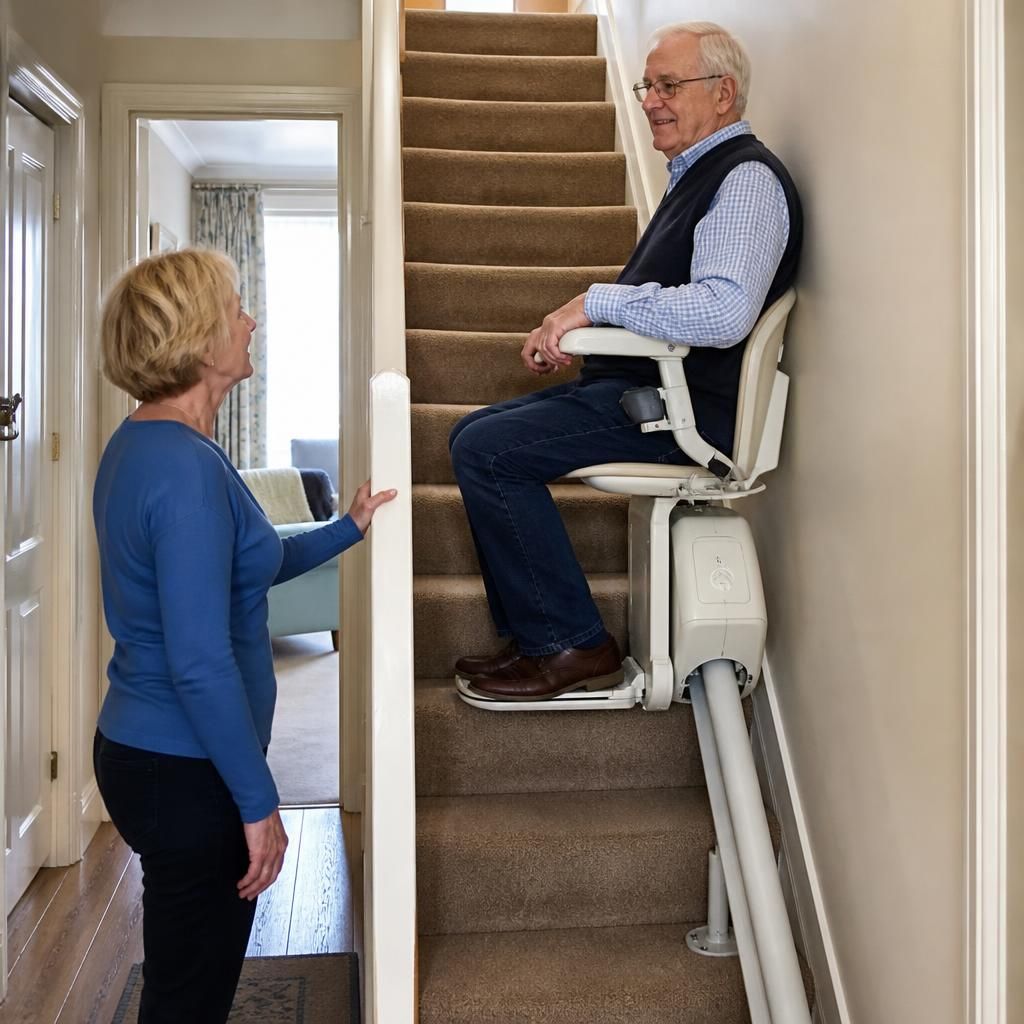
Arrange a professional assessment for your narrow staircase
Arrange a professional assessment with Independent Stairlifts to confirm whether your narrow staircase can accommodate a stairlift and identify the safest, most practical configuration for your home.