
What options are available for heavy-duty or bariatric stairlifts for disabled users?
Heavy-duty or bariatric stairlifts are designed for users who need a higher weight capacity, a wider or more supportive seat, and reinforced components than a standard model provides. Independent Stairlifts can assess the user and staircase to recommend a suitable solution, including seating, access and safety features tailored to the home.
Heavy-duty or bariatric stairlifts are purpose-designed for users who require a higher weight capacity, a wider or more supportive seat, and stronger structural components than a standard stairlift can provide. The appropriate solution depends on the user’s weight and body shape, transfer ability, posture, staircase layout and available space, so a professional assessment is essential before a model is selected or installed.
What makes a stairlift heavy-duty?
- Higher rated capacity: The lift, seat, carriage, drive system and track must all be suitable for the user’s combined weight and the way they use the stairlift. The manufacturer’s maximum safe load must never be exceeded.
- More supportive seating: A wider seat, stronger armrests and a suitable backrest can improve stability and comfort. Some models offer adjustable seat positions, a swivel seat or a powered swivel function to make getting on and off easier.
- Reinforced construction: Heavy-duty models use components designed to withstand greater loading during travel, stopping and transfers. This does not mean that every reinforced model is suitable for every staircase, as the track and fixing points must also be assessed.
- Appropriate seat configuration: Depending on the user’s posture and leg position, a standard seated design, perch or standing stairlift may be considered. A perch configuration is not automatically suitable for someone with poor balance, limited knee movement or difficulty maintaining an upright position.
How suitability is assessed
An assessment should consider more than the user’s stated weight. The installer will need to understand how the user transfers between their wheelchair, walking aid and the stairlift, whether they can sit upright and use the controls, and whether they need assistance from a carer. Hip width, leg position, trunk control and the ability to bend the knees can all affect the safest seat and footrest arrangement.
The staircase and surrounding areas are assessed at the same time. This includes the width of the stairs, the position of doors and landings, headroom, bends, obstructions, the available space at the top and bottom, and the strength and condition of the surfaces used for fixing. On a narrow staircase, a larger seat may restrict access for other household members or make it difficult to fold the lift away. In these situations, the assessment can identify whether a different seat design, track position or access arrangement is needed.
Options for different staircase layouts
- Straight heavy-duty stairlifts: These are designed for staircases without bends or intermediate landings and are usually the most straightforward option where there is sufficient width and clear access.
- Curved heavy-duty stairlifts: A bespoke track can follow bends, turns and changes in direction. The larger seat and carriage still need adequate clearance throughout the journey, including at landings and parking positions.
- Heavy-duty outdoor stairlifts: Where access between levels is outside, an outdoor model may be suitable if it has weather-resistant materials, protected electrical components and a safe, secure parking position. Outdoor exposure, surface condition and drainage must be considered during the survey.
- Standing or perch options: These can help where a seated position is difficult or where space is limited, but they require enough balance, strength and confidence to remain safely positioned. They are not a substitute for a higher-capacity seated model when the user cannot stand securely.
Safety and access features to consider
A suitable heavy-duty stairlift should provide a stable seating position, a secure seat belt and controls that the user can operate reliably. Useful features may include powered swivel or lift-up seating, adjustable armrests, a supportive footrest, obstruction sensors, a braking system, smooth start and stop functions, and controls on both the stairlift and a remote handset. The correct combination depends on the user’s abilities rather than on weight alone.
Transfers are a particularly important part of the assessment. The lift should park where the user can sit down and stand up with adequate room, without reaching across the stairwell or twisting unnecessarily. A powered swivel seat may reduce the effort required at the top of the stairs, while a suitable approach to the bottom landing can help a wheelchair or walking aid be positioned safely. If a carer will assist, the space needed for that assistance should be included in the planning.
Installation and safe use
Installation must follow the selected model’s technical requirements, including its rated load, track fixings, clearances and electrical requirements. A heavy-duty stairlift should not be chosen solely because it has the largest advertised capacity. The complete installation must be suitable for the staircase and the person using it. After fitting, the installer should explain the controls, transfers, charging, emergency procedures and safe operating position, and the user or carer should have an opportunity to practise under supervision.
Users should remain within the specified load limit, sit fully back in the seat, use the supplied restraint and keep hands, feet and clothing clear of the stairway. If the user’s weight, mobility, posture or transfer method changes, the stairlift should be reviewed rather than adapted informally. A stairlift is not intended to carry a wheelchair, walking frame or another passenger unless the equipment has been specifically designed and approved for that purpose.
Maintenance and ongoing review
Heavy-duty equipment places particular importance on routine servicing. The seat, belt, armrests, footrest, sensors, track, fixings, batteries and drive components should be checked in line with the manufacturer’s instructions. Prompt attention is advisable if the lift becomes noisy, hesitates, stops unexpectedly, shows a fault warning, develops movement in the seat or track, or no longer provides a secure transfer position.
Independent Stairlifts can assess the user’s requirements and the property before recommending a heavy-duty, bariatric, perch or bespoke curved solution. The assessment should result in a clear explanation of the model’s capacity, seating dimensions, required clearances, installation position, safety features and servicing needs, allowing the user and family to make an informed decision based on safe everyday use.
A heavy-duty or bariatric stairlift must be matched to both the user and the staircase, not selected by weight capacity alone. The seat width, armrest position, footrest, track and fixing points all need to provide sufficient support and clearance throughout the journey.
During an assessment, consider how the user transfers from a wheelchair or walking aid, whether they can sit upright and operate the controls, and where they will get on and off safely. The installer should also check bends, landings, doors, headroom and parking space. A powered swivel seat, stronger armrests or a different seat configuration may make transfers safer, while a curved track may be needed to maintain clearance on a staircase with turns. The recommended model should have a clearly stated safe working load and be suitable for the user’s current needs.
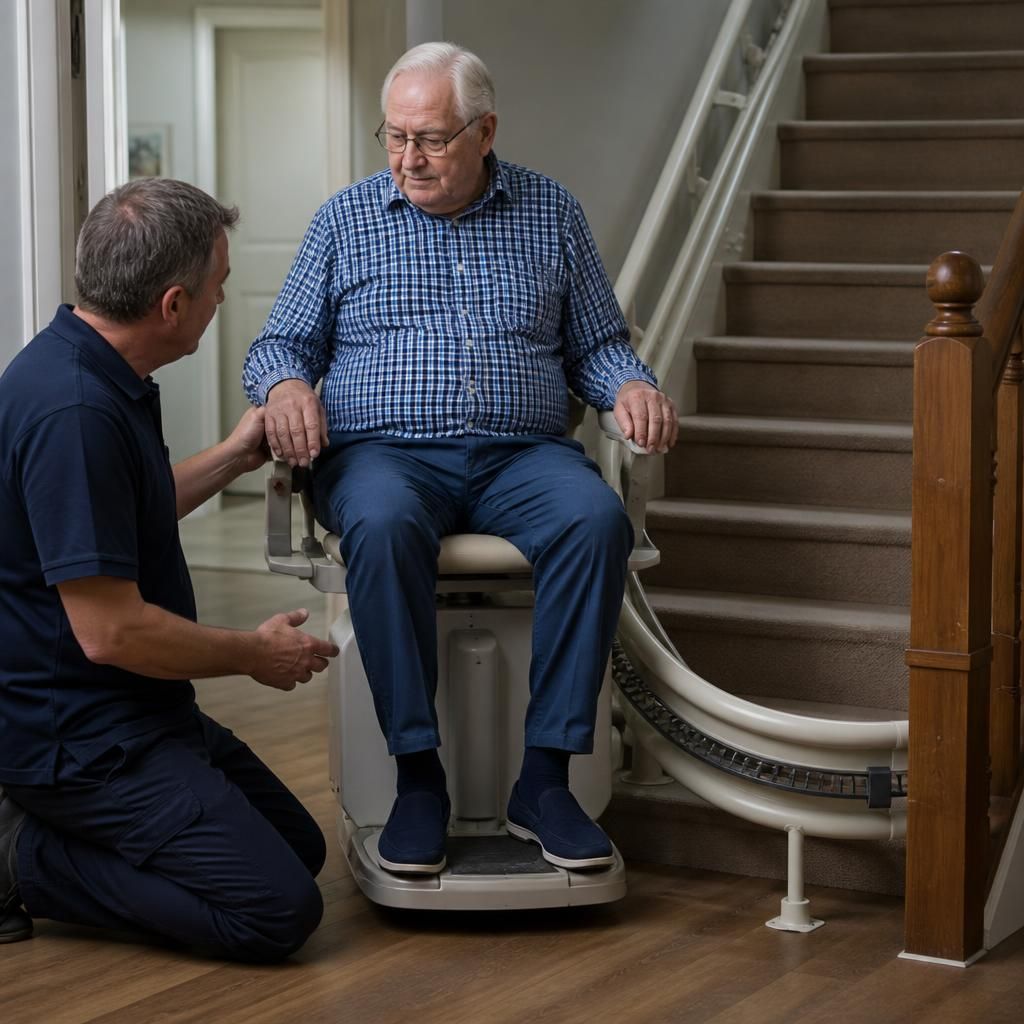
Arrange Your Heavy-Duty or Bariatric Stairlift Assessment
Arrange a professional assessment with Independent Stairlifts to review the user’s weight capacity, seating and transfer needs, staircase layout and required safety features. We can recommend a suitable heavy-duty or bariatric stairlift and explain the installation and servicing requirements.