
What factors should I consider regarding the long-term maintenance and servicing needs of a stairlift for disabled users?
Consider the stairlift’s recommended servicing schedule, warranty terms, battery and component checks, availability of repairs and ongoing technical support. Regular professional servicing, prompt reporting of faults and keeping the lift clean and unobstructed help maintain safe, reliable operation for disabled users at home.
Long-term stairlift maintenance involves following the manufacturer’s servicing schedule, checking safety-critical parts, monitoring battery performance, arranging qualified repairs and understanding the warranty and support available. Regular professional servicing helps identify wear before it affects reliability, while simple daily care and prompt reporting of faults help keep the stairlift safe for the disabled user.
Check the recommended servicing schedule
The correct service interval depends on the stairlift model, how frequently it is used, the staircase environment and whether it is installed indoors or outdoors. Follow the servicing guidance provided at installation and keep a record of completed visits. A service should be carried out by a suitably trained technician who can inspect the complete system rather than just responding to a reported fault.
A professional service will typically include checks on the track, drive system, seat, arms, footrest, controls, safety sensors, charging points and electrical connections. The technician may also check operating noises, stopping and starting, the stairlift’s travel, and whether the lift parks and charges correctly. Any adjustment or replacement should use parts that are suitable for the specific model.
Understand what the warranty covers
Read the warranty conditions before installation or renewal. Check how long cover lasts, which components are included, whether labour and call-out charges are covered, and whether servicing must be completed by an approved or suitably qualified provider. Batteries and items subject to normal wear may be treated differently from major electrical or mechanical components.
A warranty may not cover damage caused by misuse, impact, unauthorised alterations, liquid ingress, poor cleaning practices or failure to follow the operating instructions. Keep the installation documents, warranty information and service records together so that relevant details are available if a repair is needed.
Pay particular attention to the batteries
Most domestic stairlifts use rechargeable batteries and are designed to charge when parked at a designated charging point. If the stairlift is regularly left away from its charging position, the batteries may discharge and the lift may eventually stop operating. Follow the instructions for parking and charging, and make sure the charging point is not obstructed.
Reduced travel distance, slower operation, warning tones or difficulty starting can indicate a battery or charging issue, although other faults can produce similar symptoms. Do not attempt to open, modify or replace batteries unless this is specifically permitted by the manufacturer and carried out safely. Arrange a professional assessment, particularly if the stairlift is needed for essential access.
Monitor parts that experience regular wear
Components can wear at different rates depending on usage and the design of the staircase. During servicing, the technician should assess parts such as the drive mechanism, rollers, track, seat swivel and locking mechanism, footrest, armrests, safety belt, controls and sensors. The condition of wiring, covers and fixings should also be checked.
Report changes rather than waiting for the next planned service. Unusual grinding, clicking or scraping noises, jolting, hesitation, unexpected stopping, a loose seat, a belt that does not fasten correctly, or a footrest that does not operate as expected should be investigated. Do not continue using the stairlift if it appears unsafe or if a safety feature is not working correctly.
Keep the stairlift clean and unobstructed
- Keep the track, seat, footrest and controls free from clothing, bags, toys and other objects.
- Clean surfaces with the method recommended for the model and avoid pouring liquid near controls, motors, charging contacts or electrical connections.
- Do not apply oil, grease or household lubricant to the rail unless the manufacturer specifically instructs you to do so.
- Keep the staircase and the areas at the top and bottom clear so the user can approach, transfer and leave the stairlift safely.
- Tell household members not to lean, hang items from or place weight on parts that are not designed to carry it.
For an outdoor stairlift, maintenance also includes checking protection from rain, damp, frost, dirt and direct sunlight. Keep protective covers in good condition and follow the manufacturer’s instructions for parking and cleaning. Outdoor conditions can accelerate corrosion or affect electrical components, so arrange an inspection if the lift has been exposed to severe weather or water ingress.
Use trained support for faults and alterations
Stairlifts contain electrical and mechanical safety systems that should not be bypassed. Do not remove covers, alter the track, adjust safety sensors or attempt an electrical repair yourself. If the stairlift stops, check only the straightforward user instructions, such as whether it is correctly switched on, the key is in position and the lift is parked for charging. If the problem remains, contact the servicing team.
When reporting a fault, describe what happened, any warning tone or display message, whether the lift was moving or charging, and whether the issue occurs consistently. This information can help the technician prepare the correct parts and assess whether the lift should remain out of use.
Consider the user’s changing needs
Maintenance is not limited to the equipment itself. A change in strength, balance, vision, dexterity, pain or cognitive ability may affect how safely the user can transfer onto the seat, operate the controls or fasten the belt. A new wheelchair, walking aid or change in household layout may also affect access at the top or bottom of the stairs.
Arrange a review if the user is finding the seat, controls, swivel mechanism or belt harder to use. A technician or assessor may be able to adjust suitable features, but a significant change in mobility may mean that the original stairlift configuration is no longer appropriate. Never add cushions, attachments or other accessories unless their suitability has been confirmed.
Plan for servicing and unexpected repairs
Ask what support is available between planned services, how faults are reported and whether emergency assistance is provided. Confirm the likely costs of call-outs, labour, replacement batteries and other parts once warranty cover ends. For a user who relies on the stairlift for essential movement between floors, consider how access will be managed if the lift is temporarily unavailable.
Keep the stairlift model details, installation information and service history accessible. If the property is occupied by carers or family members, make sure they know the basic operating instructions, how to stop use safely and who to contact if a fault occurs. A service record can also help when assessing the condition of a reconditioned stairlift or deciding whether repair or replacement is the more suitable option.
In practice, the most important measures are to follow the manufacturer’s maintenance instructions, arrange regular servicing, keep charging points and travel paths clear, report changes promptly and use qualified technical support. These steps help maintain safe, dependable operation and allow problems to be addressed before they restrict the disabled user’s access around the home.
Regular professional servicing is a planned inspection of the stairlift’s safety-critical, mechanical and electrical components. It helps identify wear, charging problems or changes in operation before they develop into a fault that could restrict the disabled user’s access between floors.
Follow the service interval recommended for the specific model and keep a record of each visit. A qualified technician should check the track, drive system, seat, swivel and locking mechanisms, footrest, controls, safety belt, sensors, charging points and electrical connections. Report unusual noises, jolting, hesitation, unexpected stopping or reduced battery performance promptly rather than waiting for the next scheduled service.
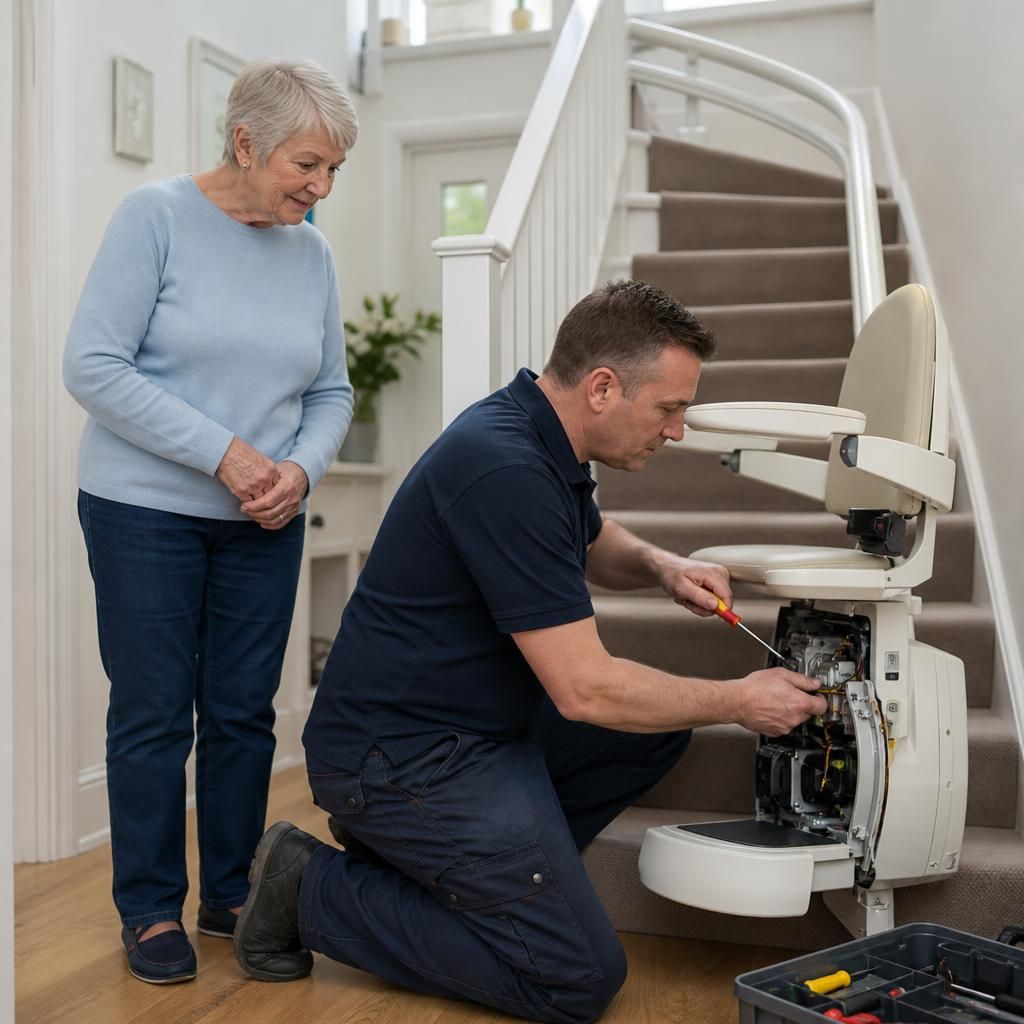
Arrange Your Stairlift Service or Maintenance Review
Arrange your stairlift service or maintenance review with Independent Stairlifts to check its condition, charging performance and safety-critical components. Contact our team to discuss servicing, repairs or any changes in the user’s mobility needs.