
What are the safety features and compliance standards a stairlift should meet to ensure the well-being of disabled users in domestic settings?
A stairlift should include obstruction sensors, secure seating and restraints, reliable braking, safe controls, battery backup and a powered swivel seat where required by the user’s mobility needs. It should also be correctly installed and maintained in accordance with BS EN 81-40 and applicable UK product-safety requirements, including relevant UKCA or CE marking.
A stairlift for a disabled user should combine appropriate physical safety features, professional installation, clear operating controls and ongoing servicing. In the UK, the product should be designed and assessed against the applicable requirements of BS EN 81-40, the standard covering inclined lifting platforms and stairlifts for people with impaired mobility, and should comply with relevant UK product-safety legislation. Depending on where the product is supplied and used, this will normally be demonstrated through UKCA or CE marking, a Declaration of Conformity and supporting technical information.
Compliance does not replace an individual assessment. A stairlift can meet the relevant standard yet still be unsuitable if the seat, controls, track position or transfer arrangements do not match the user’s abilities and the staircase. The assessment should therefore consider the user, the home, the staircase and how the lift will be used in everyday conditions.
Essential stairlift safety features
- Obstruction sensors: Sensors around the footrest, carriage and other vulnerable areas should stop the stairlift if it encounters an object on the stairs or track. The lift should stop smoothly rather than continuing to push against the obstruction.
- Secure seating and restraint: A correctly positioned seat, supportive armrests and a suitable lap belt help keep the user stable while travelling. The restraint should be easy for the user or carer to fasten, but should not release accidentally during movement.
- Reliable braking and speed control: The drive system should control travel speed consistently and bring the lift to a controlled stop at the top and bottom of the rail. The design should also prevent uncontrolled movement if power is interrupted or a drive fault occurs.
- Swivel and safety interlocks: A powered or manual swivel seat can help the user turn towards the landing for a safer transfer. Where fitted, the stairlift should not travel unless the seat is locked in the correct position. A swivel function is particularly important where the user has difficulty turning, standing or maintaining balance.
- Footrest protection: A sufficiently supportive footrest should help position the feet securely. Sensors or a protective edge can stop the lift if the footrest contacts an obstruction.
- Safe controls: The joystick, buttons or switches should be simple to operate and positioned within easy reach. Controls should require deliberate action, reducing the risk of movement caused by an accidental touch. Key switches or other access controls may be useful where children or other people could operate the lift without supervision.
- Emergency stopping and communication arrangements: The user should know how to stop the lift safely if necessary and how to summon assistance. Some installations may also benefit from an alarm, telephone or other communication method, particularly where the user spends time alone.
- Battery backup: Battery-powered stairlifts should continue to reach a safe landing, or provide an appropriate level of operation, during a mains power failure. The charging points must be positioned so that the lift can charge reliably at its parking locations.
- Limit switches and end-of-rail protection: The stairlift should stop at its intended travel limits and should not be able to run beyond the safe ends of the rail.
- Folding components and clearances: Folding arms, seats, footrests and rails can help maintain access around the staircase when the lift is parked. The installation should leave suitable clearance for other household members and should not create an avoidable trip or collision hazard.
What BS EN 81-40 and product legislation cover
BS EN 81-40 sets out safety principles for the design, manufacture, installation and testing of relevant inclined lifting platforms. It addresses matters such as mechanical strength, travel limits, protection against falls, controls, electrical safety and safeguards for users. It is a recognised technical standard rather than a general guarantee that every installation is suitable for every person.
Manufacturers and suppliers must also meet the product-safety rules that apply to the equipment. These can include the UK machinery-safety framework, electromagnetic compatibility requirements and electrical-safety requirements, where applicable. The correct conformity marking should be present for the market in which the stairlift is supplied. A UKCA or CE mark is evidence that the manufacturer has followed the relevant conformity process; it is not, by itself, an independent endorsement of a particular installation.
The supplier should be able to provide or explain the product’s Declaration of Conformity, instructions for use, safety information and maintenance requirements. The documentation should relate to the model actually installed, rather than to a different version of the stairlift.
Installation safety is as important as product design
A compliant stairlift can become unsafe if it is poorly positioned, incorrectly fixed or adjusted without regard to the user. A competent installer should assess the staircase structure, landings, available headroom, electrical supply, parking positions and likely routes used by other people in the home. For a curved or unusual staircase, the rail must be accurately measured and manufactured so that clearances and stopping positions are correct.
The assessment should also cover the user’s posture, leg position, balance, grip, vision, hearing, cognitive ability and ability to transfer on and off the seat. A standing or perch stairlift may suit someone who cannot bend their knees comfortably, while a powered swivel seat, powered footrest or additional support may be more appropriate for someone with limited strength. These features should be selected because they address an identified need, not simply because they are available.
After installation, the installer should test travel, braking, sensors, interlocks, controls, charging and the emergency procedures. The user and any regular carer should receive practical instruction, including how to fasten the belt, position the seat, respond to an obstruction, park the lift and obtain assistance. Instructions should be accessible to the user and retained for future reference.
Maintenance and checks after installation
Regular servicing helps preserve the safety functions that may not be obvious during normal use. The service schedule should follow the manufacturer’s instructions and take account of the user’s level of use and the installation environment. Checks commonly include the rail and fixings, seat and belt, swivel lock, footrest, sensors, drive system, batteries, charging contacts, controls and stopping accuracy.
Users should report unusual noise, jerky movement, unexpected stopping, reduced battery performance, a loose seat or belt, damaged wiring, repeated sensor activation or any change in the stopping position. The stairlift should not be used if a safety feature is faulty or if the equipment has been damaged, unless a competent professional has confirmed that it is safe. Household members should also keep the stairs and rail clear of objects, trailing cables and spills.
How to check that a stairlift is suitably compliant
- Ask which standard and product-safety requirements apply to the proposed model, and request the relevant conformity information.
- Confirm that the stairlift is intended for the user’s weight, posture, transfer ability and frequency of use.
- Check that the assessment covers the complete route, including the top and bottom landings and any doors or narrow passageways.
- Test the main controls and safety features with the user before accepting the installation.
- Make sure the user understands charging, parking, restraint use, emergency procedures and who to contact for assistance.
- Keep the operating manual, installation records and service details, and arrange maintenance in line with the manufacturer’s recommendations.
For a disabled user in a domestic setting, the safest choice is therefore not simply the stairlift carrying the most features. It is a correctly specified model whose controls, seating, restraints, sensors, braking, battery system and transfer arrangements are appropriate for that person, installed to the manufacturer’s requirements and maintained throughout its service life.
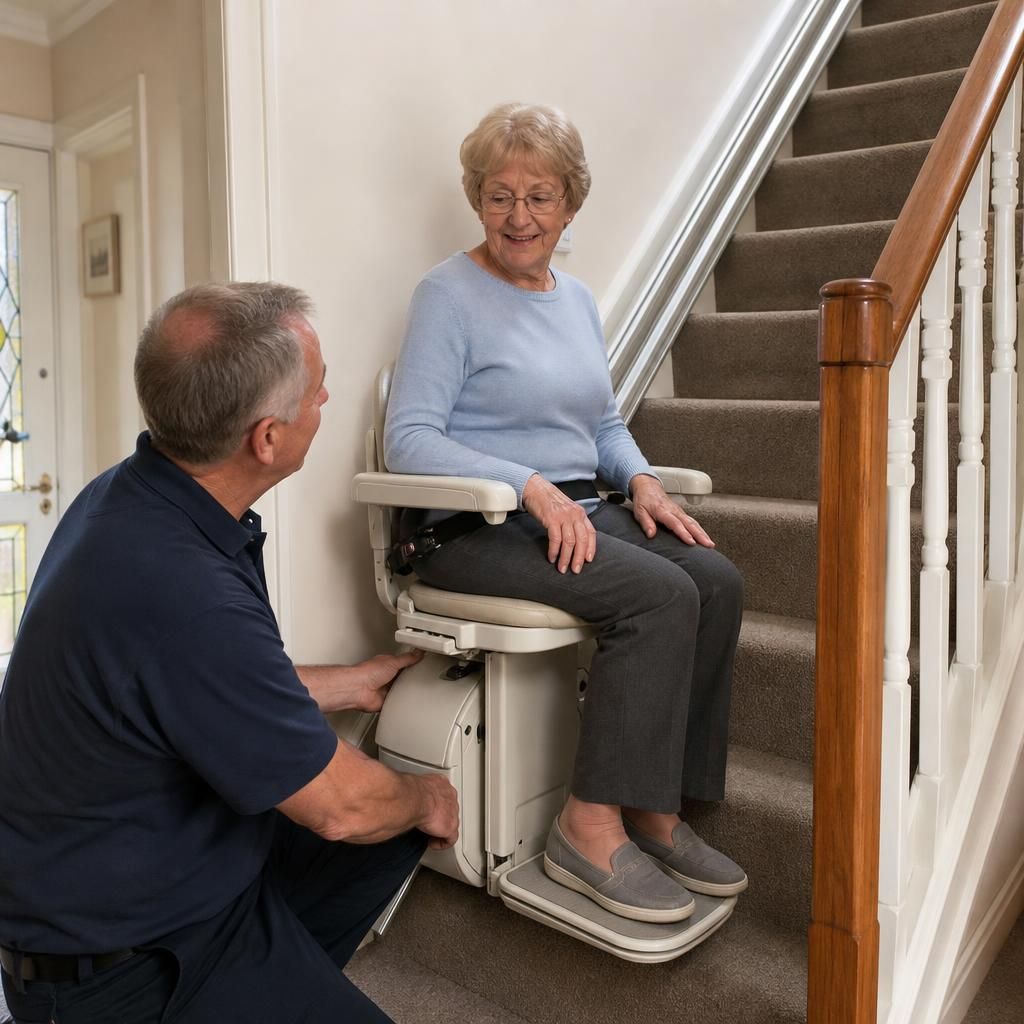
A stairlift’s safety depends on more than its built-in features. Professional assessment and installation must ensure the seat, controls, rail position, stopping points and transfer areas suit the disabled user and the staircase.
The installer should check balance, posture, leg position, reach and ability to fasten the belt, as well as landings, doors, headroom and clearance for other household members. After fitting, the stairlift should be tested for braking, sensors, interlocks, charging and emergency operation. This helps ensure the equipment is installed in line with the manufacturer’s instructions and the relevant requirements of BS EN 81-40.
Arrange a stairlift safety assessment
Arrange a stairlift safety assessment with Independent Stairlifts to check that the model, seating, controls and installation are suitable for the disabled user and their staircase.