
What are the key considerations when selecting a stairlift for disabled users?
When selecting a stairlift for a disabled user, consider the staircase layout, the user’s mobility and posture, weight capacity, comfort, safety features, and how easily the equipment can be used and maintained. A professional home assessment is essential to match the stairlift and installation to the person’s needs and the available space.
Choosing a stairlift for a disabled user means matching the equipment to the person’s mobility, posture, transfer ability and safety needs, as well as to the staircase and the home. The most suitable model is not necessarily the one with the greatest number of features; it is the one the user can approach, operate, ride and leave safely and consistently.
Start with the user’s functional needs
Consider what the user can do now and whether their mobility is likely to change. Important points include:
- Whether they can walk to the stairlift and transfer onto the seat safely.
- Whether they can bend their knees, sit upright and remain stable during the journey.
- Whether they have limited strength, balance, coordination or grip.
- Whether they use a walking frame, stick, wheelchair or other mobility aid.
- Whether pain, fatigue, tremors, weakness or involuntary movement affects their ability to use controls.
- Whether they need someone nearby to assist with transfers or positioning.
A stairlift does not remove the need for a safe transfer at the top and bottom of the stairs. If the user cannot transfer reliably, a different approach may be needed, such as additional support, changes to the surrounding area or advice from an occupational therapist or other suitably qualified professional.
Assess the staircase and available space
The shape and dimensions of the staircase determine which stairlift designs are practical. A straight stairlift is generally intended for a single, uninterrupted flight. A staircase with bends, intermediate landings, multiple flights or unusual geometry may require a curved stairlift, a different rail arrangement or more than one unit. Outdoor stairs need equipment specifically designed for external exposure rather than an indoor model.
Available space is also important. The installer should consider the stair width, headroom, ceiling height, doorways, radiators and other obstructions. At the bottom, there must be enough room for the user to turn or move away from the stairs safely. At the top, the parking position and any landing or doorway must allow a secure exit. A compact or powered folding option may be useful where the staircase is narrow or close to a hallway, but it still needs to leave an appropriate passageway for other people in the home.
Check the weight capacity and physical dimensions
Every stairlift has a manufacturer-rated maximum load. This must be suitable for the user and any clothing or items carried during the journey. Do not select a model solely by appearance or assume that a standard stairlift will be adequate. A heavy-duty or bariatric model may offer a higher rated load, a wider or stronger seat and additional support, but it must also fit the staircase and landing safely.
Seat width, depth and height should be checked against the user’s body shape and leg length. The armrests, footrest and seat belt need to provide support without making transfers more difficult. The user should be able to sit centrally, keep their feet positioned correctly and avoid contact with the wall, banister or surrounding furniture.
Prioritise posture, comfort and transfers
Comfort is a safety consideration, particularly if the user makes frequent journeys or takes longer to reach the upper floor. Look for a seat that supports an upright posture and provides suitable back, arm and foot support. A swivel seat can help the user turn towards the landing before standing, reducing the need to twist while near the top of the stairs. However, the swivel mechanism must be easy for the user or carer to operate and should lock securely in the intended position.
Some users may need a standing or perch-style stairlift because sitting down and rising again is difficult. This is not suitable for everyone, especially where balance, knee strength or involuntary movement is a concern. The correct style should be based on an assessment rather than on the diagnosis alone.
Choose controls the user can operate
Controls should be positioned where the user can reach them without leaning or stretching. Consider whether they can press and hold a control, distinguish buttons by touch or sight, and understand the direction controls. Simple, clearly marked controls are usually preferable where dexterity, vision or memory is affected.
Remote controls can allow a carer to bring the stairlift to the user or move it away from a landing. This can be useful in a shared household, but the user should still be able to control the stairlift independently where possible. Charging points, power failure operation and the location of the main isolation switch should also be explained during installation.
Review the essential safety features
Safety features should be appropriate to the user and the staircase. Depending on the model, these may include a seat belt or harness, armrests, a swivel seat, obstruction sensors, a secure footrest, braking systems and controls that require continuous pressure. Sensors should stop the stairlift if an obstacle is detected, but the stairs and landing should still be kept clear.
Ask how the stairlift behaves if the household power supply is interrupted, how it is stopped in an emergency and what the user should do if they feel unwell during a journey. The installer should demonstrate these procedures to the user and any regular carers. A seat belt should be easy to fasten and release, but it should not be left unused simply because the journey is short.
Consider installation, building use and appearance
Most domestic stairlifts are installed to the stairs rather than fixed to the wall, although the exact method depends on the property and the equipment. The assessment should identify any structural, electrical or access issues before work begins. Discuss whether doors, cupboards and emergency routes remain usable, and whether the stairlift can be parked without obstructing other residents.
For a rented property, listed building or home with shared access, confirm whether permission is required. Where a stairlift is being installed outside, the assessment should also cover weather protection, drainage, surface conditions and safe access in wet or icy conditions.
Think about future needs and servicing
A stairlift should remain suitable if the user’s mobility changes. It is worth discussing whether the seat, controls, harness and transfer position can accommodate likely changes, while avoiding unnecessary features that the user cannot operate. A reconditioned stairlift may be appropriate in some homes, provided its condition, suitability, safety checks, warranty arrangements and future servicing are clearly explained.
Ask what routine servicing is recommended, how faults are reported and whether replacement batteries and other parts can be obtained. Keep the rail, footrest and sensors clear, follow the user instructions and report unusual noises, reduced battery performance, jerky movement or repeated stops promptly. Do not attempt electrical or mechanical repairs yourself.
Use a professional home assessment before deciding
A proper assessment should bring together the user’s requirements, the staircase measurements and the practical conditions in the home. The assessor should observe or discuss transfers, seating position, control use, parking locations and the involvement of carers. They should explain suitable alternatives, limitations, installation requirements, aftercare and total costs in clear terms.
Before installation, ensure the chosen model has the appropriate rated capacity, that its features have been demonstrated to the user and that everyone involved understands safe operation. Taking the user’s abilities and home layout into account at the outset gives a more reliable result than choosing a stairlift on price or appearance alone.
Selecting a stairlift for a disabled user means matching the person’s mobility, posture and transfer ability to the staircase and available space. A professional home assessment helps confirm whether a straight, curved, outdoor, standing or heavy-duty model is appropriate.
The assessment should consider how the user approaches the lift, sits down, operates the controls, travels safely and leaves the seat at the top or bottom. It should also check stair width, landings, doorways, obstructions, parking positions and the space needed for carers or other household members. This ensures the chosen stairlift is practical to use every day, not simply suitable on paper.
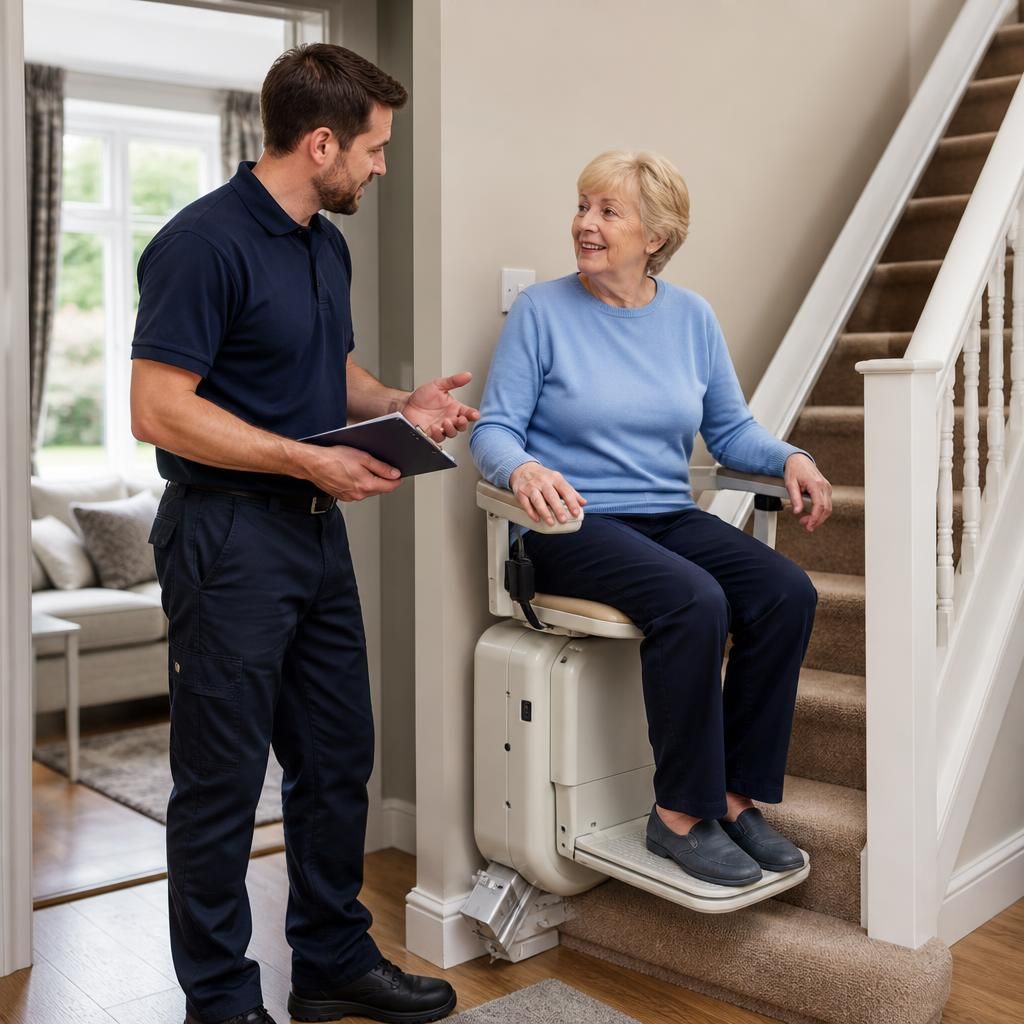
Arrange Your Stairlift Assessment
Arrange a professional stairlift assessment with Independent Stairlifts to review the user’s mobility needs, staircase layout and suitable options. We can explain the recommendation, installation requirements and ongoing support clearly before you decide.