
What should I know about the installation process of a stairlift for disabled individuals?
Disabled stairlift installation usually involves a home assessment, measuring and checking the staircase, followed by fitting the rail, chair and safety controls to suit your needs. After installation, the stairlift is tested and you are shown how to use it safely before the installer leaves.
Disabled stairlift installation is a structured process that begins with a home assessment and ends with safety testing and user instruction. An installer checks the staircase, landing areas, electrical supply and the user’s mobility needs before fitting a suitable rail, seat and controls. The aim is to create a reliable means of moving between floors without obstructing other people who use the stairs.
1. The home assessment
Before recommending equipment, the installer should assess both the individual and the property. This is more than taking measurements of the staircase. The assessment normally considers:
- Whether the staircase is straight, curved, narrow, steep, split-level or includes intermediate landings.
- The available space at the top and bottom of the stairs for getting on and off the lift safely.
- Whether doors, radiators, furniture or hallways could affect the installation or use of the stairlift.
- The user’s height, weight, balance, flexibility, walking ability and ability to transfer into and out of the seat.
- Whether the user can operate the controls, release the safety belt and position the arms and feet safely.
- Whether another person, such as a partner or carer, needs to use the stairs at the same time.
- The location of a suitable power supply and whether any electrical work is required.
It is important to explain how the stairs are used in practice. For example, tell the assessor if the user carries shopping, uses a walking frame, needs extra time to stand up, or may need assistance at either landing. These details can influence the choice of seat, controls, swivel mechanism, footrest and parking position.
2. Choosing the appropriate stairlift
A straight stairlift is generally suitable where the staircase runs in one continuous direction. A curved stairlift is designed around bends, landings and changes in direction, so its rail is made to match the staircase. Outdoor stairlifts use materials and controls intended to withstand exposure to weather, although the surrounding steps and landing must still provide a safe surface.
Where appropriate, a reconditioned stairlift may also be considered. Its condition, suitability, warranty and servicing arrangements should be explained clearly before installation. Whatever model is selected, it must suit the user’s physical abilities and the layout of the home rather than being chosen on appearance alone.
3. Preparing the staircase and installation area
Most stairlifts are secured to the stair treads rather than the wall. This usually avoids the need for major structural changes, but the installer still needs clear access to the stairs. Remove loose items, ornaments and furniture from the staircase and landing before the appointment. If the user has limited mobility, arrange an alternative way to remain safely on the required floor while work is taking place.
The installer should explain any preparation needed in advance. This may include moving a door, adjusting a handrail, providing an electrical socket or making minor changes to improve clearance. Do not undertake alterations yourself unless they have been agreed with the installer, as an apparently small change can affect the rail position or safe operation.
4. Fitting the rail and stairlift
During installation, the rail is positioned and fixed to the staircase in accordance with the survey. The carriage, seat, footrest, armrests, controls and safety belt are then fitted and adjusted. A curved stairlift requires careful alignment of the rail so that it follows the staircase smoothly while leaving suitable clearance for the user and other people.
Controls may be fitted to an armrest and supplied as a remote control, depending on the model. If more than one person uses the stairlift, remote controls can be useful for sending it to the required floor. The installer should also confirm where the stairlift will be parked and charged, and make sure that it does not unnecessarily block a doorway or landing.
5. Safety checks and testing
After fitting, the stairlift should be tested through its complete route. The installer will normally check the movement of the carriage, charging points, stopping systems, seat swivel, armrests, footrest, safety belt and operating controls. Safety sensors should respond correctly if they detect an obstruction, and the lift should stop safely when the controls are released or an appropriate stop function is used.
The installer should also check that the stairlift is stable, that the rail and fixings are secure, and that the user can get on and off without undue strain. Any unusual noise, hesitation, movement or difficulty with a control should be raised before the installation is signed off. Ask what to do if the power fails, if the lift stops on the stairs or if a fault warning appears.
6. Demonstration and handover
A proper handover is an essential part of disabled stairlift installation. The installer should demonstrate how to:
- Approach and sit in the seat safely.
- Fasten and release the safety belt.
- Use the operating control without leaning or twisting.
- Use the swivel seat or powered options, if fitted.
- Keep hands, feet, clothing and other objects clear of the moving parts.
- Park and charge the stairlift correctly.
- Use the remote control, if supplied.
- Respond to a power cut, obstruction or fault.
The user should have the opportunity to practise under supervision. If a family member or carer regularly provides assistance, they should be included in the demonstration. Make sure the operating instructions, emergency contact details, warranty information and servicing recommendations are left at the property.
Points that may need extra attention
Some disabilities create specific installation requirements. Reduced grip strength may make a conventional control difficult to use, while limited knee or hip movement may require a different seat height or swivel arrangement. If the user has involuntary movement, poor trunk control or difficulty remaining upright, the assessor may need to consider additional support and whether a stairlift is suitable at all.
For users who transfer from a wheelchair, the position of the wheelchair at each landing and the space available for transferring should be assessed carefully. A stairlift does not remove the need for safe transfers, and it may not be appropriate where the user cannot sit securely or operate the essential controls. In such cases, discuss the assessment with an occupational therapist or other relevant healthcare professional.
After installation
Keep the stairs and landing clear, follow the user instructions and arrange servicing in line with the installer’s recommendations. Do not allow children to play on the stairlift or use it as a seat when it is not moving. Report changes such as repeated stops, unusual sounds, reduced battery performance or difficulty using the controls promptly.
If the user’s condition, weight-bearing ability or transfer method changes, request a fresh assessment rather than adapting the stairlift independently. A small adjustment or different accessory may improve usability, but any change should be checked by a competent stairlift engineer.
Before the installer leaves, confirm that the lift has been tested, the user can operate it safely and the route remains usable for other people in the home. A well-planned installation should fit the staircase, accommodate the user’s abilities and provide clear instructions for safe everyday use.
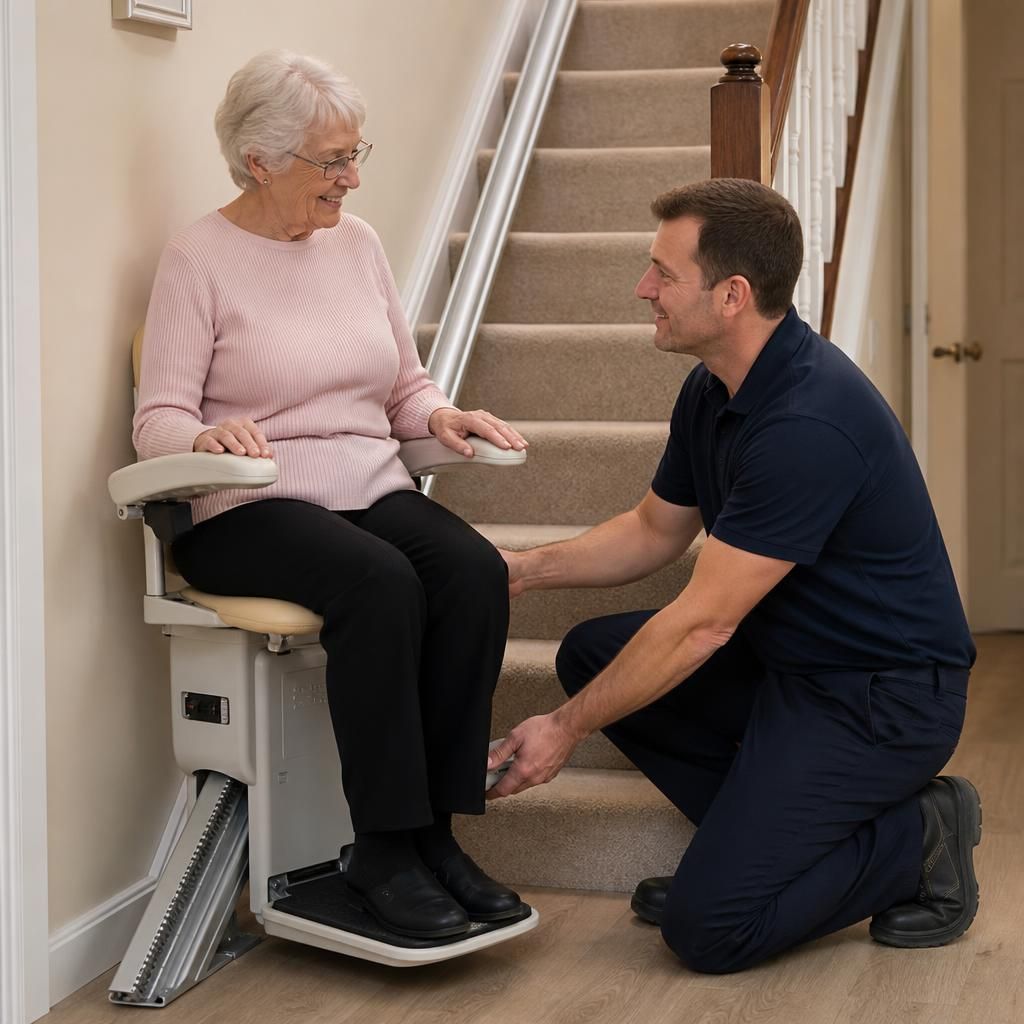
A stairlift installation should include a practical handover, not just fitting the equipment. Once the rail, seat and controls are installed, the engineer should test the complete route and show the user how to operate the lift safely.
Before the installer leaves, make sure the user and any regular carer can:
- Transfer into and out of the seat safely.
- Fasten the safety belt and use the swivel seat, if fitted.
- Operate the controls without leaning or twisting.
- Keep hands, feet and clothing clear of moving parts.
- Park and charge the stairlift correctly.
- Respond appropriately to an obstruction, power cut or fault warning.
Ask the installer to repeat any instruction that is unclear, and check that the operating guide, warranty details and emergency contact information are left at the property.
Arrange your stairlift installation assessment
Arrange your stairlift installation assessment with Independent Stairlifts to review your staircase, access requirements and the most suitable solution for your home.