
What are the safety features and compliance standards for stairlifts for disabled individuals?
Stairlifts for disabled individuals should include features such as a safety belt, powered swivel seat, obstruction sensors, controlled braking, secure footrest and battery backup, with controls suited to the user’s abilities. In the UK, they should comply with applicable machinery safety legislation and relevant standards, including BS EN 81-40, and be assessed, installed and tested by a competent professional.
Stairlifts for disabled individuals should combine physical protection, controlled movement and user-friendly controls, and should be supplied, installed and tested in accordance with the safety requirements that apply in the UK. Important features include a correctly positioned safety belt, powered swivel seat, obstruction sensors, controlled braking, a secure footrest, reliable batteries and controls that suit the user’s abilities. The stairlift should also be assessed against the staircase, the user’s mobility needs and any foreseeable risks before installation.
Key stairlift safety features
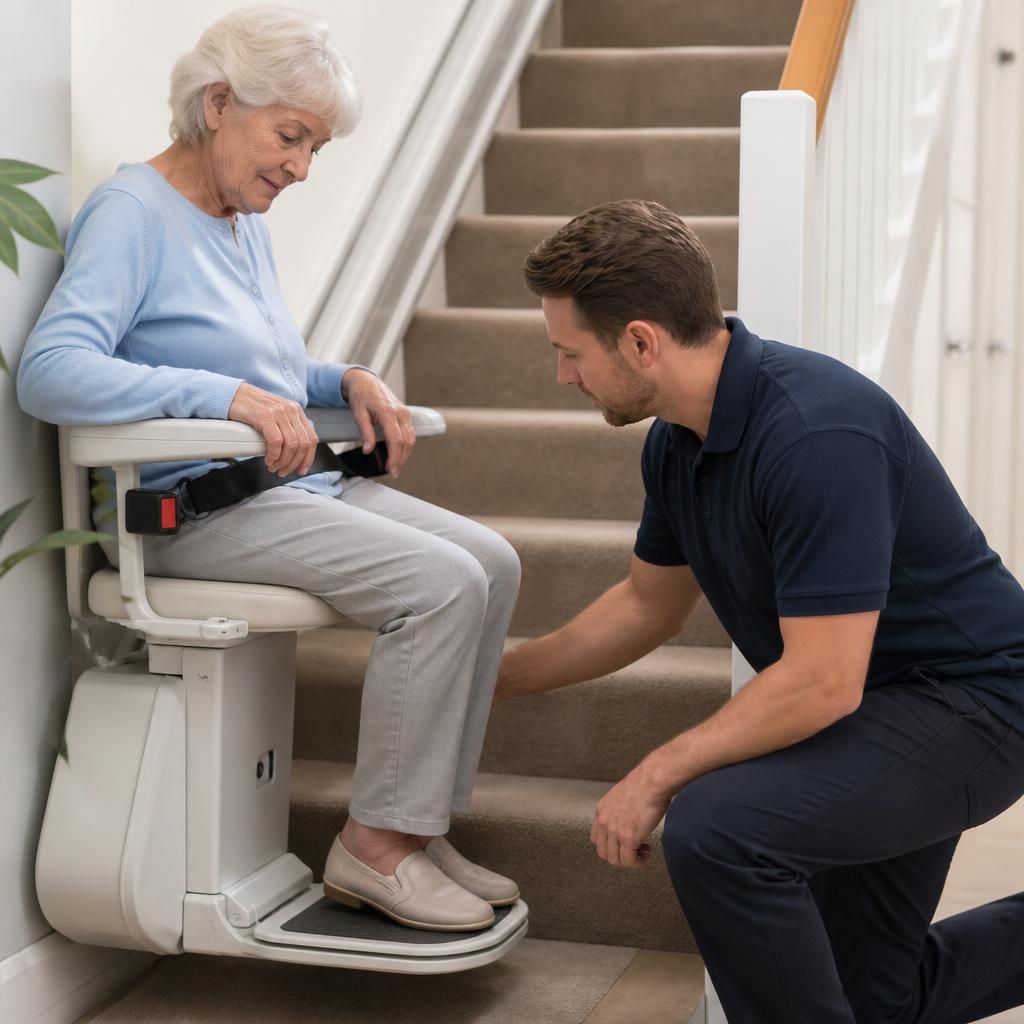
- Safety belt or harness: A seat belt helps keep the user securely positioned while the stairlift is moving. The type of belt should suit the user’s posture, balance and ability to release it independently. Some users may require additional support, but any harness or positioning aid must be compatible with the stairlift and not restrict safe evacuation.
- Powered swivel seat: A swivel seat turns towards the landing, allowing the user to get on and off facing away from the stairs. It should lock securely in the travel and exit positions. This is particularly important for anyone with reduced balance, painful joints or difficulty turning on a narrow landing.
- Obstruction sensors: Sensors and safety edges should stop or prevent the stairlift from travelling if it encounters an object on the stairs. They do not replace keeping the staircase clear, and the lift should not be used to carry items that could interfere with the sensors or footrest.
- Controlled start, stop and braking: The drive system should provide a steady start and stop, with brakes that hold the chair securely when it is stationary. The stairlift should not continue running if a control is released or a safety circuit is interrupted.
- Secure footrest and arms: A stable footrest supports the user’s feet and should include protection against contact with the steps where appropriate. Folding arms and a properly latched seat help keep the user safely within the chair during travel.
- Controls and interlocks: Controls should be easy to reach and operate, with clear direction controls and suitable pressure-sensitive or constant-pressure operation. Interlocks should prevent travel if the seat, arms or other essential components are not in the required position.
- Battery backup: Most domestic stairlifts use rechargeable batteries so they can complete journeys during a mains power cut. The charging system should be checked regularly, and the stairlift should normally be left at a designated charging point when not in use.
- Emergency controls and alarms: Depending on the model, there may be an emergency stop, audible warning, diagnostic indicator or manual lowering procedure. The user and household members should know what each control does and how to contact the installer if the stairlift stops unexpectedly.
Some stairlifts also offer adjustable seats, powered folding rails, remote controls, swivel-and-slide seats or alternative control positions. These features can improve safety when a disability affects grip, reach, strength, coordination or posture. They should be selected after an assessment rather than treated as standard requirements for every user.
Relevant UK compliance requirements
In Great Britain, stairlifts are generally treated as machinery and must meet the applicable requirements of the Supply of Machinery (Safety) Regulations 2008, as amended. A compliant product should have appropriate technical documentation, instructions and safety information, and the supplier or manufacturer should be able to provide a declaration of conformity. The applicable conformity marking may be UKCA or CE, depending on the product, supply route and whether it is being placed on the market in Great Britain or Northern Ireland. Marking alone is not a substitute for a suitable assessment and competent installation.
BS EN 81-40 is the principal British and European standard commonly associated with stairlifts and inclined lifting platforms intended for people with impaired mobility. It addresses design and construction matters such as safe travel, restraint, controls, stopping, protection against hazards and certain testing requirements. A quotation or product document may refer to the current edition or to other designated or harmonised standards used to demonstrate conformity. The installer should explain which standards and legal requirements apply to the proposed equipment.
Electrical safety is also relevant. The stairlift, charging equipment and any associated electrical work should be installed and tested competently, with suitable protection and connections. Where work affects the fixed electrical installation, it should be carried out and documented in line with the applicable electrical requirements. A stairlift should not be modified with unofficial chargers, batteries, switches or accessories, as changes can affect its safety circuits and conformity.
Assessment, installation and testing
Compliance is not only about the chair itself. Before installation, the survey should consider the staircase width and shape, landing space, doorways, lighting, trip hazards, the user’s transfer method and what would happen if the user needed to leave the stairlift during a power failure. For a curved or unusual staircase, the rail and parking positions should be designed specifically for the available space. Outdoor installations require equipment and protection suitable for weather exposure.
After installation, the stairlift should be tested through its full route. The installer should check the safety belt, swivel mechanism, sensors, braking, controls, charging points, limit switches, folding parts and emergency functions. You should receive operating instructions, information about charging and cleaning, details of the warranty and a clear procedure for reporting a fault. Ask the installer to demonstrate the controls and allow the intended user to practise getting on, travelling and getting off safely.
Using and maintaining the safety features
- Use the belt every time and remain seated with hands, feet and clothing clear of the rail and moving parts.
- Do not carry people, pets or bulky items unless the stairlift instructions specifically permit it.
- Keep the steps and landing clear, particularly around sensors, the footrest and the exit position.
- Leave the stairlift on its charging point when it is not in use, where the manufacturer’s instructions require this.
- Arrange servicing at the recommended intervals and report unusual noise, jerky movement, warning lights, repeated stopping or reduced battery performance promptly.
- Do not bypass a safety switch or continue using the stairlift after a collision, fault or abnormal movement until it has been checked.
A stairlift can comply with the relevant legislation and standards while still being unsuitable for a particular person if the seat, controls, transfer arrangements or available space do not match their needs. If the user’s condition, balance, weight, posture or ability to operate the controls changes, request a further assessment. For specific regulatory questions, the installer should identify the conformity documents for the model and explain how the completed installation has been checked.
Stairlift safety compliance covers both the equipment and the completed installation. In Great Britain, the supplier should provide appropriate conformity information, instructions and safety details, while the installer should assess the staircase, fit the lift correctly and test its safety systems.
Before accepting the installation, ask for a demonstration of the belt, swivel seat, controls, obstruction sensors, braking, charging system and emergency procedures. You should also receive clear operating instructions and know who to contact if the stairlift stops unexpectedly. Compliance marking alone does not confirm that a model is suitable for the user or the layout of the home.
Arrange a stairlift safety assessment
Arrange a stairlift safety assessment with Independent Stairlifts to check that the equipment, controls and installation are suitable for the user and staircase.