
How do I know if a stairlift is suitable for my specific disability?
A stairlift may be suitable for many disabilities, but suitability depends on your mobility, balance, posture, ability to transfer safely, stair layout and any specific needs affecting how you use the controls or seat. A tailored assessment by a qualified stairlift adviser can identify the right configuration and features, or recommend a more suitable mobility solution if a stairlift is not appropriate.
A stairlift is suitable for many people with a disability, but suitability depends on how your condition affects movement, balance, posture, transfers, grip, vision, hearing and your ability to use the controls. It also depends on the staircase, available space and whether you can sit safely and remain stable while the lift is moving. A personalised assessment is the most reliable way to determine whether a stairlift is appropriate and which configuration or alternative solution would meet your needs.
Eligibility is not based on a particular diagnosis alone. Two people with the same disability may need different arrangements, while someone with a less obvious mobility difficulty may require significant adaptations. The assessment should consider how you manage everyday movements rather than simply the name of your condition.
Mobility and balance
A stairlift may help if you can no longer manage the stairs safely because of reduced strength, restricted movement, pain, fatigue or poor balance. The adviser will usually consider whether you can:
- Approach the stairlift and position yourself safely at the bottom or top of the stairs
- Sit down and stand up without losing balance
- Remain seated throughout the journey
- Keep your feet, arms and clothing clear of the stairs and equipment
- Transfer between a wheelchair, walking aid or other seat and the stairlift
If you have unpredictable collapses, severe involuntary movements or difficulty remaining seated, a standard stairlift may need additional support features or may not be the safest option. This should be discussed openly during the assessment.
Posture, muscle control and pain
Conditions affecting the spine, joints, muscles or nervous system can make a standard seat uncomfortable or unsafe. An assessment can look at whether you need a more supportive seat, adjustable armrests, a different seat height, a powered swivel seat or a powered footrest. These features may make it easier to align your body, keep your feet supported and complete the transfer at the landing.
A powered swivel seat can be particularly useful when turning at the top or bottom of the stairs is difficult. It moves the seat into a safer position for getting on or off, but you still need to be able to transfer with the level of assistance available in your home. Where a carer helps you, the adviser should consider whether there is enough room for that assistance and whether the controls can be operated safely.
Strength, grip and control use
Most stairlifts use an armrest control, remote control or both. If you have arthritis, weakness, tremors, reduced sensation or limited dexterity, you may need controls that are easier to operate, positioned on the stronger side or supplemented by a remote control. The assessment should confirm that you can start, stop and control the lift reliably, including in an emergency.
If you cannot operate the controls independently, this does not automatically rule out a stairlift. However, a safe arrangement must be established. Depending on your circumstances, this could involve assistance from a carer, a different control position or an alternative mobility solution. Controls should not be placed where they could be operated accidentally or cannot be reached comfortably.
Wheelchair use and transfers
Many stairlift users leave a wheelchair or walking aid at one end of the stairs and use another at the other end. This requires safe transfers and suitable storage space. A stairlift does not normally carry a wheelchair with you, so the assessment should consider how you will manage at both landings.
If transferring is difficult, you may need a seat with enhanced support or a different type of access equipment. In some homes, a wheelchair platform lift, through-floor lift or stair-climbing solution may be more appropriate, subject to the building and your individual needs. The right option is the one that provides safe access without requiring a transfer that you cannot manage.
Vision, hearing and cognitive needs
Reduced vision may affect your ability to approach the seat, identify the controls or judge when to transfer. Good lighting, clear control markings, contrasting finishes and consistent positioning can help. Hearing loss does not usually prevent stairlift use, but you should be able to recognise visual indicators and understand how the lift communicates its status.
If memory problems, confusion or reduced concentration affect your ability to follow the operating sequence, the adviser should discuss this with you and, where appropriate, the person supporting you. The installation must be simple to use and the people involved should understand the operating and charging instructions. A stairlift may not be suitable if it cannot be used safely and consistently, even with reasonable adaptations.
Medical advice and changing conditions
A stairlift adviser can assess practical suitability and recommend equipment, but cannot diagnose a medical problem or replace advice from your occupational therapist, physiotherapist, GP or consultant. Ask your healthcare professional for guidance if your condition is changing, you have recently had surgery, you experience blackouts or seizures, or you are unsure whether sitting and transferring are safe.
Tell the adviser about relevant symptoms, prescribed equipment and any assistance you receive. This includes falls, dizziness, fatigue, pain, spasms, pressure-care needs and difficulties that may not be visible during a short demonstration. If your ability varies from day to day, explain your better and worse periods so the recommendation reflects normal use rather than a single good day.
How the assessment establishes suitability
- Discuss your daily routine: Explain how you currently use the stairs, where you need help and what makes them difficult or unsafe.
- Review your mobility: The adviser will consider walking, standing, sitting, transfers, balance and any walking aids or wheelchairs you use.
- Check the staircase: The layout, width, turns, landings, doors, obstructions and available parking space will affect the type of stairlift and seat that can be installed.
- Consider the controls and support: Features should be selected according to your strength, dexterity, posture, vision and ability to use the lift independently.
- Discuss alternatives if necessary: If a stairlift would involve an unsafe transfer or insufficient support, you should be told why and what other options may be worth investigating.
You should be able to try the proposed seat and controls, ask how you would get on and off at each landing, and understand what happens if the lift stops or the power supply fails. If another person will regularly help you, they should be involved in the assessment where possible.
Signs that a standard stairlift may need further consideration
- You cannot sit upright or remain safely positioned without substantial support
- You cannot transfer to or from the seat, even with the assistance available
- Your movements are unpredictable enough to create a risk during travel
- You cannot reliably operate or respond to the controls
- The staircase cannot provide adequate space for safe boarding, travel or parking
- Your weight, body shape or equipment requires a specialist configuration
These points do not automatically mean that no solution is possible. They indicate that a standard model should not be recommended without a more detailed assessment. Specialist seating, additional support, a different stairlift configuration or another type of lift may be considered.
Before proceeding, ask for the recommendation to be explained in practical terms: how you will transfer, which features are essential, who will operate the controls if you cannot, and how the arrangement will work if your condition changes. A suitable stairlift should match your abilities and the support available in your home, not just fit the staircase.
A personalised assessment is the most reliable way to establish whether a stairlift is suitable for your specific disability. It considers how you sit, stand, transfer, balance and operate the controls, as well as the staircase layout and the support available at home.
Explain your usual difficulties, including pain, fatigue, spasms, dizziness, falls or changes in mobility. If your condition varies, describe both better and worse days so the recommendation reflects everyday use. The assessment should also cover how you will transfer from a wheelchair or walking aid, whether you can remain safely seated during travel and which features may help, such as a powered swivel seat, supportive seating or easier-to-use controls.
If a standard stairlift would require an unsafe transfer or provide insufficient support, the adviser should explain why and discuss whether specialist equipment or an alternative access solution may be more appropriate.
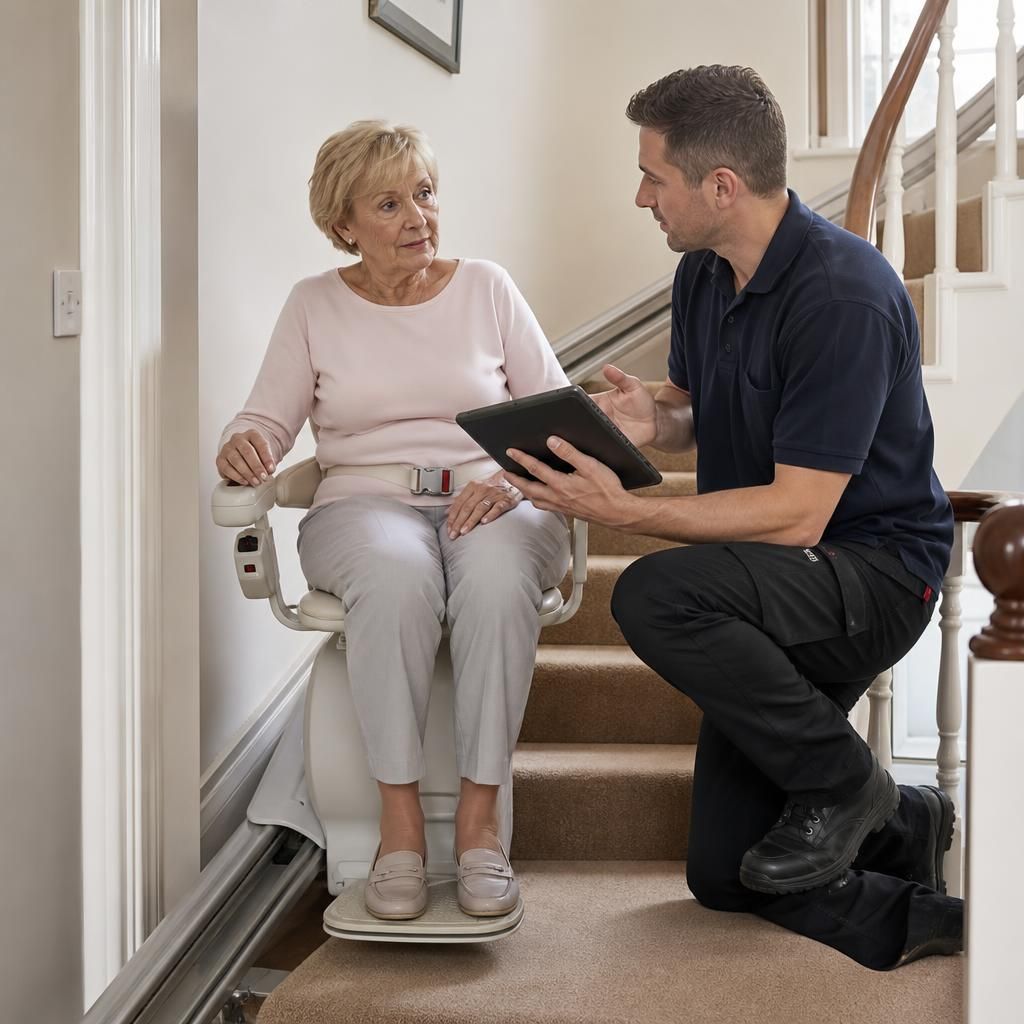
Arrange a Personalised Stairlift Assessment
Arrange a personalised stairlift assessment to discuss how your disability affects transfers, balance, posture and control use, and whether a stairlift is suitable for your home. Our adviser can also explain any adaptations or alternative solutions that may be more appropriate.