
How can I maintain the longevity and performance of my stairlift for disabled individuals?
Regular servicing, correct charging, routine cleaning and prompt attention to unusual noises or movement help maintain a stairlift’s safety, reliability and long-term performance for disabled individuals. Keep the track and seat area clear, follow the manufacturer’s operating guidance, avoid overloading the lift and arrange professional repairs rather than attempting electrical or mechanical work yourself.
Maintaining a stairlift’s longevity and performance depends on regular servicing, correct charging, careful cleaning and prompt attention to changes in its operation. Keep the lift and track clear, use it only as instructed, follow the manufacturer’s maintenance guidance and arrange professional repairs when a fault is suspected. These measures help preserve safe, dependable movement for disabled users and can prevent minor issues from becoming more disruptive or expensive problems.
Follow the manufacturer’s instructions
Keep the operating manual and any service information available to the person who uses the stairlift or provides their care. The manual will explain the lift’s maximum user weight, charging procedure, controls, safety features and recommended servicing interval. Instructions can vary between models, particularly for curved, outdoor and reconditioned stairlifts, so do not assume that advice for one lift applies to another.
Use the stairlift only for its intended purpose. A stairlift is designed to carry one seated passenger, not heavy household items, pets or additional people. Do not exceed the stated weight limit, lean out while travelling or attempt to stand before the lift has reached the landing and stopped completely. If the user’s mobility or posture changes, contact us so the seating position, controls or additional support requirements can be reviewed.
Keep the stairlift charged
Most stairlifts use rechargeable batteries and are designed to charge when parked correctly at a charging point. Encourage the user to return the lift to its designated parking position after use, unless the manufacturer’s instructions state otherwise. Avoid leaving the stairlift away from its charger for extended periods, as this can reduce availability and may cause the batteries to discharge.
Watch for signs of a charging or battery problem, including a low-battery warning, reduced travel distance, slower operation or the lift failing to start after being parked. Do not replace batteries or alter the charger unless this has been authorised and carried out by a suitably qualified technician. Battery performance can also be affected by cold conditions, particularly with outdoor stairlifts, so report repeated charging issues rather than repeatedly resetting the lift.
Carry out simple routine checks
Before using the stairlift, check that:
- the track and steps are free from clothing, toys, cables, walking aids and other obstructions;
- the seat, armrests, footrest and safety belt are secure and undamaged;
- the swivel seat, if fitted, locks into its intended travel and transfer positions;
- the controls respond normally and the key switch or remote control is available to the user;
- the stairlift starts, stops and travels without unusual vibration, hesitation or noise; and
- doors, furniture and other household items cannot obstruct the lift at any point on the staircase.
These checks should be visual and functional only. Do not remove covers, reach into the mechanism or test internal components. If anything appears loose, damaged or different from normal, stop using the lift where it is safe to do so and request advice.
Clean it carefully
Dust and surface dirt can be removed with a soft, dry or slightly damp cloth. Clean the seat, armrests, controls and footrest regularly, using a product that is suitable for the relevant material. Keep moisture away from switches, charging contacts, electrical parts and the motor housing. Never pour water over the lift, use a hose or apply abrasive cleaners, solvents or excessive lubricant.
The track should be kept free of dust and household debris, but lubrication should only be applied when the manufacturer or service engineer specifically recommends it. Applying the wrong product can attract dirt, affect the lift’s movement or interfere with components. Outdoor models need particular attention to leaves, mud, water and other debris, as well as visible signs of corrosion or weather damage.
Arrange professional servicing
Routine servicing allows a qualified stairlift engineer to inspect components that cannot be assessed safely during everyday checks. Depending on the model and its condition, a service may include checking the batteries and charger, drive system, track, seat mechanism, safety belt, sensors, limit switches, braking system and electrical connections. The engineer can also identify wear and confirm that the lift is operating in accordance with the manufacturer’s requirements.
Keep to the recommended service schedule even if the stairlift appears to be working normally. A lift used several times each day, an outdoor stairlift exposed to weather, or a model in a demanding environment may need closer monitoring. Keep records of servicing, repairs and battery replacement so that any recurring issue can be identified quickly.
Respond promptly to warning signs
Stop and seek professional advice if the stairlift:
- makes a new grinding, clicking, squealing or banging noise;
- moves unevenly, jerks, stops unexpectedly or travels more slowly than usual;
- fails to charge, displays a fault warning or repeatedly loses power;
- has a loose seat, armrest, footrest, belt or control;
- does not stop correctly at the landing or fails to respond to a safety sensor; or
- shows visible damage, exposed wiring, fluid contamination or corrosion.
Do not continue using the lift simply because it still moves. Unusual operation can indicate wear, a battery problem, an obstruction or a safety-system fault. If the stairlift stops with someone on it, follow the emergency instructions supplied with the lift and contact the relevant support service. Do not try to move the passenger manually unless there is an immediate emergency and it is safe to do so.
Avoid DIY repairs and unauthorised alterations
Stairlifts contain electrical, mechanical and safety-critical components. Do not bypass sensors, tamper with the charging system, adjust the track, dismantle covers or fit replacement parts that have not been approved for the model. Do not use extension leads or improvised charging arrangements unless specifically permitted by the manufacturer. Professional assessment is safer and helps protect the reliability of the lift.
Tell us if the user’s circumstances change, such as reduced balance, a new transfer difficulty, a change in weight or the need to travel with an oxygen cylinder or walking aid. The stairlift may require an adjustment, an accessory or a suitability review. Keeping the equipment correctly matched to the user is an important part of maintaining safe long-term performance.
For further help, have the stairlift model, the nature of the problem and any displayed fault indication available when contacting Independent Stairlifts. We can advise whether the issue requires immediate attention, a routine service or an assessment of the user’s current needs.
Professional servicing is a key part of maintaining a stairlift for disabled individuals because it checks the electrical, mechanical and safety components that cannot be assessed safely during everyday cleaning. A qualified engineer can inspect the batteries, charger, drive system, track, sensors, braking system, seat mechanism and safety belt, then identify wear before it affects reliable operation.
Arrange servicing at the interval recommended for your model, even if the stairlift appears to be working normally. More frequent use, outdoor exposure or a demanding home environment may require closer monitoring. Keep records of services, repairs and battery replacements, and contact Independent Stairlifts promptly if the lift becomes noisy, jerky, slow, difficult to charge or different from its usual operation. Do not continue using it or attempt repairs until it has been assessed where a safety fault is suspected.
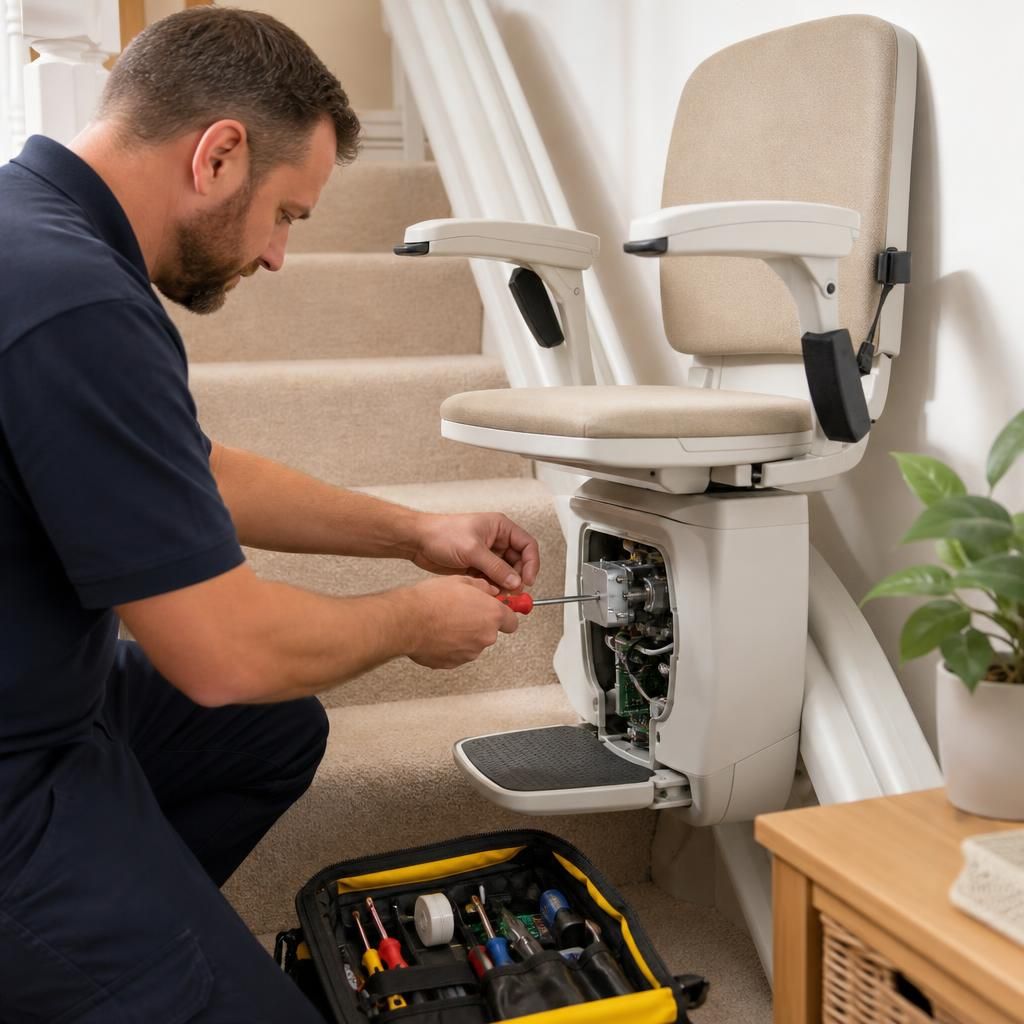
Arrange a stairlift service or maintenance assessment
Arrange a professional stairlift service or maintenance assessment with Independent Stairlifts to check its safety, charging system and mechanical performance. Contact us if you have noticed unusual noise, jerky movement, charging problems or changes in the user’s needs.