
How can I ensure that a stairlift is the right fit for my home?
A stairlift is the right fit when its rail, seat and controls suit your staircase layout, available space and individual mobility needs. A professional home assessment will confirm the required measurements, identify any access or safety issues and recommend a suitable straight, curved or outdoor model.
A stairlift is the right fit for your home when its rail can be installed safely on the staircase, its seat and controls suit the user, and there is enough space to get on and off comfortably. The most reliable way to confirm this is with a professional home assessment, which considers the staircase, surrounding rooms, access points and the individual’s mobility needs before a model is recommended.
A stairlift should not be selected by staircase type alone. Two staircases that appear similar may require different solutions because of their width, shape, landing arrangement, door positions or available space at the top and bottom. An assessment helps establish whether a straight, curved or outdoor stairlift is appropriate and whether any adaptations are needed.
Assess the staircase layout
The first consideration is the shape and construction of the stairs. A straight stairlift is generally suitable where the staircase runs in one uninterrupted direction. A staircase with a bend, curve, half-landing or more than one flight will usually need a curved stairlift with a rail made to follow its route. Separate straight stairlifts may sometimes be possible, but this depends on the landing layout and whether the user can safely transfer between them.
The surveyor will check the stair width, the position of the steps, the height and shape of the landings, and the location of walls, bannisters, doors and radiators. They will also look for features that could affect the rail, such as a low ceiling, a window, a cupboard or a doorway opening onto the stairs. These details determine where the stairlift can travel and where it can be parked without obstructing access.
For an external staircase, the assessment also needs to consider exposure to rain, frost and direct sunlight. An outdoor stairlift must be suitable for those conditions and have an appropriate charging and storage arrangement. The surrounding paving, drainage and access route should be checked as part of the installation planning.
Check the space at the top and bottom
There must be a safe area for the user to mount and leave the stairlift. At the bottom, this may mean allowing room to turn away from the stairs without stepping into a doorway or obstructing a hallway. At the top, the user needs sufficient space to swivel, stand and move towards the landing or adjacent room.
Where space is restricted, a powered or manual swivel seat, a folding rail or a different parking position may help. These options are not suitable for every staircase or user, so they should be considered during the survey rather than assumed to solve the problem. The final arrangement should leave everyday routes, fire exits and doorways usable.
Match the stairlift to the user
The correct fit depends as much on the person using the stairlift as on the building. The assessment should take account of:
- Whether the user can sit down and stand up safely, or needs powered swivelling or another transfer aid.
- Their height, build and weight, within the limits specified for the selected model.
- Whether they can bend their knees sufficiently to sit comfortably on the seat.
- Any weakness, pain, tremor, reduced balance, restricted movement or difficulties with grip.
- Whether they can operate a control on the armrest or would benefit from a remote control.
- Whether they need to travel with a walking stick, frame or other essential item.
- Whether another person may need to assist them when getting on or off the stairlift.
A person with limited hand strength may find a simple, easy-to-operate control more suitable than a small or complicated handset. Someone who has difficulty turning at the top of the stairs may need a seat that swivels before they stand. If posture, balance or transfer ability changes during the day, these factors should be discussed openly so that the recommended arrangement is practical in everyday use.
Consider the seat, rail and controls together
The seat should provide stable support and allow the user to sit with their back against the backrest and their feet securely on the footrest. The armrests, seat belt and controls should be positioned so they can be used without leaning or twisting. A powered footrest, swivel seat or different seat configuration may be helpful where movement is restricted.
The rail should follow the stairs closely while allowing the seat to travel smoothly and park in a safe position. On a curved staircase, the rail is normally made for the specific route rather than selected from a standard size. On a narrow staircase, the folded seat and footrest should be checked to ensure they do not create an unnecessary obstruction for other household members.
Controls should be available to the user and, where appropriate, to a carer or another person elsewhere in the home. The assessor should confirm that the user can understand and operate the controls, including stopping the stairlift if necessary. A demonstration is useful because comfort and ease of use are difficult to judge from measurements alone.
Check electrical and installation requirements
Most domestic stairlifts are designed to charge through a dedicated charging point on the rail or at a parking position. The installer will identify a suitable power supply and check that the charging location can be reached without creating a trip hazard. Battery-powered operation means the stairlift can usually continue to operate for a limited period during a power cut, but it still needs to be parked correctly so that its batteries recharge.
The rail is normally fixed to the stairs rather than the wall, which often reduces the need for structural changes. Even so, the installer must check the condition and construction of the steps, particularly where there are unusual surfaces, fragile finishes or alterations. Any proposed fixings, cable routes and changes to surrounding fittings should be explained before work begins.
Use the home assessment to identify practical risks
Before the installation, consider how the stairlift will work with the rest of the home. Look at whether:
- Doors can open fully without striking the stairlift or its rail.
- Furniture, ornaments or floor coverings need to be moved from the staircase or landings.
- There is adequate lighting at the boarding and exit points.
- Other people can still use the stairs safely when the stairlift is parked or folded.
- Pets and children can be kept clear of the moving parts.
- The intended parking position leaves access to essential rooms and exits.
Do not rely on photographs or a general staircase measurement to confirm suitability. Images may not show obstructions, uneven surfaces, door swings or the space needed for a safe transfer. A home visit provides a more accurate assessment and allows the installer to discuss options in the actual environment.
Confirm the recommendation before installation
Ask the surveyor to explain why the proposed model and rail arrangement suit the staircase and the user. You should understand where the stairlift will park, how the user will board and leave it, where the controls are located, and what happens if the power supply fails. If the staircase is shared with other household members, ask how much usable stair width will remain when the seat is folded.
It is also sensible to confirm the model’s weight capacity, warranty arrangements, servicing requirements and the availability of replacement batteries or other parts. These details should relate to the specific stairlift being proposed, rather than to stairlifts in general.
The final decision should be based on safe transfers, comfortable travel and reliable access throughout the home. If the user’s condition is changing, or if a carer is involved in daily transfers, mention this during the assessment. A carefully matched stairlift can then be configured around present needs while allowing the installer to identify limitations that may affect future use.
Once the survey is complete, the installer should provide a clear recommendation and explain any preparation required before fitting. If the staircase, landing or user’s needs are particularly complex, a further assessment or demonstration may be appropriate before you proceed.
A professional home assessment is the most reliable way to confirm that a stairlift will fit safely. The surveyor checks the staircase, landings, doorways and surrounding space, then matches the rail, seat and controls to the user’s mobility needs.
Measurements alone are not enough. The assessment should also confirm that the user can board and leave the stairlift comfortably, that doors and walkways remain usable, and that the folded lift will not create an avoidable obstruction. Any concerns about balance, transfers, limited movement or changing needs should be discussed before the model is selected.
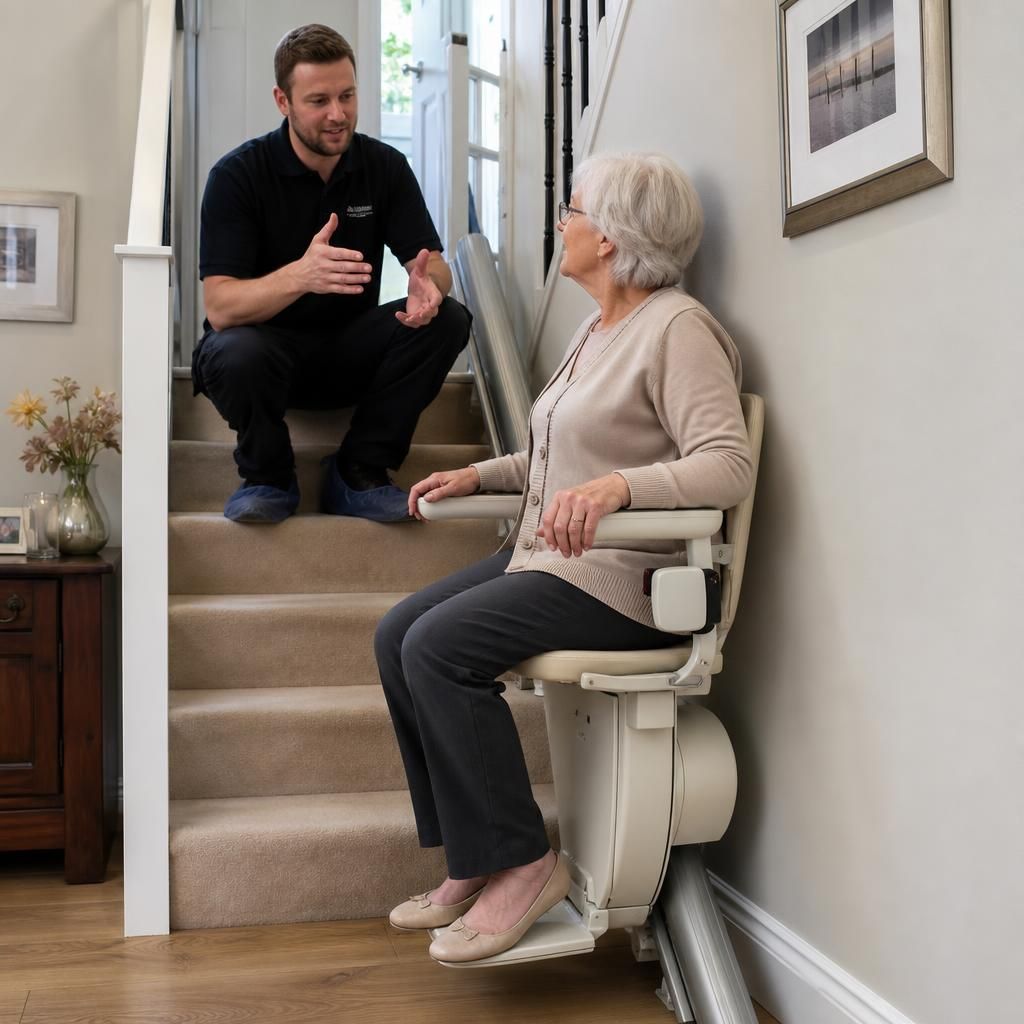
Arrange your professional stairlift home assessment
Arrange a professional stairlift home assessment to confirm that your staircase, available space and mobility needs are suitable for the recommended model.
Independent Stairlifts can assess the installation requirements and explain the most practical options for your home.