
What maintenance routines should I follow to keep my stair lift in optimal condition?
Keep your stair lift in optimal condition by keeping the track and seat area clear, checking the safety features and controls, charging the batteries correctly, and arranging professional servicing at the recommended intervals. Report unusual noises, jerky movement, warning lights or reduced battery performance promptly, and do not attempt electrical or mechanical repairs yourself.
Keeping a stair lift in optimal condition involves regular cleaning, clear access to the track, correct battery charging, basic safety checks and professional servicing. These routines help maintain smooth operation and allow faults such as unusual noises, jerky movement or warning lights to be identified before they affect reliability.
Follow the manufacturer’s instructions first. Maintenance requirements can vary between straight, curved, outdoor and reconditioned stair lifts. Your user manual should take priority, particularly for charging, lubrication, cleaning products and service intervals.
Keep the track and staircase clear
- Remove shoes, bags, toys, ornaments and other objects that could obstruct the stair lift or its sensors.
- Keep the rail free from dust, pet hair and other debris. Wipe accessible surfaces with a soft, dry or slightly damp cloth.
- Do not apply oil, grease or household cleaning products to the rail unless the manufacturer or a qualified engineer specifically advises this. Incorrect lubrication can attract dirt or affect the lift’s operation.
- Check that the lift has enough space to park safely at the top and bottom of the staircase.
For an outdoor stair lift, also check for leaves, mud, standing water, ice and other weather-related debris. Avoid using the lift when the route is obstructed, and follow the instructions for protecting the equipment in severe weather.
Check the seat and operating controls
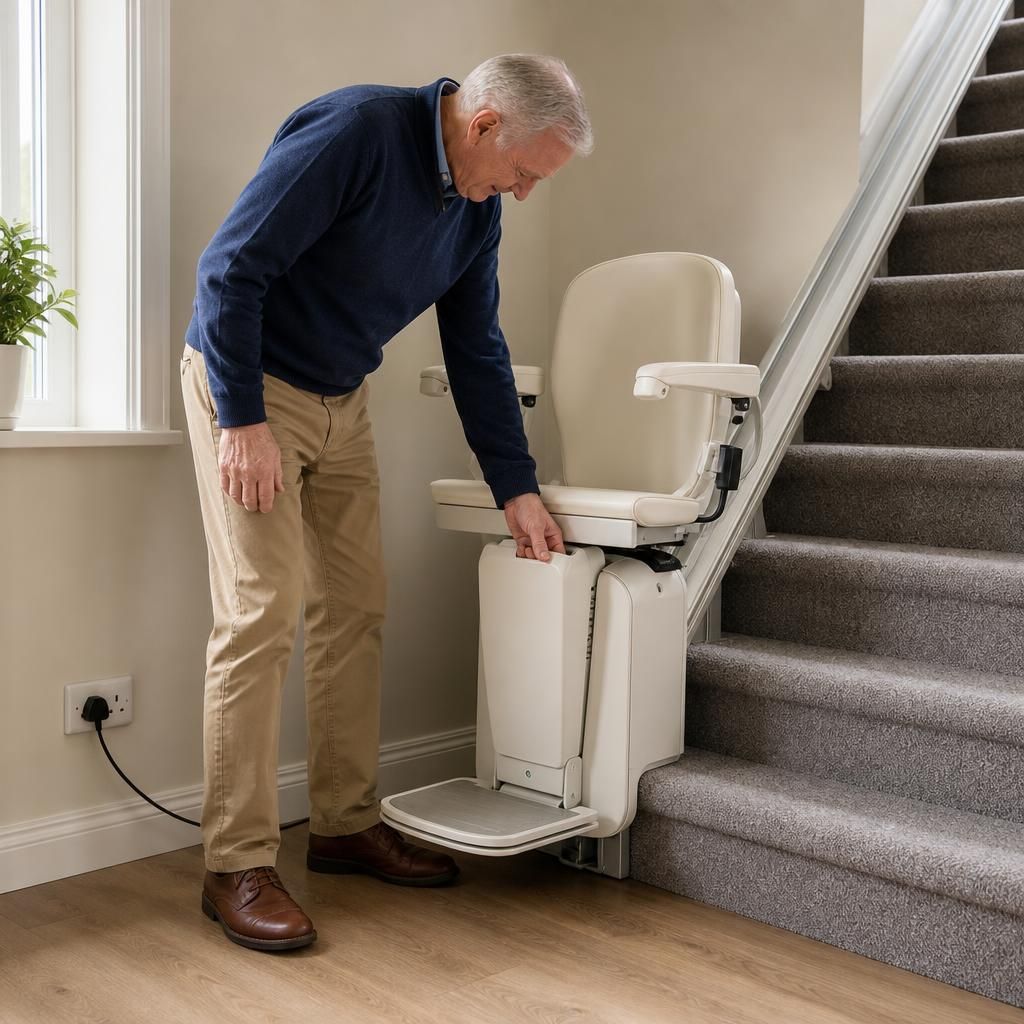
- Keep the seat, armrests, footrest and controls clean and free from objects.
- Check that the seat swivels and locks correctly if your model has a swivel seat.
- Make sure the footrest is secure and not damaged or obstructed.
- Check that the armrests move correctly and that the seat belt fastens and releases as intended.
- Use the hand control and any remote controls periodically to confirm that commands are being received correctly. Store remote controls where they will not be knocked or damaged.
Never continue using the stair lift if the seat belt, swivel mechanism, armrest, footrest or control system does not work properly. Contact Independent Stairlifts or your servicing provider for advice.
Maintain the batteries and charging points
- Park the stair lift at its designated charging point whenever it is not in use, unless your model’s instructions state otherwise.
- Keep charging contacts clean and make sure the lift is positioned correctly for charging.
- Check for warning lights, charging alerts or a noticeable reduction in travel distance or power.
- If the lift has been switched off at the mains or its isolation switch, restore the power as soon as it is safe to do so. Extended periods without charging can reduce battery performance.
- Do not attempt to open, test or replace batteries yourself. Battery work should be completed by a suitably qualified engineer.
A battery that loses charge quickly, causes the lift to stop unexpectedly or repeatedly triggers an alert should be reported promptly. Batteries are serviceable components and may eventually need replacement, but reduced performance should not be ignored.
Carry out simple safety checks
Before travelling, check that the staircase is clear and that the lift appears secure. During operation, pay attention to its movement and listen for changes in sound. The lift should travel smoothly and stop when the controls are released. Safety edges, sensors and emergency stop controls should be tested only in accordance with the user manual, as the correct procedure differs between models.
Do not bypass or disable a safety sensor, switch or interlock. If a safety feature prevents the lift from operating, this may indicate an obstruction or a fault that requires professional attention.
Arrange professional servicing
Have the stair lift serviced at the intervals recommended for your model and use. A qualified engineer can inspect the drive system, rail, batteries, charging equipment, sensors, switches, seat mechanisms and fixings, as well as identify wear that may not be visible during routine cleaning.
Arrange an earlier inspection if the stair lift is used heavily, has been exposed to damp or extreme weather, has been moved, or has been unused for an extended period. Keep service records and note any faults, repairs or battery replacements so that the engineer has a clear maintenance history.
Report faults promptly
Stop using the stair lift and seek advice if you notice jerky or unusually slow movement, grinding or clicking sounds, a burning smell, repeated stops, warning lights, charging problems, loose components or a seat belt that will not secure correctly. If the lift stops on the stairs, follow the emergency instructions in the manual and avoid trying to force it up or down the track.
Electrical, mechanical and battery repairs should not be attempted as a do-it-yourself task. Do not remove covers, alter the wiring or adjust the rail, drive system or safety equipment. These actions can create further faults and may compromise safe operation.
A consistent routine of keeping the stair lift clean and unobstructed, charging it correctly, checking its main safety components and arranging qualified servicing will help preserve reliable performance. If you are unsure about a maintenance task, contact Independent Stairlifts for model-specific guidance rather than guessing.
Correct battery charging is an essential stair lift maintenance routine because it helps preserve dependable operation and reduces the risk of the lift stopping unexpectedly. Park the lift on its designated charging point whenever it is not in use, unless your model’s instructions state otherwise.
Keep the charging contacts clean and check that the lift is positioned correctly to charge. Report warning lights, charging alerts or a noticeable reduction in travel distance promptly. Do not open or replace the batteries yourself; battery work should be carried out by a qualified engineer. If the lift has been disconnected from the mains, restore the power as soon as it is safe to do so.
Book a Professional Stair Lift Service
Book a professional stair lift service with Independent Stairlifts to have your lift’s drive system, batteries, charging points and safety components checked by a qualified engineer. Contact us to arrange a service or discuss any changes in performance.