
What factors should I consider when deciding between a new or reconditioned stair lift?
When choosing between a new or reconditioned stair lift, consider your budget alongside the lift’s condition, warranty, safety features, suitability for your staircase and likely long-term support. A reconditioned model may offer good value for a straightforward installation, while a new stair lift can provide more choice, the latest features and a warranty tailored to your needs.
The choice between a new and reconditioned stairlift should be based on more than the purchase price. Consider the total cost, the condition and age of the equipment, warranty and servicing arrangements, suitability for your staircase, required features, and how long you expect to use the lift. A reconditioned stairlift can be a practical, cost-effective option where a suitable model is available, while a new stairlift generally offers the widest choice of configuration, upholstery, features and warranty terms.
Start with the staircase and the user’s needs
The stairlift must be suitable for both the staircase and the person using it. Straight staircases usually provide more choice, whereas curved, narrow, steep or unusually shaped staircases may require a lift designed around the individual stairway. Outdoor installations also need equipment and materials intended to withstand changing weather conditions.
Consider how the user will transfer on and off the seat, whether they need a swivel or powered swivel seat, the amount of space available at the top and bottom of the stairs, and whether the controls can be operated comfortably. Weight capacity, seat width, footrest position, armrest support and the ability to fold the lift away when it is not being used should also be assessed. These requirements apply whether the stairlift is new or reconditioned.
A reconditioned model is only suitable if its design and dimensions meet these needs. Choosing a cheaper lift that is uncomfortable, difficult to operate or poorly suited to the staircase can result in a less satisfactory solution and additional costs later.
Compare the total cost, not just the initial quote
Reconditioned stairlifts are often less expensive because key components have previously been installed and used. This can make them appropriate when there is a clear budget limit or when the lift is needed for a shorter period. However, the quoted price should be compared on a like-for-like basis.
Check what is included, such as the survey, fitting, removal of an existing lift, electrical work, delivery, warranty cover and future servicing. Ask whether batteries, chargers, remote controls and essential safety components are included, and whether there could be additional charges for a curved or more complex installation. A new stairlift may have a higher initial cost but could provide a longer or more comprehensive warranty and greater choice of specification.
Also consider the likely cost of ownership. Batteries and other wearable parts may eventually need replacement on either type of lift. Ask how repairs are handled, whether call-outs are included in any service arrangement and whether parts will remain available for the expected period of use.
Check the condition and refurbishment process
“Reconditioned” should mean more than simply removing a lift from one staircase and installing it on another. Ask what inspection, cleaning, testing and replacement work has been carried out. A responsible refurbishment process should include checks of the drive system, batteries, charging points, controls, seat, armrests, footrest, track and safety mechanisms.
It is reasonable to ask which parts are new, which are refurbished and which are original. Find out whether the stairlift has been tested after refurbishment and whether the installer will check its operation once it has been fitted in your home. The cosmetic condition may vary, but appearance should not be confused with mechanical condition or suitability.
For a new stairlift, confirm the exact model and specification being offered rather than relying on a general description. This makes it easier to compare the equipment, controls, seat options and safety features with a reconditioned alternative.
Understand the warranty and aftercare
Warranty terms can differ significantly between new and reconditioned stairlifts. Read the documentation carefully and check the length of cover, what parts and labour are included, and whether batteries or accidental damage are excluded. Some warranties may apply only to the original installation or may have different conditions for reconditioned equipment.
Ask who to contact if the stairlift stops working, how faults are reported and whether assistance is available outside normal working hours. Confirm that servicing and repairs can be provided in your area. Reliable aftercare is particularly important where the stairlift is the user’s main means of accessing another floor.
Consider availability and installation times
A suitable reconditioned stairlift may be available for a straightforward staircase, but the choice can be limited by the models and tracks in stock. A new stairlift can usually be specified more precisely, although manufacture and delivery may affect the installation date. If the lift is needed urgently, ask what equipment is genuinely available and whether the proposed model meets the user’s requirements rather than choosing solely on speed.
For a curved staircase, a reconditioned lift may include a track previously made for another property. It should only be considered if the track configuration is appropriate and can be safely installed in the intended position. In some cases, a new, made-to-measure track will provide a better fit and more suitable stopping points.
Review safety and compliance
Both new and reconditioned stairlifts should be installed, tested and handed over by a competent professional. The lift should have suitable safety features, including a seat belt, obstruction sensors, safe braking and controls that are easy for the user to operate. The user should receive clear instructions on charging, parking, emergency lowering where relevant, and what to do if the lift stops.
Do not assume that an older stairlift is unsafe simply because it is reconditioned, or that a new stairlift is automatically suitable because it has the latest specification. Safety depends on the condition of the equipment, the quality of the installation, correct use and ongoing maintenance. Ask for the relevant documentation and make sure the completed installation is demonstrated to the user and anyone who may assist them.
Think about future changes
Consider how long the stairlift is likely to be needed and whether the user’s mobility or physical requirements may change. A new lift may offer more options for adapting the specification, while a reconditioned lift may be appropriate where the current needs are clear and unlikely to change. If the property may be sold or the stairlift will only be required temporarily, ask about removal and whether the equipment can be reused or sold on. The answer will depend on the type of lift, its condition and the installation.
It is also worth considering the needs of other household members. A compact seat or fold-away design may help preserve access on a shared staircase, while powered controls may be important if the user has limited strength or dexterity.
Use the assessment and quotation to make the final decision
A home assessment should establish the staircase type, available space, landing clearances, electrical requirements and the user’s physical needs. Use this assessment to compare new and reconditioned options with the same criteria. Ask for a written quotation that identifies the stairlift, included work, warranty, aftercare and any exclusions.
In general, a reconditioned stairlift may be the right choice when a suitable model is available, the refurbishment and testing process is clear, and the warranty and support are satisfactory. A new stairlift is often preferable when the staircase is complex, the user needs particular features, a precise fit is required, or longer-term specification and warranty choice are priorities. Independent Stairlifts can assess the staircase and discuss both options so that the decision is based on safety, suitability and overall value rather than price alone.
A reconditioned stairlift should only be considered when its condition, safety checks and warranty are clearly documented. Ask what has been inspected, cleaned, tested or replaced, including the drive system, batteries, controls, track, seat and safety sensors.
Compare the warranty and aftercare with the terms offered for a new stairlift. Check whether parts and labour are covered, how faults are reported, whether batteries are included, and whether servicing is available locally. A lower purchase price may not represent good value if the lift is unsuitable for the staircase or difficult to support later.
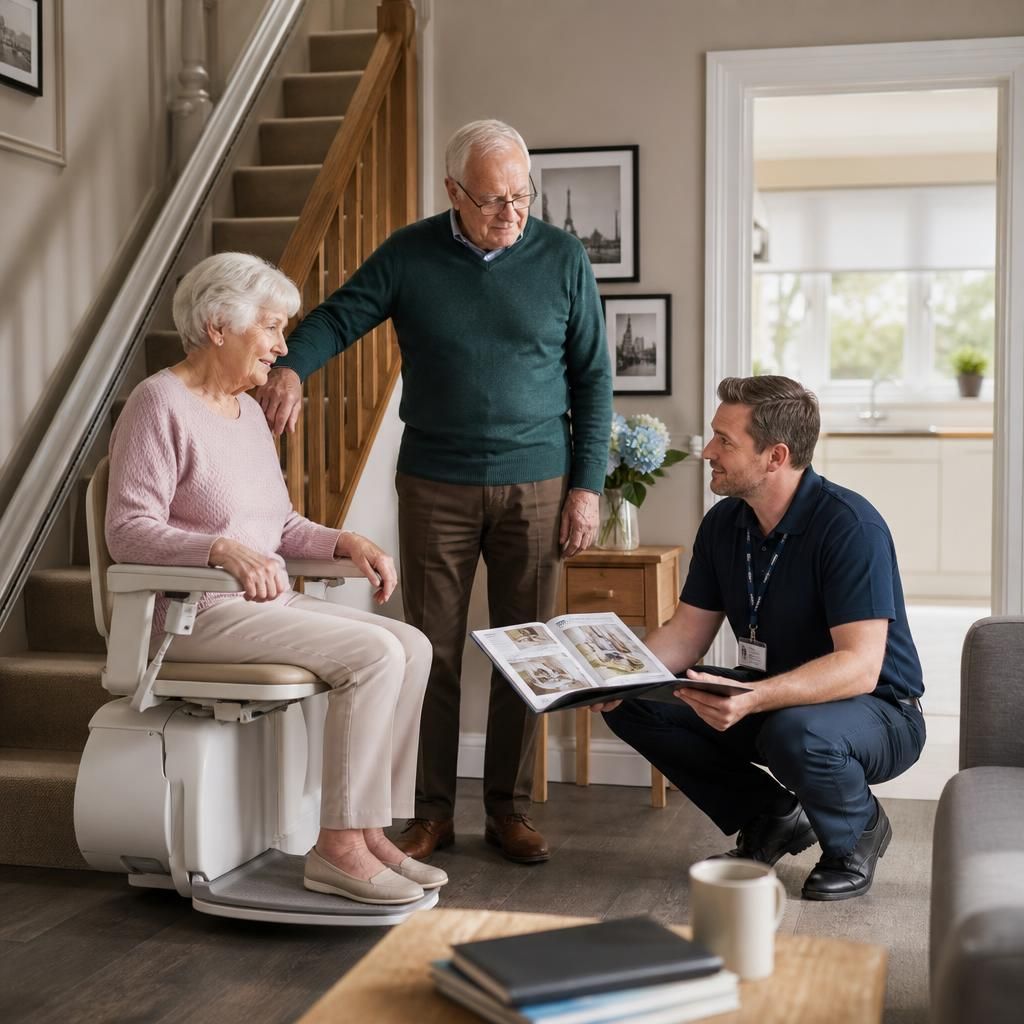
Discuss Your New or Reconditioned Stairlift Options
Speak to Independent Stairlifts about your new or reconditioned stairlift options. We can assess your staircase and discuss the most suitable solution for your needs, budget and expected length of use.