
How do I choose the right stair lift for my specific staircase type?
Choose a stairlift based on your staircase layout, including whether it is straight, curved, narrow, split-level or outdoors, as well as the available space and your mobility needs. A professional home assessment will confirm the most suitable rail design, seat and safety features for a secure, comfortable fit.
The right stairlift is determined primarily by the shape and construction of your staircase, the space available at the top and bottom, and the way you need to use it. A straight stairlift is normally suitable for a single, uninterrupted flight, while a curved stairlift is designed for stairs with bends, landings, turns or multiple sections. Outdoor stairlifts require weather-resistant equipment, and narrow or unusually shaped stairs need careful consideration of the rail, seat and access space. A professional assessment will confirm which configuration can be installed safely in your home.
Start with the staircase layout
Look at the full route between the levels you need to connect rather than only the first flight of stairs. The following features affect the type of stairlift required:
- Straight flight: A staircase with no change of direction or intermediate landing can usually accommodate a straight stairlift. The rail follows the stairs from the lower to the upper floor.
- Curved or turning staircase: A bend, quarter-turn, half-turn, winding section or intermediate landing will generally require a curved stairlift. Its rail is made to follow the individual path of the stairs.
- Split-level or multi-flight staircase: If the stairs change direction or include separate flights, a continuous curved system may be appropriate. In some homes, separate stairlifts or an alternative arrangement may be considered, depending on the layout and how much independent movement is possible between flights.
- Narrow staircase: A restricted width does not automatically rule out a stairlift, but it can affect the choice of seat, rail position, controls and folding mechanism. The available walking route for other household members must also be considered.
- Outdoor staircase: External steps need equipment designed for exposure to rain, sunlight, temperature changes and debris. The position of the stairlift and the storage or parking area are important as well as the stair shape.
Consider the space at the top and bottom
The stairlift must provide a safe place to get on and off. At the bottom, there needs to be enough room to approach the seat without standing on the first step. At the top, you may need a level landing, a short overrun or a swivel seat so that you can turn towards the landing before standing.
An extended rail can sometimes carry the seat beyond the top or bottom step, improving access where the landing is limited. However, the best solution depends on doorways, hallways, radiators, furniture and the direction in which you need to leave the stairlift. These details should be checked during the home assessment rather than assumed from photographs alone.
Choose the rail design for the staircase
Straight stairlift rails are manufactured to match the length and angle of a straight flight. They are generally more straightforward where the staircase has a consistent direction. Curved rails are measured and made to follow the precise contours of the stairs, including changes in direction and landings.
On some curved staircases, a rail can be positioned close to the inside or outside of the bend. The preferred position may depend on the stair width, available landing space, obstructions and where you need to transfer on and off the seat. A rail that fits the stairs technically may not be the most convenient option if it restricts access to a room or creates an awkward parking position.
Match the seat to your mobility needs
The seat should support a stable transfer and comfortable journey. Consider how easily you can bend your knees, sit down, stand up and remain upright while travelling. A powered swivel seat may reduce the need to twist at the top or bottom, while powered folding features can be useful if lifting the footrest or armrests is difficult.
Other points to discuss include the seat height, back and arm support, footrest size, seat belt and control position. If more than one person will use the stairlift, controls may be needed on both arms or at convenient points on the staircase. The lift should be suitable for the user’s weight and posture, and any medical or balance-related difficulties should be explained during the assessment.
Check how the stairlift will work in daily use
A suitable stairlift must leave enough room for safe use without creating an unnecessary obstruction. Fold-away components can help preserve access to the stairs when the lift is parked. On a narrow staircase, check whether the footrest, arms and seat can be folded comfortably and whether another person can still use the stairs safely.
Think about where the stairlift will be parked when it is not in use. A charging point is normally required at a suitable end position, and the lift should not block a doorway, corridor or important route. On a curved staircase, parking locations can be more complex because the rail may continue around a landing or into a hallway.
For outdoor stairs, assess the whole environment
An outdoor stairlift should be selected for the conditions at the property, not simply because the staircase is outside. Check whether the stairs are fully exposed, partially sheltered or close to coastal conditions, and consider the surface beneath the lift, drainage and the position of the power supply. Weather-resistant covers and suitable materials can help protect the equipment when it is parked, but the lift still requires appropriate care and inspection.
External lighting, wet or slippery steps, uneven paving and the route to the entrance should also be considered. The stairlift improves access along the stairs, but it does not remove other hazards around the approach or landing areas.
Understand the options for unusual staircases
Staircases may include narrow treads, unusual angles, low ceilings, radiators, bannisters, doorways or limited landing space. These features do not necessarily prevent installation, but they can influence the rail position and the type of seat or controls needed. In some cases, a compact design, hinged rail or alternative parking arrangement may help. Where the stairlift cannot provide a safe transfer or leaves insufficient clearance, other access options may need to be discussed.
Accurate measurements are particularly important where the stairs are unusually shaped. A surveyor should assess the complete route, identify obstructions and confirm clearances at each point rather than measuring only the width of the treads.
Decide whether a new or reconditioned stairlift is appropriate
A reconditioned stairlift may be suitable where the staircase layout is compatible with an available system and the equipment has been properly checked, serviced and supplied with appropriate support. Straight stairlifts are often easier to match to an existing layout, while a curved stairlift is normally made for the individual staircase and may have fewer directly compatible options.
Ask what inspection and refurbishment work has been completed, what warranty or aftercare is included, and whether replacement parts and servicing are available. The condition and suitability of the equipment matter more than selecting an option based only on its age or initial cost.
Use the assessment to make the final choice
Before installation, discuss your usual route through the home, who will use the stairs, whether you need to carry items, and any difficulty with transfers, bending or balance. The assessment should confirm the stairlift type, rail route, parking position, seat configuration, power arrangements and safety features.
Do not choose solely by comparing photographs or standard descriptions. Two staircases that appear similar can require different solutions because of their landings, obstructions or available clearance. A properly measured and demonstrated stairlift should fit the staircase, support your individual movement needs and remain practical for everyone who uses the home.
The correct stairlift for your staircase is confirmed by assessing the complete route, including the steps, landings, top and bottom access areas, and any nearby doors or obstructions. A straight stairlift may suit an uninterrupted flight, while a curved model is usually needed where the stairs turn or include intermediate landings.
A professional assessment should also check:
- whether there is enough space to approach, leave and park the stairlift safely;
- how the rail position affects the remaining walking route;
- whether a swivel seat, folding parts or an extended rail would improve access; and
- which seat, controls and safety features match the user’s mobility needs.
This is particularly important for narrow, split-level or unusually shaped staircases, where a solution that appears suitable from measurements or photographs may not provide adequate clearance in daily use.
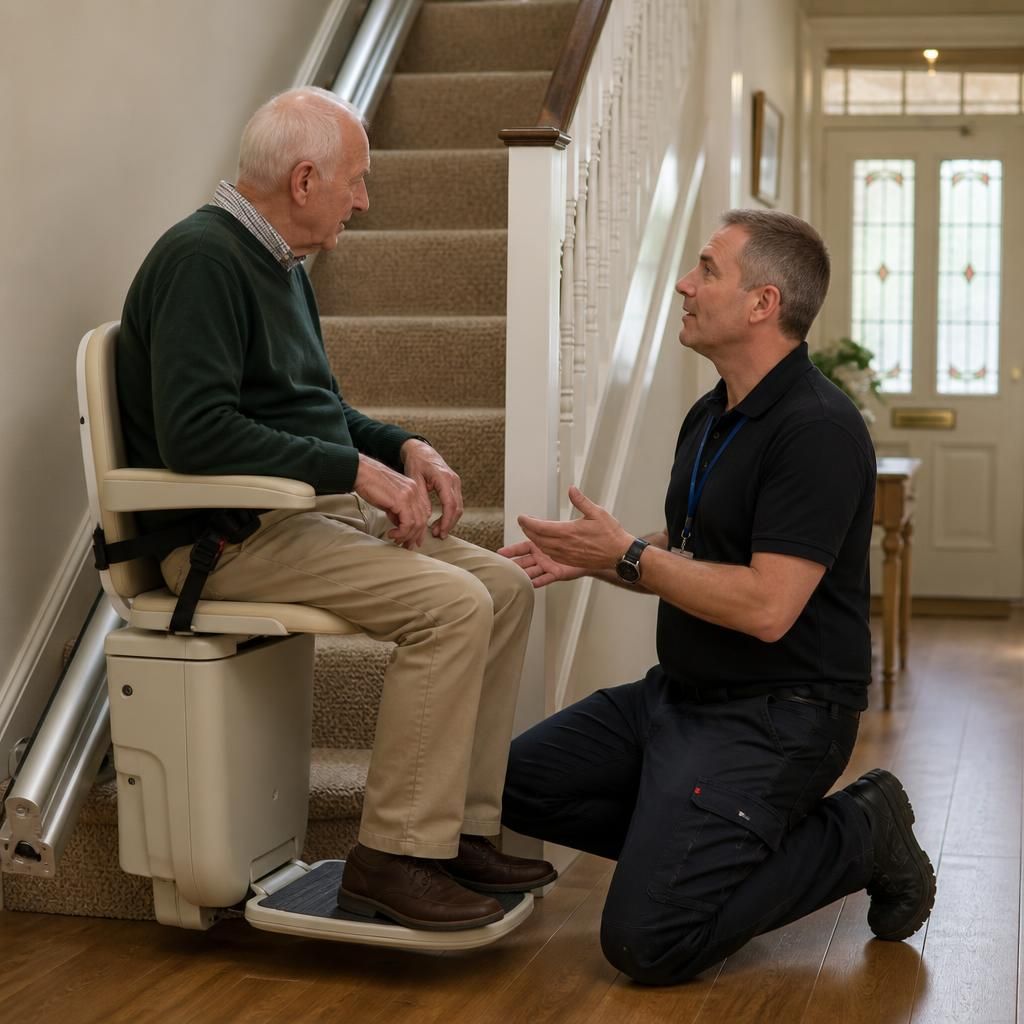
Book your stairlift assessment
Book a home assessment to confirm which stairlift, rail design and seat configuration are suitable for your staircase and mobility needs. We will check access, clearances and parking positions before installation.