
How does Independent Stairlifts ensure the safety and reliability of its installations for disabled users?
Independent Stairlifts ensures safe, reliable installations through a detailed assessment of the user, staircase and home, followed by professional fitting, safety checks and user guidance. Each stairlift is selected to suit the individual’s mobility needs and installed in line with the manufacturer’s instructions and applicable safety requirements.
Independent Stairlifts supports safe, reliable stairlift installations through a structured process: assessing the user and staircase, selecting suitable equipment, fitting it professionally, checking every safety function and explaining its operation clearly. The installation must suit both the person’s mobility needs and the physical conditions in the home; a stairlift is not considered suitable simply because it fits the stairs.
Assessment of the user and home
The assessment considers how the disabled user transfers on and off the seat, how they approach the stairlift, their balance and posture, and whether they can operate the controls safely. The assessor will also consider fatigue, involuntary movement, limited grip, visual impairment, cognitive difficulties and whether another person may need to assist. This helps determine whether a standard seated stairlift is appropriate or whether features such as a powered swivel seat, adjustable seat position, more supportive armrests, a standing or perch configuration, or a heavy-duty model should be considered.
The surrounding home environment is assessed as well. This includes the staircase width, shape, gradient, landings, bends, doors, radiators, handrails and available space at the top and bottom. The assessor checks that the user can transfer safely without being placed too close to an obstruction or an unprotected stair edge. Where necessary, the proposed route and parking positions are discussed with the customer before any fitting takes place.
Choosing equipment that matches the installation
Independent Stairlifts supplies different types of stairlift to accommodate varied domestic layouts, including straight, curved, outdoor and reconditioned options. A curved stairlift may be needed where the staircase changes direction or includes intermediate landings, while an outdoor model requires equipment designed for exposure to weather and changing conditions. The choice is based on the staircase, the intended use and the user’s requirements rather than on a single standard design.
Important specifications include the safe working load, seat dimensions, footrest size, travel controls, battery arrangement and the amount of support provided by the seat and arms. For users with higher body weight or particular postural needs, a suitable heavy-duty model may be more appropriate. The equipment must also allow safe access, comfortable positioning and adequate clearance throughout its movement. If the user’s needs or the property layout mean that a stairlift would not provide safe access, this should be identified during the assessment rather than overlooked.
Professional fitting and installation checks
The stairlift is installed to the staircase and in accordance with the manufacturer’s instructions. The installer checks that the rail is securely fixed, that the carriage travels smoothly and that the seat, footrest and controls are correctly positioned. Care is taken around narrow sections, bends and landings, where small changes in clearance can affect safe transfers and the ability of other people to use the stairs.
After fitting, the installer tests the complete system rather than relying only on the appearance of the finished installation. Checks include starting and stopping, travel in both directions, charging, battery operation, seat movement, armrests, belts, controls and the operation of safety edges and sensors. The lift should stop if it detects an obstruction in its path, and the installer verifies that the user can reach and use the controls without adopting an unsafe position.
Where the stairlift includes a swivel seat, powered footrest or other powered movement, those functions are checked for correct operation and safe locking. Top and bottom parking positions are also reviewed, particularly where they affect doorways, landings or access for other household members.
User instruction is part of safe installation
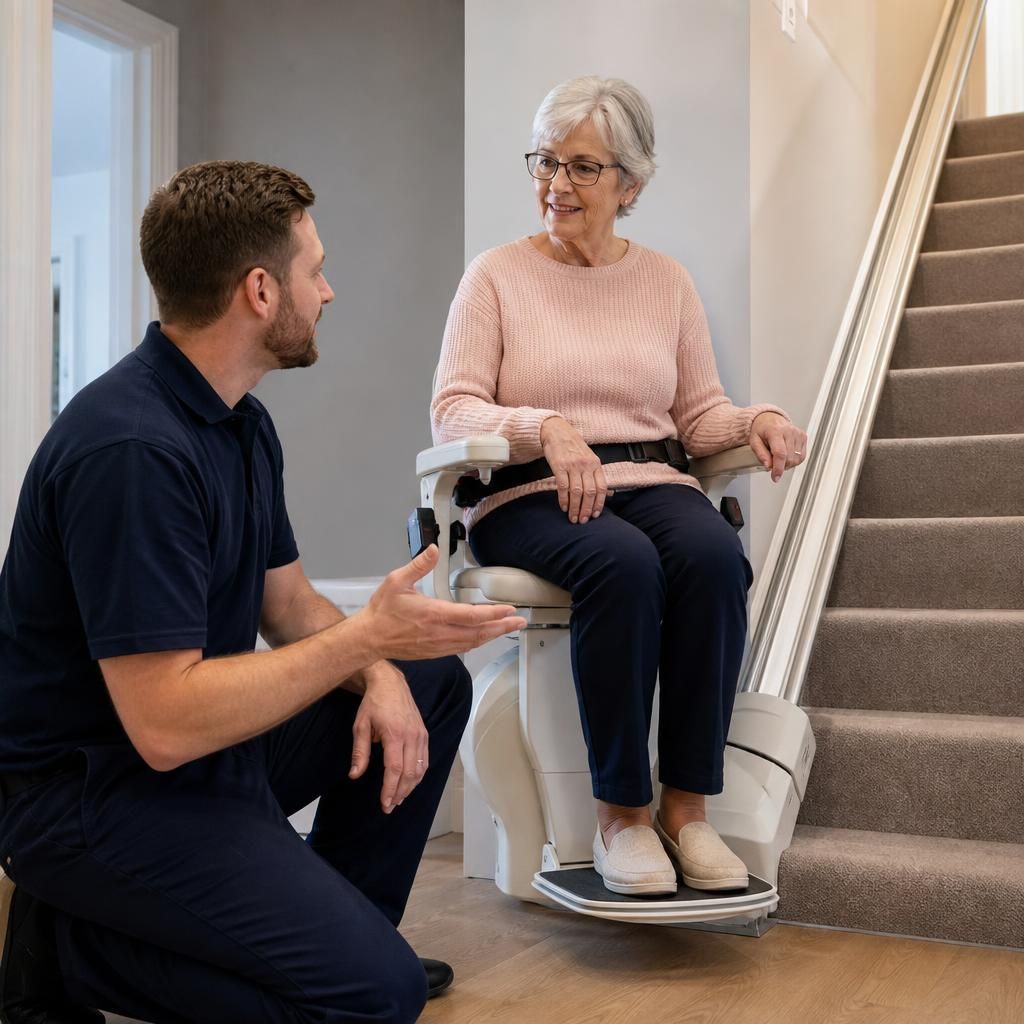
A reliable installation depends on the user knowing how to operate the stairlift. The installer demonstrates how to sit down and stand up safely, fasten and release the seat belt, use the controls, swivel the seat where fitted, stop the lift and park it for charging. The user is shown how to respond if the stairlift stops and how to keep the rail, footrest and travel path clear.
Instructions should be adapted to the user’s abilities. For example, a person with limited hand strength may need guidance on using a simple control or remote, while someone with reduced vision may benefit from repeated verbal explanation and a consistent operating routine. A family member or carer can also be included where they provide regular assistance, but they should not operate the lift in a way that places the user at risk.
Safety features that help protect the user
- Seat belt: helps keep the user securely positioned during travel and should be used as instructed.
- Swivel or powered swivel seat: allows the user to turn towards the landing before standing, reducing the need to twist on the stairs.
- Safety sensors and edges: detect obstructions and stop the stairlift to help prevent contact with objects or people.
- Fold-away components: can help preserve usable space when the stairlift is parked, although the folded equipment must still leave adequate clearance.
- Braking and controlled stopping: help the lift stop steadily at the selected landing or when an obstruction is detected.
- Battery backup: allows many stairlifts to continue operating during a mains power interruption, provided the batteries are charged and maintained correctly.
- Locking and interlock functions: help prevent travel or seat movement when the relevant component is not in a safe position.
Features vary between models, and not every feature is suitable or necessary for every user. A safety feature is effective only when the equipment is correctly installed, maintained and used as intended.
Compliance and responsible installation
Stairlift equipment and its installation should meet the applicable UK requirements and relevant manufacturer guidance. Independent Stairlifts follows the appropriate installation instructions and safety procedures for the equipment supplied. The exact requirements can depend on the type of stairlift, its location and the circumstances of the installation, so compliance is considered alongside the individual assessment rather than treated as a substitute for it.
Customers should receive information about safe use, charging, cleaning, servicing and what to do if a fault occurs. It is also important not to modify the stairlift, remove safety components or allow untrained people to repair it. Any change in the user’s mobility, weight, confidence or ability to transfer should prompt a review, as the original arrangement may no longer provide the same level of support.
Servicing and ongoing reliability
Regular servicing helps identify wear, battery deterioration, loose fixings, changes in travel performance and faults with controls or safety sensors. The appropriate servicing interval depends on the model, how often it is used and its environment. Outdoor stairlifts may require particular attention to weather protection, drainage, exposed controls and the condition of covers and fixings.
Users should keep the travel path clear, leave the stairlift on its charging point when it is not in use where the manufacturer requires this, and report unusual noises, jerky movement, incomplete charging or repeated stopping. A fault should not be bypassed or investigated by the user. Contacting the service team promptly helps prevent a minor issue from becoming a safety problem.
For reconditioned stairlifts, suitability and condition remain important considerations. The equipment must be appropriate for the staircase and user, and its safety functions should be checked before it is put into service. A reconditioned option is not suitable merely because it is available; it must pass the same practical assessment and installation checks required for safe use.
By combining individual assessment, appropriate equipment selection, competent fitting, documented safety checks, user instruction and ongoing servicing, Independent Stairlifts helps ensure that a stairlift provides dependable access without creating new hazards for the disabled user or other people in the home.
Professional safety checks confirm that the stairlift is secure, travels correctly and can be used safely by the disabled user before the installation is completed. Independent Stairlifts checks the rail fixings, travel path, seat, footrest, controls, seat belt, charging system and obstruction sensors.
The installer also tests stopping, parking and any swivel or powered functions, then demonstrates safe operation to the user and their carer where appropriate. This includes transferring on and off the seat, using the controls, keeping the route clear and responding if the stairlift stops unexpectedly.
Arrange your stairlift safety assessment
Contact Independent Stairlifts to arrange a stairlift safety assessment tailored to the disabled user, staircase and home environment. We can advise on suitable equipment, installation requirements and safe operation.