
How can I assess the suitability and benefits of different stairlift styles, such as bariatric or standing options, for disabled users with unique mobility requirements?
Assess suitability by considering the user’s weight, posture, balance, transfer ability, joint movement, confidence and the staircase layout, then compare these needs with the safe operating limits and seating or standing support offered by each stairlift style. Bariatric models can provide increased capacity and a wider, stronger seat, while standing or perch options may suit users who find sitting down or rising difficult, but both require an in-home assessment to confirm safe transfers, clearance and installation.
The suitability of a stairlift style depends on the user’s functional ability, body size, posture, transfer method, confidence and the staircase itself. Bariatric stairlifts can support users who need a higher weight capacity and a wider, stronger seat, while standing or perch stairlifts can help people who cannot comfortably bend their knees or lower themselves into a conventional chair. Neither option is appropriate solely because of a diagnosis or body weight: an in-home assessment is needed to confirm safe transfers, positioning, clearances, track installation and day-to-day usability.
Begin with the user’s actual mobility requirements
The assessment should focus on what the user can safely do at the top and bottom of the stairs, rather than simply selecting a model based on a medical condition. Consider:
- Whether the user can walk short distances and approach the stairlift safely.
- Whether they can transfer from a wheelchair, walking frame, chair or bed onto the stairlift.
- How much they can bend their hips, knees and ankles, and whether they can straighten their legs during travel.
- Their ability to sit upright, maintain balance and follow operating instructions.
- Whether they can grip a handle, operate controls and release a seat belt or harness when required.
- Any involuntary movements, reduced sensation, weakness on one side, dizziness, fatigue or pain that may affect use.
- Whether another person will assist with transfers or controls, and whether the user may need to operate the lift independently.
Mobility can vary during the day or as a condition progresses. The most suitable stairlift should therefore be usable on a less capable day, not only when the user is feeling well. If the user cannot reliably transfer, sit or stand in the required position, a stairlift may not be the safest solution without additional support or changes to the surrounding area.
When a bariatric stairlift may be suitable
A bariatric stairlift is designed for users who require a higher permitted user weight and more substantial seating than a standard model can provide. Depending on the design, it may offer a wider seat, stronger seat base, reinforced arms, a longer or deeper seat, and a larger footrest. These features can improve stability and comfort where a standard seat is too narrow or does not provide adequate support.
Suitability must be checked against the manufacturer’s stated safe operating limit. This limit includes the user and anything they carry, and it must not be exceeded. The assessor should also check the user’s seated width, hip position, leg length and ability to keep their arms and clothing within the protected area. A larger seat does not automatically provide better support if the user cannot sit against the backrest or reach the controls safely.
Bariatric equipment can require additional space at landings, on bends or at the bottom of the stairs. A wider seat or larger footrest may affect the available passageway, door access or the position in which the seat swivels. The proposed track and parking position must therefore be checked carefully, particularly on narrow, curved or open staircases.
When a standing or perch stairlift may be suitable
A standing, perch or semi-perch stairlift allows the user to travel in a raised position, with the body supported by a perch seat, back support, side supports and a safety belt or harness as appropriate. This can suit someone who finds a low seated transfer difficult because of restricted knee or hip movement, pain, stiffness or difficulty standing up from a conventional chair.
The user still needs enough strength, balance and postural control to approach the lift, position themselves correctly and remain supported throughout the journey. A perch design is not the same as simply standing on a moving platform. The user must follow the prescribed posture and use the available supports. It may be unsuitable for someone who is unable to stand securely, has significant balance problems, experiences unpredictable collapses or cannot maintain their grip or position.
Standing models can also affect stair clearance. The user’s head, shoulders, knees and feet need adequate space as the lift travels, especially on narrow stairs, beneath low ceilings or around bends. The assessment should include the user wearing their usual footwear and any braces or supports that they normally use.
Compare the main stairlift styles against the user’s needs
- Standard seated stairlifts: Often suitable where the user can transfer into a chair, sit upright and bend their legs sufficiently. Seat height, swivel action, armrest position and belt design are important for safe transfers.
- Bariatric stairlifts: Appropriate where the user needs a higher safe weight capacity or more substantial seating. Check dimensions, support, footrest size, staircase clearance and the available parking space.
- Standing or perch stairlifts: May help users who struggle to sit down or rise from a low seat. Confirm that they can balance, use the supports and maintain the required position for the whole journey.
- Powered swivel or powered footrest models: Can reduce the effort needed to turn, position the feet or leave the stairlift at the landing. They may be useful where shoulder, hip, knee or hand movement is limited, provided the user can operate the controls safely.
- Heavy-duty models with enhanced seating: May combine increased capacity with additional support, but they can need more staircase and landing space. The physical dimensions matter as much as the weight rating.
- Outdoor stairlifts: May be considered for external steps where the equipment is specifically designed for outdoor exposure. The surface, drainage, weather protection, power supply and safe approach must all be assessed.
Assess transfers at both ends of the staircase
A stairlift is only as safe as the transfer onto and off it. The assessor should examine whether the user can approach the seat or perch without twisting, stepping backwards unexpectedly or reaching too far. At the top landing, there must be enough space to swivel or dismount safely and move towards a secure area. At the bottom, the user should be able to leave the stairlift without being forced into a narrow doorway, sharp turn or cluttered route.
Where a wheelchair or walking frame is used, consider where it will be left while the user travels. A second mobility aid, a transfer board or assistance from another person may be needed. These arrangements should be practical every time the stairs are used, not just during installation.
Check the staircase and the home environment
The staircase assessment should cover its width, length, pitch, bends, intermediate landings, ceiling height, bottom and top clearances, wall construction and available parking positions. Curved staircases often require a bespoke rail, while straight staircases may allow more flexibility in where the lift parks. Narrow stairs can limit the choice of seat, footrest or standing position.
Other factors include doors, radiators, bannisters, adjacent walls, light switches and frequently used walkways. A stairlift should not create an avoidable obstruction or prevent other household members from using the stairs safely. If the user has a visual, hearing or cognitive impairment, controls, indicators and warning sounds should also be considered. Any proposed changes to furniture, handrails or access routes should be agreed before installation.
Consider safety features and adjustments
Useful features depend on the user’s needs rather than being included simply for convenience. These may include a seat belt or harness, swivel seat, adjustable seat height, supportive armrests, a contoured backrest, powered footrest, obstruction sensors, safe-start controls, remote controls and a manual lowering or emergency procedure. A hinged or retractable rail may be helpful where a doorway or walkway is close to the bottom of the stairs.
Controls should be reachable without the user leaning, twisting or releasing their main support. A key switch or lockable control can prevent unintended operation where appropriate. If more than one person will use the stairlift, the settings and transfer method must be safe for each regular user; a configuration that suits one person may not suit another.
Use the assessment to select, rather than assume, the right style
- Record the user’s weight, seated or standing measurements, transfer method and relevant movement restrictions accurately.
- Discuss the user’s usual footwear, braces, cushions, walking aids and any assistance they receive.
- Observe or carefully discuss the approach, transfer, travel posture and dismount at both landings.
- Compare suitable models by safe operating limit, seating dimensions, support, controls, clearance and parking requirements.
- Check how the choice will work if mobility changes, and whether adjustments or additional support may be needed later.
- Explain operation, charging, emergency procedures, cleaning and servicing before the user makes a decision.
The final recommendation should balance safety, independence, comfort and the practical layout of the home. A bariatric stairlift is not automatically the best choice for every larger user, and a standing stairlift is not automatically safer for someone with painful joints. Independent Stairlifts can assess the user and staircase together, explain the advantages and limitations of the available styles, and identify a configuration that supports the user’s real transfer method and daily routine.
A bariatric or standing stairlift is suitable only when its support, dimensions and operating position match the user’s abilities and the staircase. A bariatric model may provide a wider seat and higher safe operating limit, while a standing or perch model can reduce the need to lower into and rise from a conventional seat.
The assessment should check the user’s transfer at both landings, posture during travel, ability to use the controls and capacity to remain secure throughout the journey. It must also allow for seat width, footrest size, headroom, stair clearance and parking space. A larger seat or raised travelling position can affect access on narrow stairs, so suitability cannot be confirmed from weight or diagnosis alone.
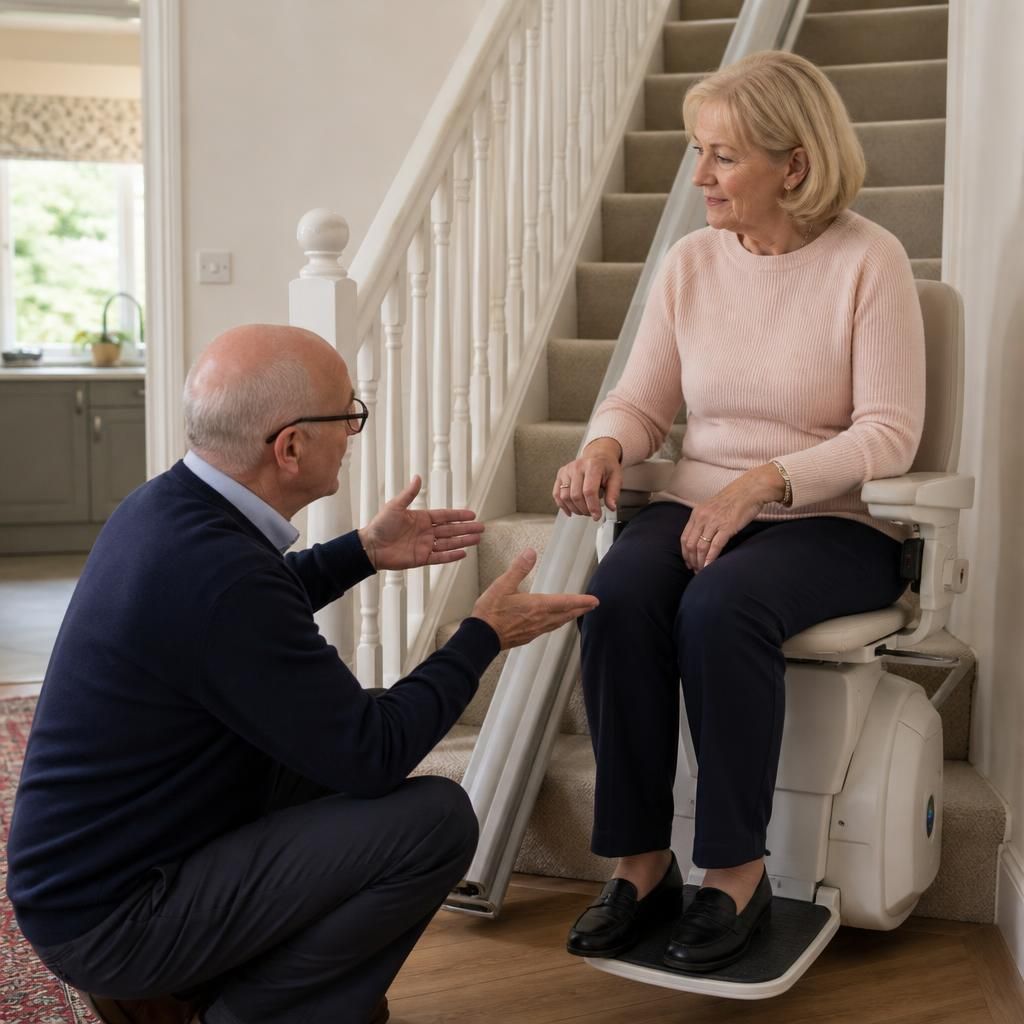
Book a Stairlift Assessment for Your Mobility Needs
Book a stairlift assessment with Independent Stairlifts to compare bariatric, standing and other options against your mobility needs and staircase. We’ll assess transfers, posture, clearances and practical safety before recommending a suitable solution.